Basilica dei Frari: Masterpieces by Titian and Renaissance Monuments in Venice

The Basilica dei Frari is a 14th-century Gothic church that holds some of the most important masterpieces of Venetian Renaissance art, offering an immersive artistic experience away from tourist crowds.

  • Titian’s Works: admire the Assumption of the Virgin and Madonna of Ca’ Pesaro, two revolutionary Renaissance masterpieces.
  • Renaissance Sculptures: discover Canova’s funerary monument, the tomb of Doge Foscari, and Donatello’s Saint John the Baptist.
  • Unique Gothic Architecture: explore the majestic interior of this brick basilica, a rare example in Venice.
  • Panoramic View: climb the bell tower for a different perspective on the rooftops of the San Polo district.
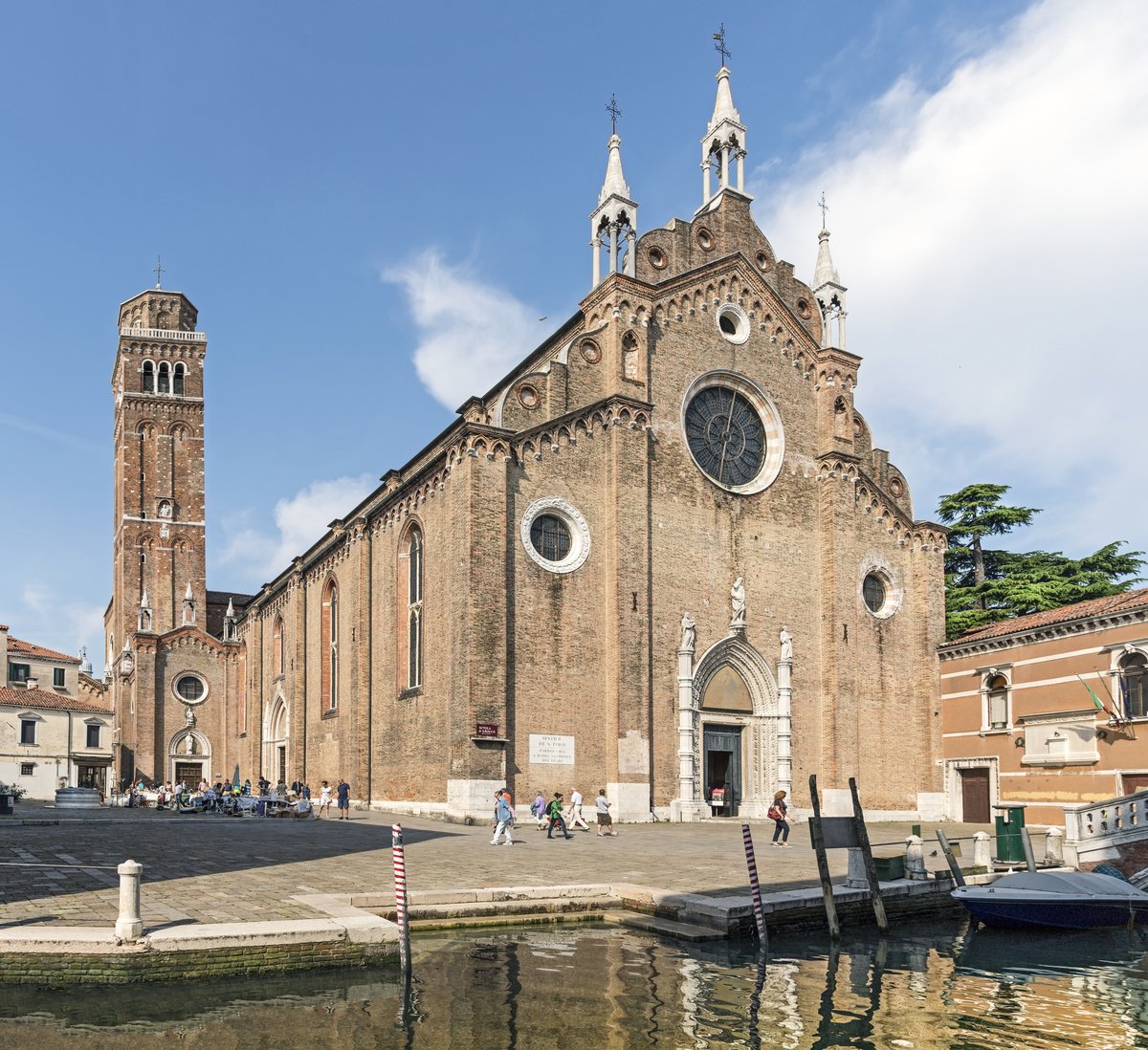
Copertina itinerario Basilica dei Frari: Masterpieces by Titian and Renaissance Monuments in Venice
The Basilica of Santa Maria Gloriosa dei Frari in Venice houses Titian’s Assumption of the Virgin and Madonna of Ca’ Pesaro, Canova’s funerary monument, and works by Donatello. Guide to the main artistic attractions in the San Polo district.

Good to know


Introduction

While Venice bustles with tourists between St. Mark’s Square and the Rialto Bridge, there’s a corner of silent majesty that often escapes most visitors: the Basilica of Santa Maria Gloriosa dei Frari. Don’t be fooled by its brick facade, seemingly modest compared to the city’s baroque splendors. Crossing the threshold of this Gothic giant is a breathtaking experience. The interior space, vast and solemn, immediately envelops you with its intimate atmosphere, a powerful contrast to the external chaos. Here you’re not just a visitor, but a guest in an art sanctuary, where light filters through the high stained-glass windows and illuminates masterpieces that have marked the history of Venetian painting. It’s the perfect place to rediscover the true spirit of Venice, away from the crowds, immersing yourself in a concentration of beauty and spirituality.

Historical Notes

The history of the Frari is inextricably linked to the Franciscan Order, which settled in this area of Venice in the 13th century. Construction of the current building began in 1330 and continued for over a century, with consecration taking place in 1492. It is not just a church, but a true pantheon of the Serenissima: within its walls rest doges, artists, and notable figures, such as the composer Claudio Monteverdi. Its Gothic brick architecture represents a unique feature in Venice, more typical of the Veneto hinterland, and attests to the power and influence achieved by the Conventual Franciscan Friars. Every stone tells centuries of devotion, prestigious commissions, and a central role in city life.

  • 1250: The Franciscans settle in the area.
  • 1330: Construction begins on the current basilica in Gothic style.
  • 1492: Consecration of the church.
  • 1518: Titian completes the altarpiece of the Assumption.

The Absolute Masterpieces of Titian

A visit to the Frari is a mandatory pilgrimage for Titian enthusiasts. Two of his monumental works dominate the nave and capture every gaze. On the high altar towers the Assumption of the Virgin, completed in 1518. It is a revolutionary work: the Virgin, surrounded by a whirlwind of angels, ascends toward heaven with a dynamism and use of color that mark the transition to the mature Venetian Renaissance. Nearby, in the sacristy, is the Madonna of Ca’ Pesaro. Here Titian breaks traditional schemes, shifting the sacred figure to the side and including the patrons, the Pesaro family, in a scene full of realism and majesty. Observing these paintings up close, with their vibrant brushstrokes and intense colors, is an experience that goes beyond mere artistic observation.

Beyond Titian: Sculptures and Funerary Monuments

Although Titian steals the show, the basilica is an open-air museum of Renaissance sculpture. Don’t miss the sculptural complex of the tomb of Doge Francesco Foscari, a masterpiece of craftsmanship. But the true gem is the funerary monument to Canova, designed by the neoclassical sculptor’s pupils to house his heart (his body is in Possagno). It’s a pyramid of white Carrara marble, of heartbreaking purity and melancholy, contrasting with the opulence of the other tombs. Also look for Donatello’s Saint John the Baptist, a wooden statue of intense and realistic expressiveness, and the monument to Titian himself, erected centuries after his death. These three-dimensional masterpieces continuously dialogue with the paintings, creating a unique emotional journey.

Why Visit It

Visiting the Frari is worthwhile for three concrete reasons. First, it’s a concentrated art history lesson: in a single hall, you see the evolution from Donatello to Titian, from Gothic to Renaissance. Second, it offers an authentic oasis of peace in the heart of Venice; here you can admire the masterpieces calmly, without being jostled. Third, the bell tower visit (separate and paid) provides a panoramic view of Venice different from that of San Marco, more intimate and focused on the roofs and courtyards of the San Polo district. It’s a complete experience that combines art, spirituality, and a privileged glimpse of the city.

When to Go

The best time for a visit is the early afternoon, especially on weekdays. The large morning crowds from organized tours have thinned out, and the sunlight filtering through the side windows illuminates the artworks with a special warmth, enhancing the colors of Titian’s canvases. Avoid the midday hours on the hottest summer days, as the interior, though cool, can become very crowded. A visit on a quiet winter morning, when fog envelops the external canals, can be incredibly atmospheric, offering you the basilica almost to yourself.

In the Surroundings

After leaving the Frari, immerse yourself in the everyday Venice of the San Polo district. Just a few minutes’ walk away, you’ll find the Scuola Grande di San Rocco, another artistic temple entirely decorated with a cycle of paintings by Tintoretto—a complementary and overwhelming experience. For a tasty break, head to the Rialto Market (in the morning) or look for a traditional small osteria in the nearby alleys, where you can sample cicchetti and an ombra (a glass of wine) in an authentic atmosphere, away from the more beaten paths.

💡 Did You Know…?

One of the most fascinating details concerns Antonio Canova’s funeral monument. The artist, originally from Possagno, had designed a large mausoleum for Titian in the Basilica. Upon his death, his pupils decided to use that design to create the monument for Canova himself, which is now inside the Frari. Canova’s heart, however, is preserved in an urn in his hometown. Another curiosity: the Frari bell tower, 70 meters high, is the second tallest in Venice after St. Mark’s and offers a breathtaking view of the city, less crowded than the main square.