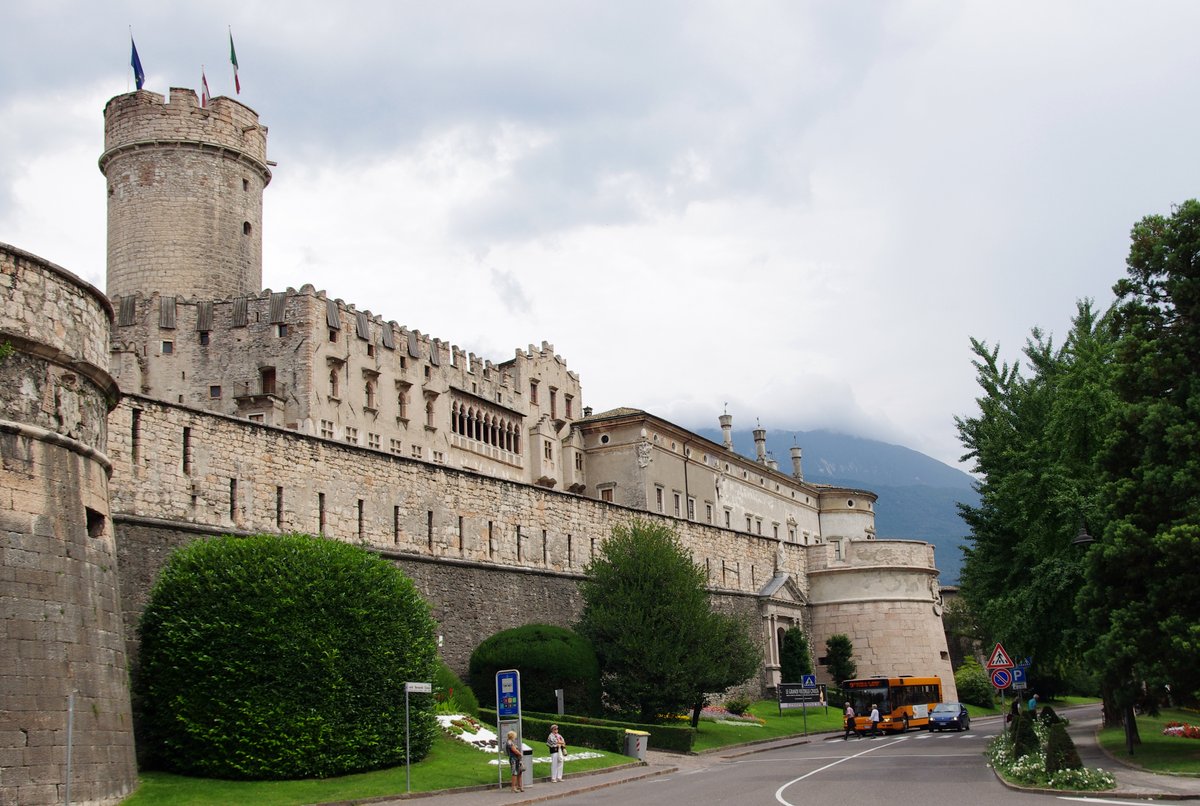
Buonconsiglio Castle in Trento encapsulates centuries of history within a single monumental complex, from the medieval Castelvecchio to the Renaissance Magno Palazzo. The visit includes frescoed halls, panoramic loggias, and art collections spanning Roman archaeology to the Middle Ages, with views over the city and mountains.
- Cycle of the Months in the Eagle Tower: a masterpiece of International Gothic depicting scenes of medieval life.
- Renaissance Magno Palazzo: halls decorated with mythological frescoes and stuccoes commissioned by Bishop Bernardo Clesio.
- Traces of the Council of Trent: rooms that hosted the council sessions between 1545 and 1563.
- Audio guide included: a step-by-step guide accessible to all, no art expertise required.
Introduction
As soon as you arrive in Trento, the Castello del Buonconsiglio immediately strikes you: it’s not just a castle, but an entire monumental complex that dominates the city. Its imposing silhouette, with towers and courtyards blending different styles, already promises a journey through time. Upon entering, you feel catapulted between the Middle Ages and the Renaissance, with an atmosphere that mixes episcopal power and refined art. Personally, I was surprised to discover that here you don’t just breathe the air of a fortress, but also of a noble residence, with details that tell centuries of Trentino history. It’s one of those places that, even if you’re not a history enthusiast, leaves you with something: perhaps the view of the mountains from the Torrione, or the feeling of walking where the Council of Trent took place.
Historical Overview
The history of Castello del Buonconsiglio is a tapestry of power and art spanning nearly a thousand years. Originally built as a fortress in the 1200s, it became the residence of the prince-bishops of Trent, who transformed it into a symbol of their authority. In the 16th century, under Bishop Bernardo Clesio, the castle reached its golden age: it was expanded with the Magno Palazzo, a Renaissance masterpiece adorned with frescoes that still amaze visitors today. Between 1545 and 1563, the
Council of Trent was held here, an event that reshaped the history of the Catholic Church. After the end of episcopal rule, the castle served various purposes, including as a barracks, before becoming a museum. Every corner tells a different story: from the austere Middle Ages to the opulent Renaissance halls, and even the prisons where irredentists like Cesare Battisti were held.
- 13th century: construction of the original nucleus, Castelvecchio.
- 16th century: expansion with the Magno Palazzo under Bernardo Clesio.
- 1545-1563: hosts sessions of the Council of Trent.
- 1803: end of the prince-bishopric, the castle passes to the state.
- 1920: becomes a provincial museum.
The Frescoes of the Cycle of the Months
If there’s one thing you can’t miss, it’s the frescoes of the Cycle of the Months in the Eagle Tower. Created in the late 14th century, they offer a window into medieval life in Trentino: each month is depicted with scenes of work, festivities, and nature, filled with realistic details that make you feel part of that world. Looking at January, with its snow and bonfires, or August, with the grape harvest, you understand how people lived here centuries ago. What struck me most was the attention to detail: the clothing, the tools, even the expressions of the characters seem to speak to you. They’re not just works of art, but a true social narrative, perhaps one of the most complete from the European Middle Ages. And the light streaming through the tower windows makes everything even more evocative, as if time had stood still.
The Magno Palazzo and Its Halls
In addition to Castelvecchio, there is the Magno Palazzo, the Renaissance section commissioned by Bernardo Clesio. Here, the atmosphere changes completely: instead of thick walls and austere spaces, you’ll find halls decorated with mythological frescoes, stuccoes, and monumental fireplaces. The Loggia del Romanino, with its frescoes of chivalric subjects, is a gem that often surprises visitors. Then there are the bishop’s private rooms, such as the Audience Chamber, where you can still sense the air of power. I like to imagine that crucial meetings took place in these halls during the Council, while outside, the history of Europe was changing. And don’t forget the inner courtyard, with its well and arches: it’s the perfect spot for a break, perhaps imagining the courtiers who once animated it.
Why Visit It
Visiting Buonconsiglio Castle is worthwhile for at least three concrete reasons. First, it’s a journey through art and history concentrated in one place: from the Middle Ages to the Renaissance, with frescoes that are absolute masterpieces, like the Cycle of the Months. Second, it gives you a unique insight into episcopal power in Trentino, showing you how the prince-bishops lived and governed. Third, it’s a living place: beyond the permanent collections, it often hosts temporary exhibitions that enrich the visit, especially on themes related to the territory. And let’s face it, the view of Trento and the mountains from the Torrione is priceless: it offers a different perspective on the city, perfect for some souvenir photos.
When to go
The best time? I’d recommend going on an autumn morning, when the light is soft and the colors of the mountains around Trento glow with red and gold. During that period, the castle is less crowded than in summer, and you can enjoy the frescoes at your leisure, perhaps discovering details that might otherwise go unnoticed. In winter, with snow covering the rooftops, it has a special charm, but be mindful of the cold in the unheated rooms. In spring, the courtyards bloom and the atmosphere is livelier. Avoid peak-season weekends if you’re not a fan of crowds: sometimes, in the smaller rooms, it can get a bit cramped.
In the Surroundings
After visiting the castle, explore the historic center of Trento, just a short walk away: Piazza del Duomo, with the Neptune Fountain and the Cathedral of San Vigilio, is the city’s heart and another site connected to the Council. Then, if you wish to continue with art, make a stop at MUSE, the Science Museum designed by Renzo Piano: it’s not historical like the castle, but offers a modern perspective of Trentino, perfect for balancing your visit. Alternatively, for a more tranquil experience, take a stroll along the banks of the Adige River, which flows near the castle: it’s a pleasant walk that provides different views of the city.