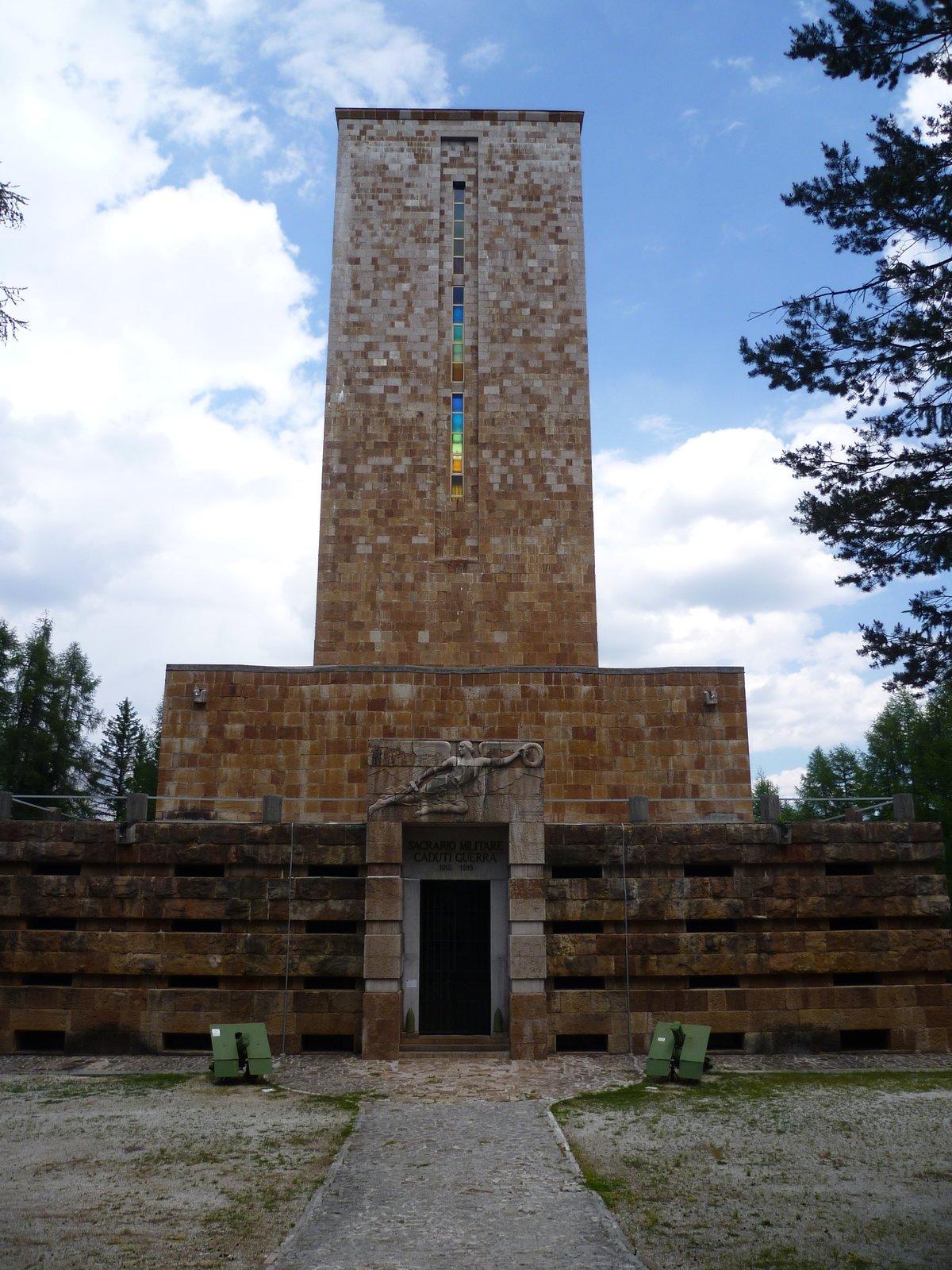
The Pocol Ossuary houses the remains of over 9,700 soldiers from the First World War in a solemn stone building. The rear terrace offers a 360-degree view of the Tofane, Cristallo, and Sorapiss peaks. Access is straightforward with nearby parking, making it ideal for a visit that combines history and scenery.
- Military memorial with an underground crypt containing 9,700 fallen Italian and Austro-Hungarian soldiers
- Exceptional panoramic view from the Tofane to Sorapiss from the rear terrace
- Solemn architecture in local stone designed in the 1930s by Pietro del Fabbro
- Strategic location at 1,535 meters along the road to Passo Falzarego
Introduction
Arriving at the Pocol Ossuary is an experience that strikes you immediately. It’s not just a monument, but a place where history and landscape powerfully merge. It stands at nearly 1,600 meters, along the road from Cortina d’Ampezzo ascending towards Falzarego Pass, and its location is absolutely spectacular. You find yourself before an austere stone building that holds the remains of thousands of soldiers from the First World War. But what leaves an impression, perhaps even more than the solemnity of the place, is the panorama: the Ampezzo Dolomites, with the Tofane and Cristallo peaks, embrace you in a silence that speaks. It’s a place that makes you reflect, but also simply stop and gaze.
Historical Background
This military shrine originates from a specific and painful history. It was built between 1935 and 1936 to gather the remains of Italian and Austro-Hungarian soldiers who fought in the mountains around Cortina, a harsh front during the Great War. Architect Pietro del Fabbro designed it as a symbolic fortress. Inside, in the crypt, rest the remains of over 9,700 soldiers, many of whom are unknown. It’s not just a number: walking among the niches, one understands the scale of that high-altitude tragedy. Its purpose was and is clear:
to honor the memory and unite the victims of both sides in a single sacred place, a message of peace after so much destruction.
- 1915-1918: Fierce fighting on the Dolomite front.
- 1935-1936: Construction of the Ossuary based on Pietro del Fabbro’s design.
- 1939: Official inauguration of the monument.
Architecture That Speaks
The building doesn’t go unnoticed. It’s massive, square-shaped, with an appearance reminiscent of a fortress or a small stronghold. This is no coincidence: it was meant to blend into the wartime landscape of these mountains. Climbing the access staircase leads to a paved square. Above the entrance portal, a large mosaic depicting Saint Martin, the patron saint of infantry, stands out. Upon entering, the atmosphere changes completely. Light filters through the narrow windows, illuminating the central crypt with its niches. The effect is one of great solemnity. Every detail, from the local stone to the austere arrangement, seems to want to tell the harshness of that war. I was struck by the simplicity, the absence of excessive rhetoric. It’s a place that communicates more through silence than words.
The Balcony Overlooking the Dolomites
Exiting from the rear of the ossuary opens onto a terrace that, in my opinion, is the true emotional heart of the visit. It is a natural balcony perched over the valley. From here, the view is 360 degrees and breathtaking. Before you, in all their majesty, stand the Tofane, with their characteristic spire-like shape, and the Cristallo massif. In the distance, if the day is clear, you can also glimpse Pelmo. It is a panorama I know well from postcards, but experiencing it from this point, with the weight of history behind you, is different. You feel like staying silent, absorbing all that beauty. It is the strongest contrast: the human tragedy enclosed within the walls and the eternal, peaceful grandeur of nature ahead. I recommend bringing a camera, but also just sitting for a moment on the low wall and looking.
Why Visit It
For at least three very concrete reasons. First, it is an authentic and moving memorial site, not a tourist reconstruction. It puts you face to face with the history of the area in a direct way. Second, it offers one of the most beautiful panoramic views in the entire Cortina area, and I assure you the competition is fierce. Third, it is a destination that pairs perfectly with a day in the mountains: you can go on a hike and then stop here for a moment of reflection or simply to admire the landscape. It is accessible to everyone, does not require demanding trekking, and provides a complete experience, made of emotions and pure beauty.
When to Go
My advice? Go in the late afternoon, especially on a beautiful sunny day. The low-angled light of the setting sun bathes the Dolomite walls in warm tones, from gold to pink, creating an unforgettable spectacle. In winter, with snow covering everything, the contrast between the white and the dark stone of the ossuary is very evocative, but be aware that the road can be icy. In summer, mornings are often clear, but it can be more crowded. Autumn, with the colors of the larch trees, offers a melancholic and beautiful atmosphere. In short, every moment has its charm, but sunset remains my favorite.
In the Surroundings
The visit to the Ossuary can easily be combined with other historical or natural experiences. Just a few minutes’ drive away, towards Falzarego Pass, you’ll find the Lagazuoi Galleries, an incredible open-air museum. These are trenches, tunnels, and positions from the Great War carved into the mountain, which you can explore (with caution and appropriate equipment; sometimes a helmet is required). It’s like stepping into history. Alternatively, for a lighter yet still historically themed experience, you can take a walk to the nearby Pianozes Lake, a small, tranquil body of water perfect for a refreshing break with the same breathtaking panorama in the background.