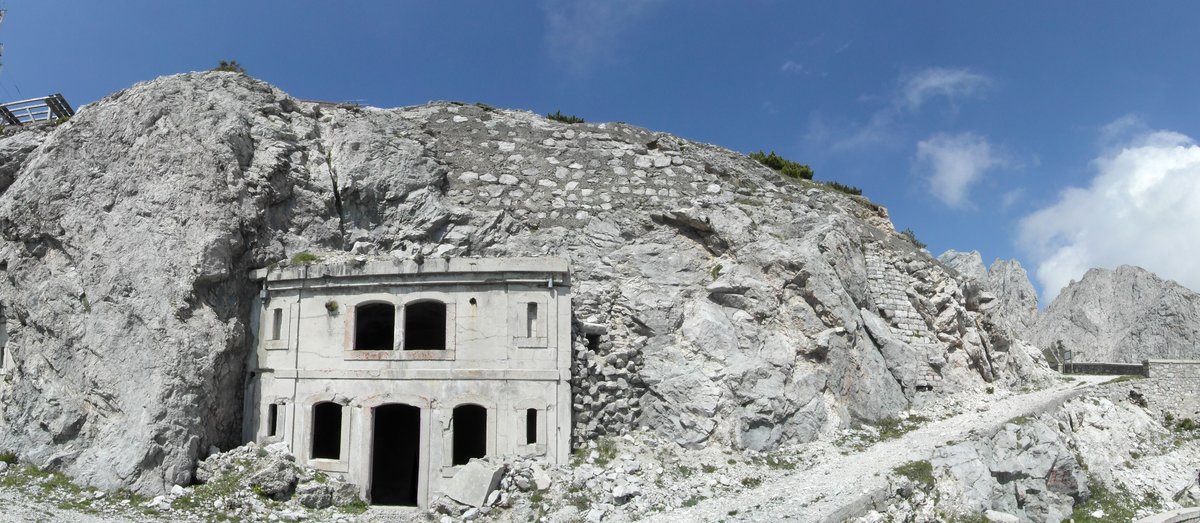
Forte Tudaio is an Austro-Hungarian fortress built between 1884 and 1889 at an altitude of 1,450 meters, offering free access and panoramic views of the Dolomites. The moderately difficult hiking trail starts from the center of Vigo di Cadore.
- Breathtaking views of the Sesto, Pelmo, and Antelao Dolomites from the Boite Valley
- Well-preserved military structure in stone and brick with visitable barracks and storerooms
- Free access via a moderately difficult hiking trail
- Historic strategic location without tourist crowds, ideal for sunset photography
Introduction
Arriving at Forte Tudaio is a breathtaking sight. It’s not just a military fortress; it’s a balcony suspended over the Dolomites, with a view that embraces Cadore and the most iconic peaks. You find yourself in Vigo di Cadore, a tranquil village, and suddenly you’re catapulted into a postcard-perfect panorama. The feeling is strange: on one side, the solid stone of history; on the other, the vastness of the mountains. This isn’t a place to visit in a hurry. You stop, breathe, and wonder why it isn’t talked about more. Personally, I’ve always found it fascinating how places so rich in history often fly under the radar of mass tourism. Here, the silence is broken only by the wind and, if you’re lucky, the flight of an eagle. It’s one of those experiences that make you feel small in the face of nature, yet part of something greater.
Historical Notes
Forte Tudaio was not built to be beautiful, but to be useful. Constructed between
1884 and 1889 by the Austro-Hungarian Empire, it was part of the Cadore defensive system, a barrier against potential attacks from Italy. It’s curious to think that this fortress, so peaceful today, was once a military outpost. It never saw actual battles, but during World War I it was used as an observation post and command point. After the conflict, it passed to the Italian Army and was gradually abandoned. Today, after a conservation restoration, it is open to visitors and tells a story of border history, made of strategy and fears. It is not a museum crowded with relics, but its very structure is the most eloquent artifact. I like to imagine the soldiers on guard, their eyes fixed on the same mountains that we admire today for pure pleasure.
- 1884-1889: Construction by the Austro-Hungarian Empire.
- 1915-1918: Used as an observation post during World War I.
- Post-war: Transferred to Italy and decommissioned.
- Today: Restored and open for visits.
Military Architecture and Panoramas
What strikes you about Forte Tudaio is its dual nature. From the outside, it almost seems camouflaged into the rock, with its thick walls and loopholes betraying its original purpose. Inside, the spaces are essential: corridors, cannon rooms (now empty), narrow staircases. There is no furniture, but the atmosphere is palpable. Then, you climb to the upper terraces and the world changes. The view is simply breathtaking: before you stretches the Boite Valley, with the villages of Vigo and Lozzo di Cadore like tiny models, and in the background the Sesto Dolomites, Pelmo, Antelao. On a clear day, you can even see the Marmarole. It is this contrast that makes the place special: the weight of military history dissolves into the lightness of an endless panorama. I recommend exploring every corner, even the most hidden ones: from some windows, you glimpse different, more intimate views.
An Experience for All the Senses
Visiting Forte Tudaio is not just a visual experience. It’s a journey that engages all the senses, if you take the right amount of time. The scent of damp stone in the interior rooms, mingled with the aroma of resin and earth from the surrounding woods. The silence, perhaps broken by the rustle of leaves or the call of a cuckoo. The feel of the rough rock of the walls, telling decades of weathering. And then, of course, the taste: there’s no bar up here, but on the descent towards Vigo awaits the chance to sample something authentic. Perhaps that’s why the place leaves a lasting impression: it’s not just a postcard, but a multisensory memory. Sometimes I wonder if the Austrian builders ever imagined that their fortress would one day become a privileged observation point for tourists and mountain enthusiasts. Probably not, and that’s the beauty of history: it transforms.
Why Visit It
For at least three concrete reasons. First: the panoramic view of the Dolomites is among the most extensive and spectacular in the area, and doesn’t require strenuous climbs. Second: it’s a piece of living, tangible history, a well-preserved example of late 19th-century military architecture that helps you understand the tensions of a border. Third: it’s a place off the beaten track, where you can still enjoy peace and space without crowds. You won’t find kiosks or queues, just the fort and the landscape. Perfect for those seeking an authentic experience, away from the chaos. And, last but not least, it’s an excellent starting point for exploring Cadore, an area rich in traditions and natural beauty that is often underestimated.
When to Go
The best time? Undoubtedly late summer afternoons or early autumn. In summer, the air is crisp and the days are long: arriving around 5-6 PM gifts you with a warm, golden light that illuminates the Dolomite walls, with long shadows sketching the valley. In autumn, the spectacle doubles: fiery colors from the larch and beech forests surrounding the fort add to the panoramas. In winter, with snow, it must be magical, but access might be more challenging and the cold intense. In spring, watch out for sudden showers. In short, pick a sunny day, preferably midweek for extra tranquility, and prepare for a show worth the journey.
In the Surroundings
A visit to Forte Tudaio can easily be combined with other experiences in Cadore. Just a few minutes by car away is Lozzo di Cadore, with its interesting Dairy Museum and charming historic center. Alternatively, for a plunge into nature, you can hike to Lago di Centro, a small alpine lake nestled in the woods, perfect for a relaxing break. If you’re interested in history and craftsmanship, it’s worth stopping in Pieve di Cadore, the birthplace of Tiziano Vecellio, where you can visit his house-museum and soak up the atmosphere of a village rich in traditions related to woodworking and eyewear. These are all nearby destinations that complete the picture of an authentic and welcoming mountain region.