Introduction
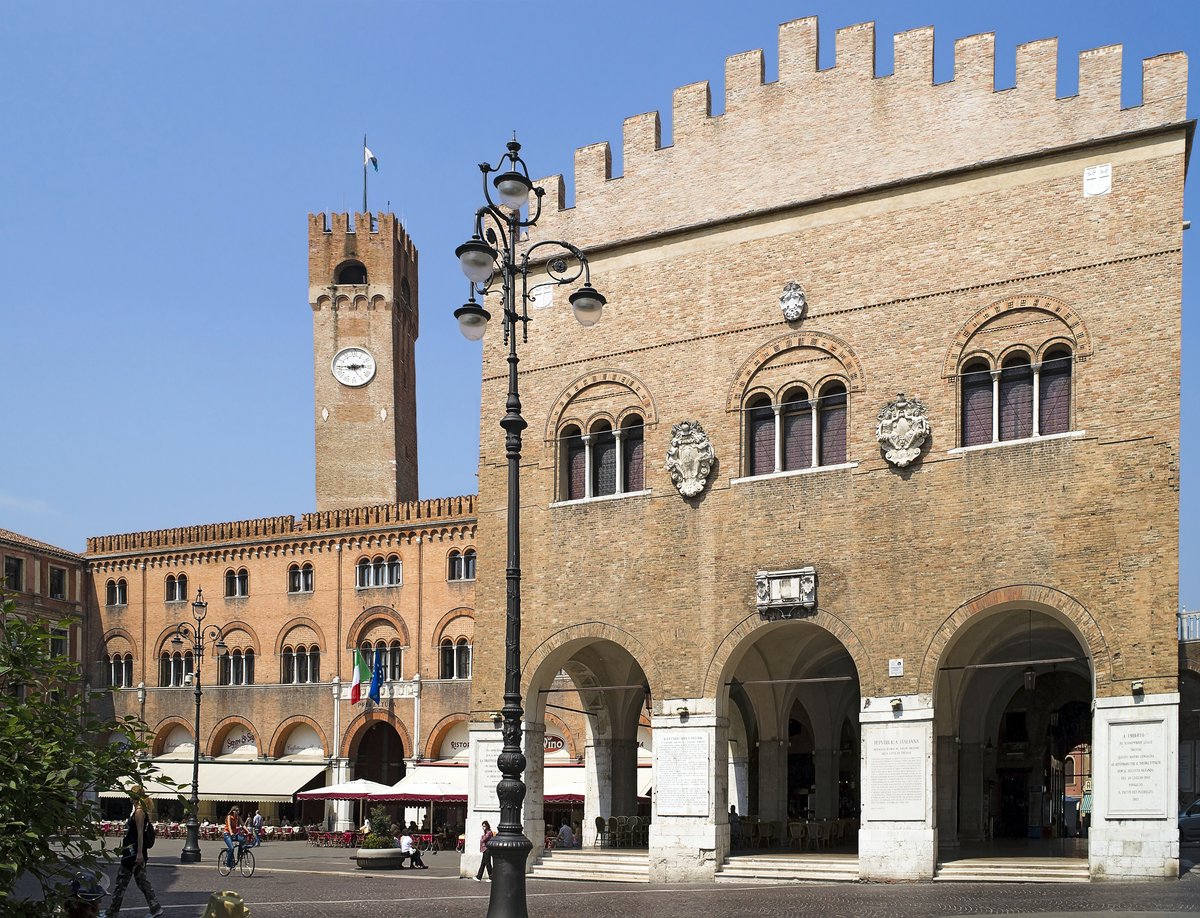
Stepping into Palazzo dei Trecento is like taking a leap back to the Middle Ages, but without too much pomp. You find yourself in Piazza dei Signori, surrounded by cafés and palaces, and suddenly you look up at this mass of red brick with its Guelph battlements. You could almost hear the voices of the councilors who debated here as early as the 1200s. Today it’s the seat of the City Council, but the best part is that you can visit it: on Saturday and Sunday afternoons, for a few euros, you go up to the main floor and discover a huge hall with a wooden truss ceiling that leaves you speechless. And then there are the frescoes, the coats of arms of the podestà, the Madonna and Child. A place that smells of living history, not a museum.
Introduction
Stepping into Palazzo dei Trecento is like taking a leap back to the Middle Ages, but without too much pomp. You find yourself in Piazza dei Signori, surrounded by cafés and palaces, and suddenly you look up at this mass of red brick with its Guelph battlements. You could almost hear the voices of the councilors who debated here as early as the 1200s. Today it’s the seat of the City Council, but the best part is that you can visit it: on Saturday and Sunday afternoons, for a few euros, you go up to the main floor and discover a huge hall with a wooden truss ceiling that leaves you speechless. And then there are the frescoes, the coats of arms of the podestà, the Madonna and Child. A place that smells of living history, not a museum.
Historical Notes
The Palazzo dei Trecento was built around 1185 to host the assemblies of the free commune, and was completed in 1268 with the addition of a prison. Initially called Domus Nova Communis, it later became the seat of the Court of Consuls, the Podestà, and the Great Council, composed of three hundred members: hence the name. Over the centuries it underwent continuous modifications: in 1552 the ground floor loggia was opened, and the external stairs were moved several times. The bombing of April 7, 1944 severely damaged it: a wing collapsed, but thanks to superintendent Forlati it was decided to restore it. The merlons, originally Ghibelline, were rebuilt in Guelph style. Today a row of set-back bricks marks the difference between the original and the reconstruction.
Historical Notes
The Palazzo dei Trecento was built around 1185 to host the assemblies of the free commune, and was completed in 1268 with the addition of a prison. Initially called Domus Nova Communis, it later became the seat of the Court of Consuls, the Podestà, and the Great Council, composed of three hundred members: hence the name. Over the centuries it underwent continuous modifications: in 1552 the ground floor loggia was opened, and the external stairs were moved several times. The bombing of April 7, 1944 severely damaged it: a wing collapsed, but thanks to superintendent Forlati it was decided to restore it. The merlons, originally Ghibelline, were rebuilt in Guelph style. Today a row of set-back bricks marks the difference between the original and the reconstruction.
Architecture and Battlements
The building is a quadrilateral of exposed brick, with a loggia on the ground floor opened in 1552 by Andrea da Valle: a portico connecting two squares, where today you find three cafés. The upper floor is the real protagonist: a hall 12 meters high, 20 wide, and 46 long, lit by triple windows. The wooden truss ceiling is spectacular. What struck me most is the battlements: during post-war restorations, the Ghibelline merlons (swallow-tailed) were replaced with Guelph ones (square-shaped), a detail that tells the aesthetic choices of each era. The external staircase, now on Piazza Indipendenza, has a troubled history: two ramps on the facade were demolished in the 19th century, and the current one is a reconstruction from 1906.
Architecture and Battlements
The building is a quadrilateral of exposed brick, with a loggia on the ground floor opened in 1552 by Andrea da Valle: a portico connecting two squares, where today you find three cafés. The upper floor is the real protagonist: a hall 12 meters high, 20 wide, and 46 long, lit by triple windows. The wooden truss ceiling is spectacular. What struck me most is the battlements: during post-war restorations, the Ghibelline merlons (swallow-tailed) were replaced with Guelph ones (square-shaped), a detail that tells the aesthetic choices of each era. The external staircase, now on Piazza Indipendenza, has a troubled history: two ramps on the facade were demolished in the 19th century, and the current one is a reconstruction from 1906.
The Frescoes of the Hall
As soon as you step into the hall, your gaze is drawn to the back wall. At the center is a Madonna and Child between Saints Liberale and Peter, and on the sides of the windows, four female figures representing the cardinal virtues: Prudence, Justice, Fortitude, and Temperance. These are frescoes from the second half of the 16th century, likely by Venetian artists. On three sides, a band runs with the coats of arms and names of the podestà who governed Treviso between the 14th and 15th centuries. Each shield is different, and reading the names makes you imagine stories of power and administration. Not everything is original: the left part was lost in the bombing, but what remains is moving. A side fresco shows a cartouche-shaped coat of arms with Justice, from the late 1500s.
The Frescoes of the Hall
As soon as you step into the hall, your gaze is drawn to the back wall. At the center is a Madonna and Child between Saints Liberale and Peter, and on the sides of the windows, four female figures representing the cardinal virtues: Prudence, Justice, Fortitude, and Temperance. These are frescoes from the second half of the 16th century, likely by Venetian artists. On three sides, a band runs with the coats of arms and names of the podestà who governed Treviso between the 14th and 15th centuries. Each shield is different, and reading the names makes you imagine stories of power and administration. Not everything is original: the left part was lost in the bombing, but what remains is moving. A side fresco shows a cartouche-shaped coat of arms with Justice, from the late 1500s.
Why visit it
First: it’s one of the rare medieval palaces in Italy where you can actually step into a still-in-use council chamber with its original frescoes. Second: the view from the hall through the triple windows gives you unique perspectives on Piazza dei Signori and the nearby towers. Third: the ticket is cheap, and in an hour you’ll take a trip back in time. If you’re in town for a weekend, it’s a must-see to understand the soul of Treviso.
Why visit it
First: it’s one of the rare medieval palaces in Italy where you can actually step into a still-in-use council chamber with its original frescoes. Second: the view from the hall through the triple windows gives you unique perspectives on Piazza dei Signori and the nearby towers. Third: the ticket is cheap, and in an hour you’ll take a trip back in time. If you’re in town for a weekend, it’s a must-see to understand the soul of Treviso.
When to Go
Saturday or Sunday afternoon is the only time it’s open, but I recommend choosing a sunny day: the light streaming through the triple windows magically illuminates the frescoes, and the ground-floor loggia is a perfect spot for an outdoor coffee. Avoid the midday hours in summer, but the air-conditioned hall will keep you comfortable. In autumn, with the city’s warm colors, the atmosphere is even more evocative.
When to Go
Saturday or Sunday afternoon is the only time it’s open, but I recommend choosing a sunny day: the light streaming through the triple windows magically illuminates the frescoes, and the ground-floor loggia is a perfect spot for an outdoor coffee. Avoid the midday hours in summer, but the air-conditioned hall will keep you comfortable. In autumn, with the city’s warm colors, the atmosphere is even more evocative.
Nearby
Just a stone’s throw away, still in Piazza dei Signori, you’ll find the Palazzo del Podestà with its Clock Tower, a 19th-century neo-Gothic gem. Turn the corner and you’re in Piazza San Vito, where the Chapel of Santa Lucia houses 14th-century frescoes by Tommaso da Modena – a little-known treasure. And the palace loggia itself is a great spot for an aperitivo, sipping a prosecco while watching the piazza come to life.
Nearby
Just a stone’s throw away, still in Piazza dei Signori, you’ll find the Palazzo del Podestà with its Clock Tower, a 19th-century neo-Gothic gem. Turn the corner and you’re in Piazza San Vito, where the Chapel of Santa Lucia houses 14th-century frescoes by Tommaso da Modena – a little-known treasure. And the palace loggia itself is a great spot for an aperitivo, sipping a prosecco while watching the piazza come to life.