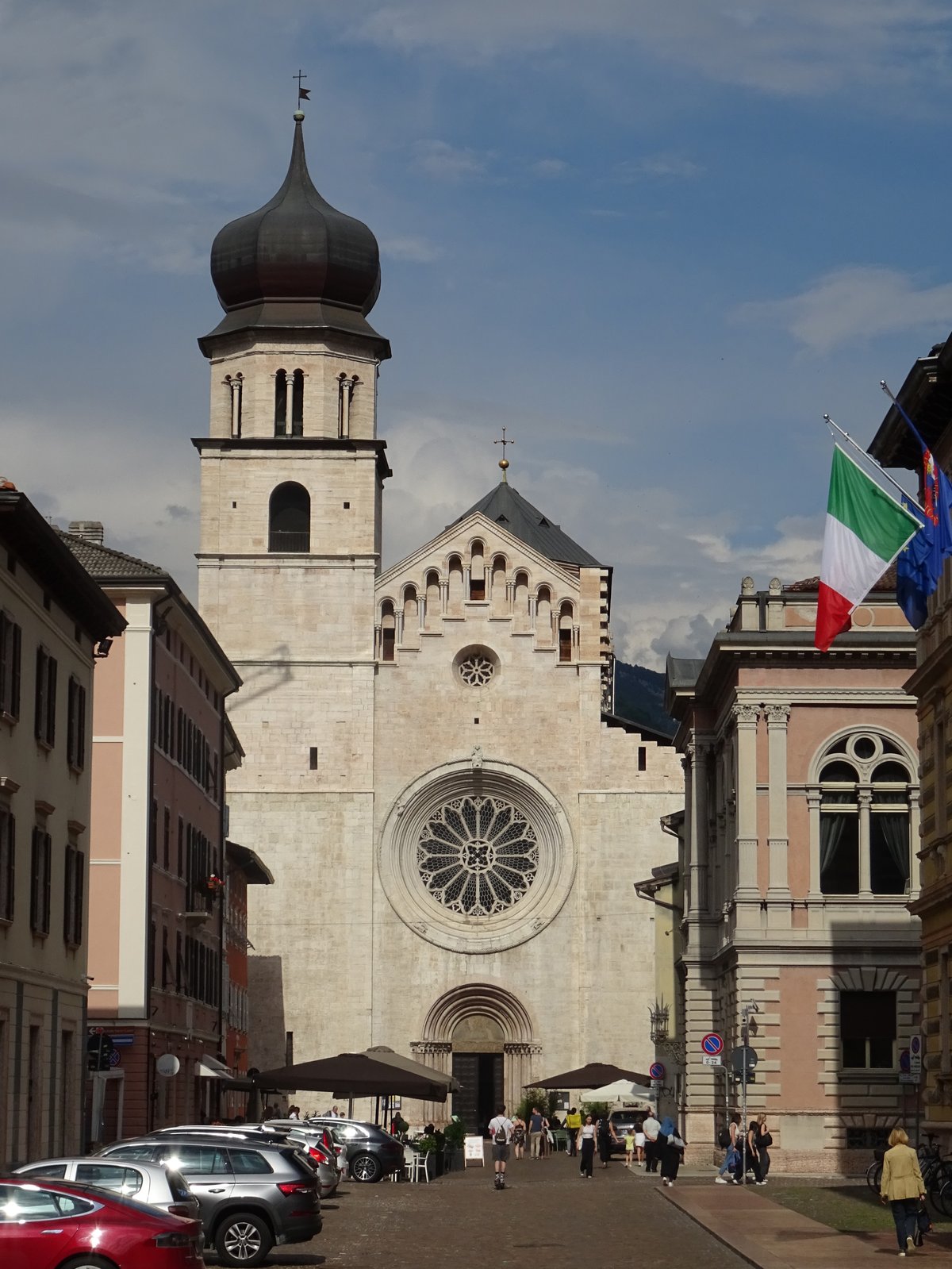
St. Vigilius Cathedral, the religious heart of Trento, is a Romanesque-Gothic masterpiece that holds centuries of history. Inside, you can feel the atmosphere of the Council of Trent, which took place here from 1545 to 1563. Among medieval frescoes, the Wheel of Fortune, and the paleochristian basilica, every corner tells a piece of history.
Admire the rose window of the Wheel of Fortune on the north transept, symbol of the ever-changing fate of humans.
Discover the Chapel of the Crucifix, with the wooden crucifix from the Council.
Visit the excavations of the 4th-century paleochristian basilica beneath the cathedral.
Don’t miss the Tridentine Diocesan Museum, which preserves the cathedral’s treasure.
Welcome to Piazza Duomo
Stepping into Piazza Duomo in Trento is like traveling back in time. The Cathedral of San Vigilio dominates the scene with its asymmetrical façade – one unfinished bell tower, the other soaring – and that rose window that seems to stare at you. But it’s when you cross the threshold that you understand: history is palpable here. Beams of light filter through the stained glass, massive columns guide you toward the altar, and a near-solitary silence envelops you. It’s not just a church; it’s a stone book telling centuries of faith, art, and power.
Welcome to Piazza Duomo
Stepping into Piazza Duomo in Trento is like traveling back in time. The Cathedral of San Vigilio dominates the scene with its asymmetrical façade – one unfinished bell tower, the other soaring – and that rose window that seems to stare at you. But it’s when you cross the threshold that you understand: history is palpable here. Beams of light filter through the stained glass, massive columns guide you toward the altar, and a near-solitary silence envelops you. It’s not just a church; it’s a stone book telling centuries of faith, art, and power.
Historical Background
The cathedral stands on an early Christian basilica from the 4th century, where the martyrs Sisinnius, Martyrius, and Alexander were buried, followed by Saint Vigilius himself. The current building was commissioned by Bishop Federico Vanga in 1212, entrusted to Adamo d’Arogno and the Comacine masters. Construction lasted over a century, with Gothic and Baroque additions. The Council of Trent opened here on December 13, 1545, and its decrees were signed on December 4, 1563. In 1511, Emperor Maximilian of Habsburg was crowned here. The remains of the underground basilica were brought to light between 1964 and 1977.
Historical Background
The cathedral stands on an early Christian basilica from the 4th century, where the martyrs Sisinnius, Martyrius, and Alexander were buried, followed by Saint Vigilius himself. The current building was commissioned by Bishop Federico Vanga in 1212, entrusted to Adamo d’Arogno and the Comacine masters. Construction lasted over a century, with Gothic and Baroque additions. The Council of Trent opened here on December 13, 1545, and its decrees were signed on December 4, 1563. In 1511, Emperor Maximilian of Habsburg was crowned here. The remains of the underground basilica were brought to light between 1964 and 1977.
The Wheel of Fortune and Hidden Treasures
One of the most iconic elements is the Rose Window of the Wheel of Fortune on the north transept: a large twelve-petal flower with the blindfolded goddess at its center, symbol of the fickleness of human fate. Don’t miss the Romanesque protiro with stylophoric lions on the northern side. Inside, the Chapel of the Crucifix (17th century) houses the Crucifix of the Council, a wooden work by Sixtus Frei from the early 16th century. Beneath the presbytery, excavations allow you to visit the paleo-Christian basilica with mosaics and floor tombs. A journey intertwining medieval, Baroque, and archaeological art.
The Wheel of Fortune and Hidden Treasures
One of the most iconic elements is the Rose Window of the Wheel of Fortune on the north transept: a large twelve-petal flower with the blindfolded goddess at its center, symbol of the fickleness of human fate. Don’t miss the Romanesque protiro with stylophoric lions on the northern side. Inside, the Chapel of the Crucifix (17th century) houses the Crucifix of the Council, a wooden work by Sixtus Frei from the early 16th century. Beneath the presbytery, excavations allow you to visit the paleo-Christian basilica with mosaics and floor tombs. A journey intertwining medieval, Baroque, and archaeological art.
The Council of Trent: When History Changed
Imagine: within these aisles, for nearly twenty years, council fathers, theologians, and princes of the Church debated the future of Catholicism. The cathedral was the stage for the solemn sessions of the Council of Trent (1545-1563). A movable tribune was set up in the choir for the debates. Here, on 20 April 1561, Ludovico Madruzzo received the cardinal’s biretta. The high altar preserves the memory of the signing of the acts by 217 fathers. For further exploration, the Diocesan Museum of Trent preserves precious iconographic testimonies and the cathedral treasury.
The Council of Trent: When History Changed
Imagine: within these aisles, for nearly twenty years, council fathers, theologians, and princes of the Church debated the future of Catholicism. The cathedral was the stage for the solemn sessions of the Council of Trent (1545-1563). A movable tribune was set up in the choir for the debates. Here, on 20 April 1561, Ludovico Madruzzo received the cardinal’s biretta. The high altar preserves the memory of the signing of the acts by 217 fathers. For further exploration, the Diocesan Museum of Trent preserves precious iconographic testimonies and the cathedral treasury.
Why Visit It
Three reasons not to miss it: 1. An open-air museum: 14th-century frescoes, Romanesque and Baroque sculptures coexist under one roof. 2. A dive into the Counter-Reformation: experience firsthand the places where post-Reformation Catholic doctrine was decided. 3. The underground basilica: few know that beneath your feet lies a 4th-century church with original mosaics. A unique experience combining faith, history, and archaeology, ideal even for non-believers.
Why Visit It
Three reasons not to miss it: 1. An open-air museum: 14th-century frescoes, Romanesque and Baroque sculptures coexist under one roof. 2. A dive into the Counter-Reformation: experience firsthand the places where post-Reformation Catholic doctrine was decided. 3. The underground basilica: few know that beneath your feet lies a 4th-century church with original mosaics. A unique experience combining faith, history, and archaeology, ideal even for non-believers.
When to Go
To experience the cathedral in all its glory, choose a spring or autumn morning, when the slanting light illuminates the rose window and frescoes. Avoid the midday hours on weekends if you prefer tranquility. Personally, I find late afternoon has a special atmosphere: the setting sun filters through the Rose of Fortune window, casting shifting light on the columns. During the year, the Festival of Sacred Music (June–July) offers concerts that enhance the evocative acoustics.
When to Go
To experience the cathedral in all its glory, choose a spring or autumn morning, when the slanting light illuminates the rose window and frescoes. Avoid the midday hours on weekends if you prefer tranquility. Personally, I find late afternoon has a special atmosphere: the setting sun filters through the Rose of Fortune window, casting shifting light on the columns. During the year, the Festival of Sacred Music (June–July) offers concerts that enhance the evocative acoustics.
Nearby
Just a few steps away, the Museo Diocesano Tridentino is worth a visit: over 17,000 works from the 11th to the 19th century, with a spectacular view of the cathedral from above. Don’t miss the archaeological area of Porta Veronensis, the ancient Roman gate. Then stroll along Via Belenzani, with its Renaissance and frescoed palazzos, all the way to Piazza Fiera. If you have time, head up to Castello del Buonconsiglio (10 minutes on foot): the bishop’s residence with the frescoes of the Months.
Nearby
Just a few steps away, the Museo Diocesano Tridentino is worth a visit: over 17,000 works from the 11th to the 19th century, with a spectacular view of the cathedral from above. Don’t miss the archaeological area of Porta Veronensis, the ancient Roman gate. Then stroll along Via Belenzani, with its Renaissance and frescoed palazzos, all the way to Piazza Fiera. If you have time, head up to Castello del Buonconsiglio (10 minutes on foot): the bishop’s residence with the frescoes of the Months.