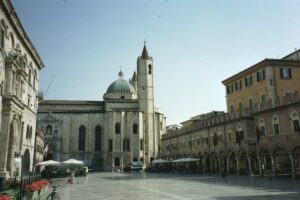
If you have just one day to discover Fermo, this walking itinerary takes you into the heart of the city, among history, art and breathtaking views. Start from Piazza del Popolo, climb the Torre Matteucci for a 360° panorama of the Marche hills, then immerse yourself in culture by visiting the Teatro dell’Aquila, one of the oldest in the region. Continue with the Civic Museums: in Palazzo dei Priori you’ll admire archaeological finds and artworks, while in the nearby Palazzo Ducale you’ll uncover the city’s history. The route is entirely in the historic center, no transportation needed. Fermo offers medieval corners, artisan shops and an authentic atmosphere. Perfect for a last-minute cultural trip.
🗺️ Your trip at a glance
A walking tour that hits the highlights of Fermo: Teatro dell’Aquila, Torre Matteucci and two civic museums. Ideal for a relaxed cultural day.
- Ideal for: history and architecture enthusiasts, solo travelers or couples looking for a dive into the past.
- Highlights: complete visit of the historic center in a few hours, climb the tower for a unique view, combined tickets at a reduced price.
- For whom: those who love art cities and want a compact yet rich experience, away from mass tourism.
Itinerary stops
Stop no. 1
Teatro dell’Aquila: An 18th-Century Gem
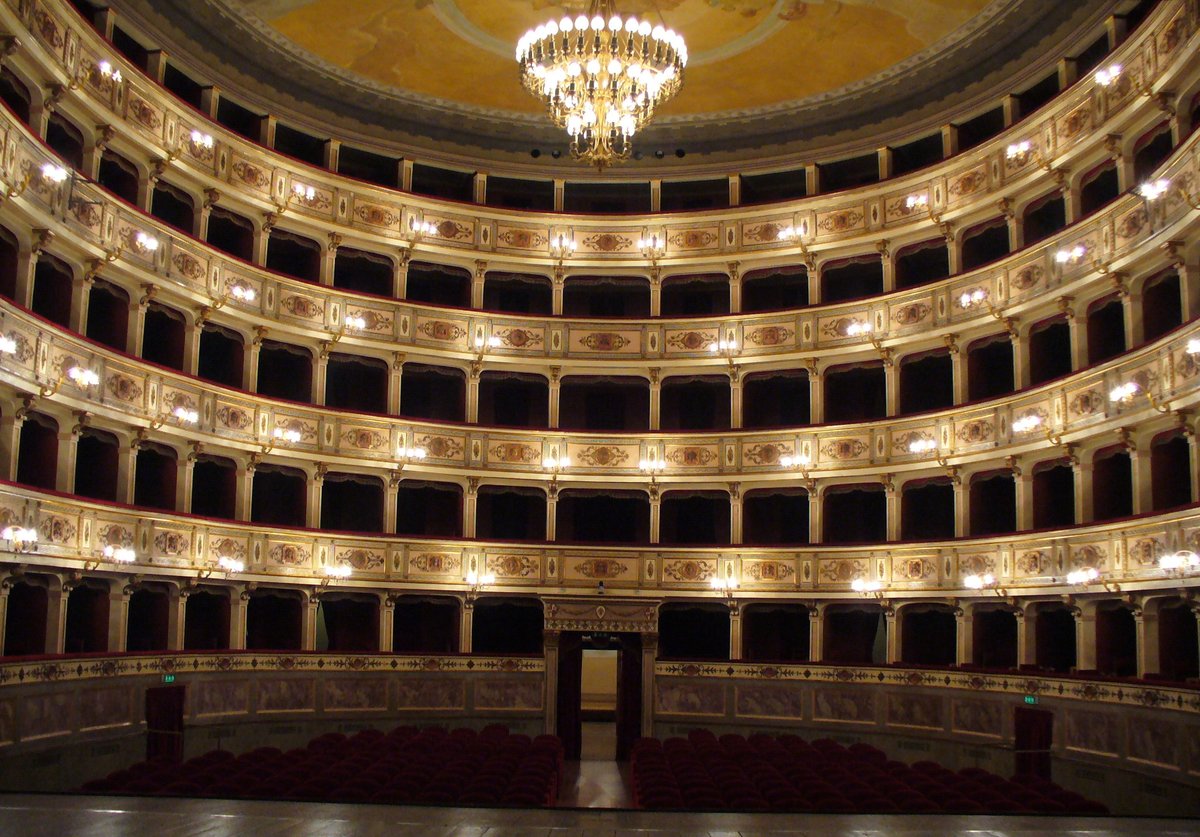 The first stop of this day in Fermo simply had to be the Teatro dell’Aquila, one of the most impressive historic theaters in the Marche region. Stepping through the entrance on Via Mazzini, you’re immediately immersed in an 18th-century atmosphere: the elliptical hall, with its 124 boxes arranged over five tiers, makes you feel small yet privileged. The ceiling fresco by Luigi Cochetti depicts the gods of Olympus intently listening to Apollo, while the chandelier with 56 gilded iron arms, which arrived from Paris after the 1826 fire, adds a touch of sophisticated light. Built between 1780 and 1790 to a design by Cosimo Morelli, it was inaugurated in September 1790. After a period of neglect, a careful restoration in 1997 restored its splendor. Today it’s still very active: plays, opera, and concerts by nationally renowned artists alternate here. If you’re lucky, you might catch a rehearsal or a performance: the acoustics are truly exceptional, as experts say. For me, it was thrilling to know that figures like Toni Servillo and Stefano Accorsi have trod these boards. A tip: book a guided tour—it will let you access the stage as well and discover fascinating behind-the-scenes stories.
- Go to the page: Fermo’s Aquila Theatre: Perfect Acoustics and One of the Largest Stages in the Marche Region
- Via Giuseppe Mazzini, Fermo (FM)
- Open in Google Maps
- View on Google Images

You should go if…
Stop no. 2
Climbing to Torre Matteucci
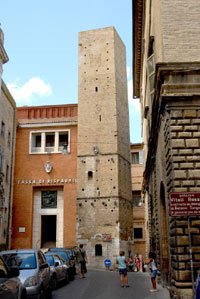 After leaving the theatre, I continue along Corso Cavour to the small square of Carmine, where the Torre Matteucci stands tall, the only medieval tower of a noble family still standing in the center of Fermo. 25 meters high, with a base of 5×4 meters, its construction dates back to the 13th-14th century. Although today it is surrounded by buildings, it was once a lookout point. The most fascinating legend? That of the condottiero Saporoso Matteucci who in 1542 captured the daughter of Sultan Suleiman, holding her prisoner right here. From his love story with the Turkish princess was born a famous tale. The tower, restored in 2011 by the Cassa di Risparmio di Fermo, is not always open, but during special events like ‘Fermo Attivo’ you can climb up to the balcony. If you get the chance, don’t miss the view: a gaze that spans from the Adriatic Sea to the Sibillini Mountains. The Istrian stone blocks at the base and the Matteucci coats of arms on the façade tell centuries of history. A true gem for those who love medieval details.
- Corso Cavour, Fermo (FM)
- Open in Google Maps
- View on Google Images
You should go if…
Stop no. 3
Pinacoteca Civica: Masterpieces at Palazzo dei Priori
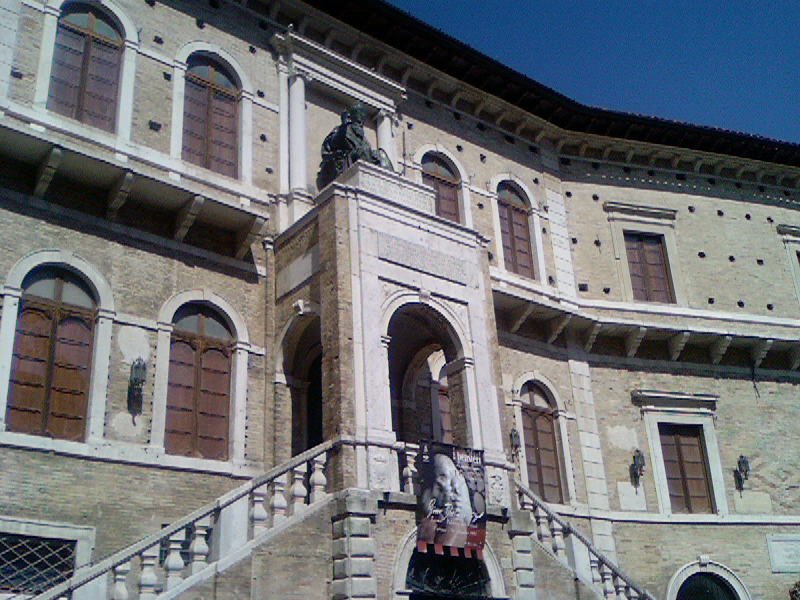 From the tower I descend towards Piazza del Popolo, and climb to the second floor of Palazzo dei Priori for the Pinacoteca Civica. Here, in five rooms arranged by period, you discover a journey from the 1300s to the 1800s. The highlight? Rubens’ Adoration of the Shepherds, his only painting in the Marche region, which arrived here thanks to a patron from Fermo. Nearby, the luminous panels by Jacobello del Fiore and the polyptych by Andrea da Bologna. But the real surprise is the Sala del Mappamondo (Globe Room), with 17th-century walnut shelves and a 1713 globe designed by Amanzio Moroncelli. The gallery, founded in 1890, collects works from suppressed churches: a heritage that speaks of devotion and power. After the 2016 earthquake, it reopened in 2021, fully restored. Don’t miss the wooden statue of the Margutto, the 2.20-meter-tall dummy of the Quintana joust. Full ticket €9, open Tuesday to Sunday 10:30 AM–6:30 PM. For me, it’s a dive into centuries of Marche art.
- Go to the page: Fermo Civic Art Gallery: Masterpieces from the 14th to the 18th Century in the Palazzo dei Priori
- Piazza del Popolo, Fermo (FM)
- Open in Google Maps
- View on Google Images
You should go if…
Stop no. 4
Diocesan Museum: Sacred Treasures from Miniatures to Goldsmithing
 Leaving the Pinacoteca, I head towards the Cathedral, and next to it I discover the Diocesan Museum. Opened in 2004, it occupies the spaces of the ancient Confraternity of the Suffrage: an intimate setting housing works from the Paleochristian period to the 20th century. The first room is the Cathedral Treasury: here the Messale de Firmonibus, illuminated in 1436 by Giovanni di Ugolino da Milano, with the famous page of the Cavalcade of the Assumption, leaves me breathless. Next to it, the Chasuble of St. Thomas Becket, a rare Arab textile from 1116, and the Staurotheca of Pope Pius III. Going upstairs, the silver room displays the pontifical service of Cardinal Brancadoro signed by Valadier, while the picture gallery offers paintings by Crivelli, Barocci, and Hayez. The combined ticket (10€) also grants access to other museums; but I focus here. Open only on Saturdays and Sundays, from 10am to 1pm and 2pm to 5pm – better to book. A concentration of faith and art that speaks of centuries.
- Via del Teatro Antico, Fermo (FM)
- http://www.museodiocesanofermo.it/
- Open in Google Maps
- View on Google Images
You should go if…