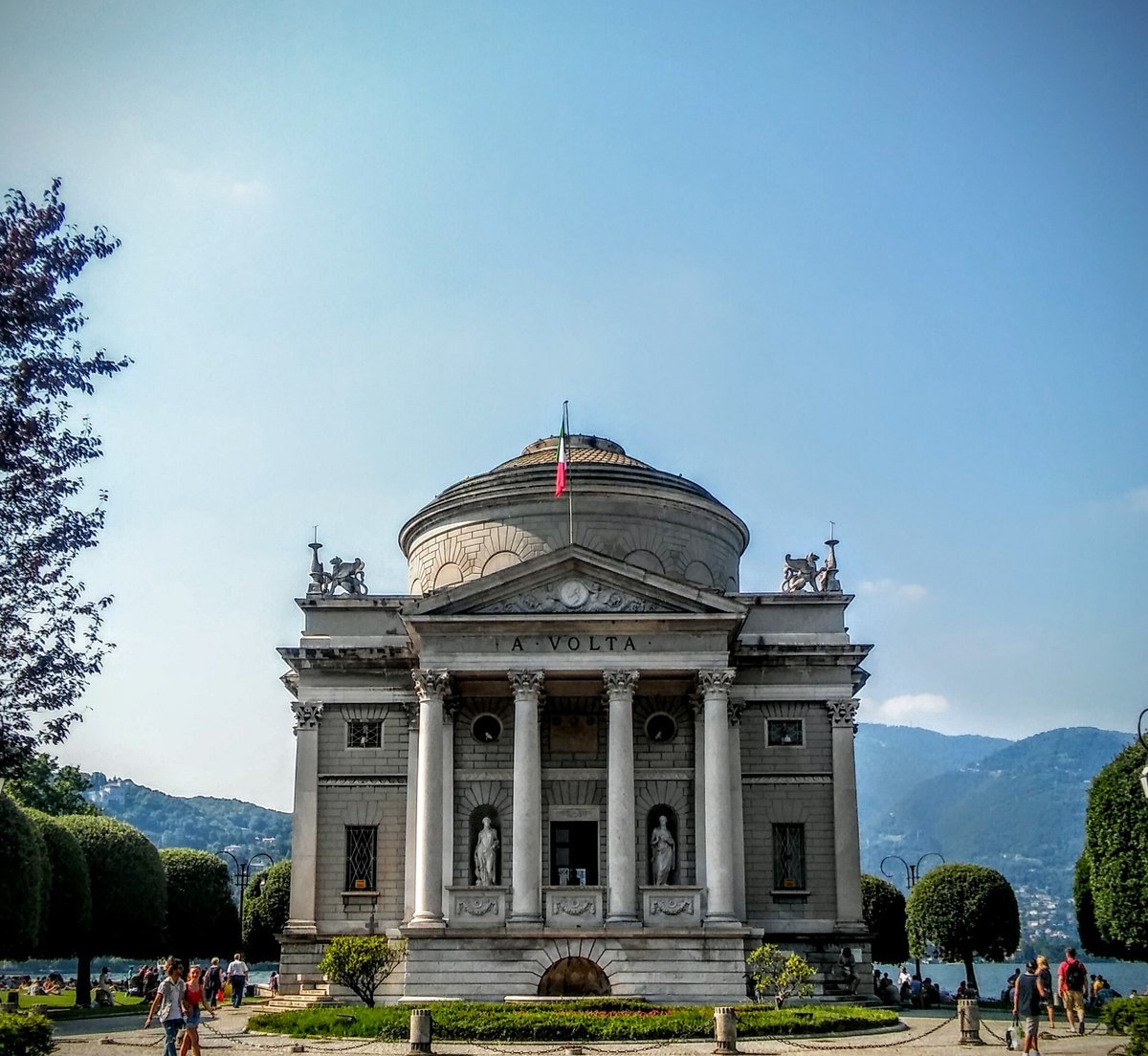
The Tempio Voltiano is the civic museum dedicated to Alessandro Volta, on Como’s lakeside promenade on Viale Marconi. Inaugurated on 16 July 1928 to a design by Federico Frigerio, it combines a neoclassical building inspired by the Pantheon with original instruments and reconstructions devoted to the Voltaic pile and the science of electricity. It is open Tuesday to Sunday, 10:00-18:00 (last entry 17:30), with a paid ticket and lift.
– Neoclassical architecture: dome, six-column portico and statues of Faith and Science
– Volta collection: Voltaic pile, electrophori, documents and memorabilia
– Lakeside location: on foot from the centre and by bike from Villa Olmo
– Events and families: lectures, guided tours and educational activities
Tempio Voltiano: Volta’s Museum on Lake Como
Don’t call it a church: the Tempio Voltiano is a museum, yet it has the solemn air of a small Pantheon overlooking the water. On Como’s lakeside promenade, at the end of Viale Guglielmo Marconi, the white building stands out between the green and the blue of the lake, and it sparks curiosity even from outside. Inside, it preserves Alessandro Volta’s original instruments and reconstructions, the Como-born scientist of the battery. The display is compact, orderly, almost intimate: scientific apparatus gives way to portraits, medals to documents. Don’t expect a giant interactive museum; here the appeal lies in its scale and setting. It took me a little while to realize that the name “Tempio” is a tribute, not a sign of religious use. And perhaps this very ambiguity is what makes it memorable: a place dedicated to science within a classical form, with the lake as a backdrop. Opening hours, tickets and access are easy to arrange, but the visit is best savored slowly.
Historical Background
The museum was founded through the will of the entrepreneur
Francesco Somaini, who conceived, financed and later donated it to the city of Como. The design is by architect
Federico Frigerio, commissioned to build a prestigious home for the studies and instruments of
Alessandro Volta, who died on
5 March 1827. It was inaugurated on
16 July 1928, amid celebrations marking the centenary of Volta. The building is therefore not a religious temple but a secular monument to science: white stone, polychrome marbles, a central dome and references to the Pantheon. Over time the Temple has become part of Como’s Civic Museums system and continues to host initiatives, conferences and exhibitions. Its history is short compared with Volta’s, and that is precisely what makes it interesting: it is a museum built much later, to tell the story of a figure belonging to the eighteenth and nineteenth centuries.
- 1827 – Alessandro Volta dies
- 1899 – a decision is made to dedicate a museum to him
- 1928 – inauguration of the Volta Temple
The building: a Pantheon on the lake
Seen from the lakeside promenade, the Volta Temple looks like a slice of Greece that has landed by the lake. The façade has a six-column portico and a triangular pediment; the pronaos is Corinthian and houses the statues of Faith and Science, by Carlo and Luigi Rigola. The plan is square, while the interior opens into a circular hall topped by a dome with a central light. The materials chosen — white limestone and polychrome marbles — create a luminous, slightly theatrical effect, but without excess. Federico Frigerio wanted a building worthy of the scientific value of its contents and, at the same time, capable of holding its own in the urban scene. The result is a compact, elegant monument that changes face with the light: almost dazzling at noon, softer in the late afternoon. It reminded me of a little pavilion from a world’s fair, yet firmly planted on the lakefront. The portico invites you to stop even before you go in.
Inside the museum: the battery and other inventions
Inside, the visit unfolds over two floors. On the ground floor, you follow the story of Volta’s discoveries; on the first floor, his life and international fame are recounted. Among the exhibits are electrophori, condensers and several versions of the voltaic pile, along with instruments for the study of gases and electrometry. There are also busts, bas-reliefs, portraits, medals, letters, manuscripts and personal items. Not everything is original: the museum also displays reconstructions, useful for understanding how the devices worked. The sections dedicated to “The Life of Alessandro Volta”, “The Invention of the Battery”, “Airs and Gases” and “Electrometry” help you find your way. The specialized library is reserved mainly for scholars and researchers, by appointment. The feeling is that of a “museum within a museum”: container and content seem designed together. For children it may be more educational than spectacular, but the antique machines have their own charm. The panels on the first floor also have an English translation.
Opening hours, tickets and access
The Volta Temple is on Viale Guglielmo Marconi, on the lakeshore. It is open Tuesday to Sunday, 10:00–18:00, with last entry at 17:30; closed on Mondays, except 6 April 2026, and on 1 January, 1 May, 15 August and 25 December. Admission is charged: from 1 February 2025 the new Civic Museums ticketing applies, available at the ticket office by cash or card or online on Vivaticket. For residents of Como and its province there is the CoMmUnity card, valid for 365 days, with unlimited access to the Pinacoteca civica, the Volta Temple and the Cathedral; the Como Art pass allows visits to the three sites within 72 hours. Groups and school parties should book in advance. The museum is accessible to people with reduced mobility or wheelchair users thanks to a lift. It is best to check the website before setting off.
Why visit it
There are at least three concrete reasons to stop. First: it is considered the only museum in the world entirely dedicated to a scientist, and that alone makes it a different stop from the usual art collections. Second: it lets you see up close instruments linked to the battery and electricity — objects that usually stay in physics books. Third: the setting. The Volta Temple stands on the lakefront, so you can combine it with a walk without having to plan a whole day. It is not a place to “consume” quickly: better to go in with curiosity, read a few panels and let the machines surprise you. To those looking only for large interactive exhibitions it may seem understated; to those who love the history of science and small museums it will appeal greatly. I would recommend it especially to anyone visiting Como for the first time who wants to understand why Volta is still so important to the city.
When to go
There’s no mandatory time, but in my opinion the best moment is the morning or late afternoon, when the light on the lake is lower and the white building doesn’t dazzle. On a clear day in the shoulder season, the lakeside promenade is pleasant and less crowded; in summer it’s best to avoid the middle hours, especially if you want to stroll outdoors. The interior visit isn’t huge, so you can fit it into a sunny day without giving up the rest. I’d avoid public holidays and the busiest weekends if your goal is to read the panels at leisure. One practical note: the museum closes on Mondays, so don’t leave it for the last day if your stay begins right then. If you get grey skies, though, the Voltiano Temple works well as a cultural refuge too: the intimate atmosphere and the bright dome make the stop enjoyable.
Nearby
After the museum, the most natural thing to do is walk along the lakefront toward central Como, stopping to look at the water and the mountains. Nearby is the War Memorial, inaugurated by Sandro Pertini, which you pass along the cycle-pedestrian path leading to Villa Olmo. The latter is a neoclassical villa with a garden overlooking the lake—a good way to extend the walk and shift register: from science museum to landscape. Science enthusiasts can also seek out Volta-related sites in the city, for example Casa Volta, home of the Order of Engineers, which is occasionally opened for visits combined with the Temple. There’s no need to plan everything: just let the shoreline guide you. If you have time, grab a coffee in the lakefront area and observe the Temple from afar: the perspective over the water gives it an even more monumental air.