
St. Vigilius Cathedral is the symbol of Trento, with a history dating back to the 4th century and unique frescoes from the Council of Trent. The crypt preserves remains of the early Christian basilica and the relics of the patron saint. The Piazza Tower offers views over the city and surrounding mountains.
- Cycle of Council of Trent frescoes in the central nave, with vivid historical scenes and bright colors
- Early Christian crypt with the remains of St. Vigilius, low arches, and ancient flooring
- Majestic Romanesque facade dominating Piazza Duomo, with a symbolic rose window
- Piazza Tower staircase accessible for unique views of Trento and the surrounding mountains
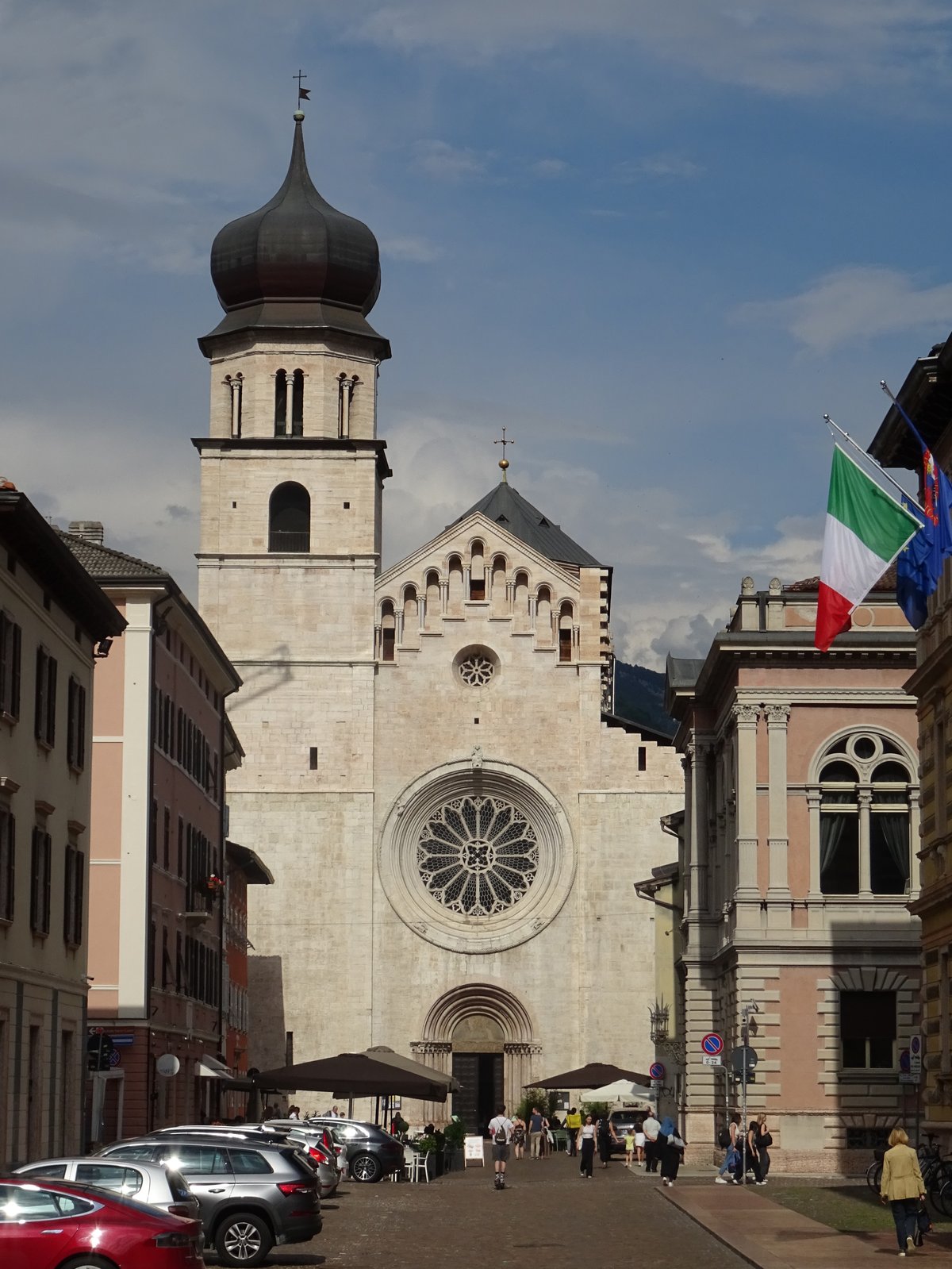
St. Vigilius Cathedral in Trento houses 16th-century Council frescoes and a crypt with early Christian remains. Discover the Romanesque facade, the Piazza Tower, and its role in Church history.
- Piazza Adamo d’Arogno, Trento (TN)
- Open in Google Maps
- View on Google Images Cattedrale di San Vigilio a Trento
Good to know
Introduction
When you arrive in Piazza Duomo, the Cathedral of San Vigilio immediately strikes you. It’s not just a church; it’s the beating heart of Trento, with that Romanesque facade that seems to tell centuries of history. I stopped to look at it and immediately felt that this place has a soul. Perhaps because this is where the Council of Trent took place, an event that changed the history of the Church. Or perhaps because, within its walls, you breathe a unique atmosphere of silence and light. The Cathedral dominates the square with a majestic presence, and you can’t help but go inside. Inside, the frescoes captivate you, and you find yourself walking slowly, almost without realizing it. It’s a place that makes you feel small in the face of history, yet also part of something greater. If you visit Trento, you can’t skip it. It’s as if the city itself is waiting for you here, ready to reveal its secrets.
Historical Overview
The history of the Cathedral begins in the 13th century, though the site had been sacred long before. It was built on the foundations of an early Christian basilica dedicated to Saint Vigilius, the patron saint of Trent. Then, in the 16th century, something epochal occurred: the Council of Trent. For nearly twenty years, bishops and theologians from across Europe gathered here, giving rise to what we now call the Counter-Reformation. The frescoes in the central nave vividly depict these events, with scenes that seem to leap from the pages of a history book. The Cathedral has endured fires, restorations, and transformations, yet it has always maintained its central role in the city’s life. Every stone tells a story of faith, power, and art, woven into a single, captivating narrative. Timeline summary:
- 13th century: construction begins on the Romanesque Cathedral
- 1545-1563: the Council of Trent takes place
- 18th century: significant Baroque interventions inside
- 20th century: restorations to restore the original forms
The Council Frescoes
Entering the central nave, you look up and are left breathless. The frescoes adorning the vaults are not just beautiful—they are a historical document. They depict scenes from the Council of Trent, with solemn figures debating, praying, and making decisions. I observed them for a long time, trying to imagine the atmosphere of those years. The colors are vivid, the details meticulous, and there’s a sense of movement that draws you into the story. These are not just any artworks: they are the visual memory of a crucial moment for the Catholic Church. Someone told me that, in some spots, traces of 19th-century restorations are still visible, but to me, everything seemed perfectly integrated. If you love art or history, these frescoes alone are worth the visit. They help you understand why Trento is not just a mountain city, but a crossroads of cultures and ideas.
The Crypt and Its Surprises
Descending into the Cathedral’s crypt is like traveling back in time. Here, beneath the main floor, lie the remains of the early Christian basilica and, according to tradition, the relics of Saint Vigilius. The space is intimate, almost cozy, with low arches and soft lighting that creates a suggestive atmosphere. I noticed interesting details, such as the carved capitals and ancient floorings, which tell distant stories. It’s not as spectacular as the nave above, but it has a different charm, more quiet and reflective. Some visitors rush through, but I recommend pausing for a moment, breathing in the cool air, and letting your imagination wander. Perhaps it’s here that one truly feels the connection to Trento’s origins, even before it became the city we know today.
Why Visit It
Visiting the Cathedral of San Vigilio is not just a tourist stop; it’s an enriching experience. First, for the Council frescoes, unique in their kind in Italy: you won’t find them so well-preserved and narrative elsewhere. Second, for the atmosphere: it’s a living place of worship where you can attend masses or simply enjoy a moment of quiet away from the city’s hustle. Third, for the location: it’s in Piazza Duomo, the heart of Trento, making it easy to combine the visit with a stroll through the historic center, perhaps stopping for a coffee at one of the nearby cafes. In short, it offers art, history, and spirituality all at once, without the need for expensive tickets or complicated bookings. I found it indispensable for truly understanding the soul of this city.
When to Go
The best time to visit the Cathedral? It depends on what you’re looking for. If you want to avoid the crowds, try early in the morning, when light filters through the stained glass and creates evocative shadow plays on the frescoes. In summer, the afternoon can be perfect for escaping the heat, as the interior remains cool and quiet. I’ve noticed that in autumn, with leaves falling in Piazza Duomo, the atmosphere becomes even more romantic. Avoid peak hours on weekends if you don’t like sharing the space with too many tourists. Personally, I prefer weekdays, when I can walk calmly and stop to observe every detail without rushing. In winter, with snow whitening the square, the spectacle is truly magical, but be mindful of early closing hours.
In the Surroundings
After visiting the Cathedral, don’t miss two nearby places that complete the experience. First, the Trento Diocesan Museum, right next to the Duomo: here you’ll find sacred artworks, manuscripts, and artifacts that delve into the history of the diocese and the Council. Second, take a quick trip to the Buonconsiglio Castle, just a few minutes’ walk away: it’s a monumental complex with towers, courtyards, and Renaissance frescoes that transport you to another era. Both places are easily reachable on foot from the city center and offer different insights into Trento, from art to court life. I visited them on the same day and felt like I had taken a comprehensive journey through the city, without needing to drive or waste time.
💡 Did You Know…?
Look closely at the rose window on the facade: it’s not just decorative. Its rays represent the spread of faith from the center, Trento, to the world. In the crypt, look for the column with the inscription “UGO”: it’s said to be the mark left by a medieval pilgrim. And if you hear a particular bell sound, it’s the concert of the bell tower, considered among the most beautiful in Trentino.