Introduction
Turin’s Duomo is not just the city’s cathedral, but also the keeper of one of Christianity’s most fascinating mysteries: the Holy Shroud. Strolling through Piazza San Giovanni, the white marble façade stands out elegantly, but the real surprise lies inside. The apse hides the Chapel of the Holy Shroud, a Baroque masterpiece by Guarino Guarini that seems suspended between heaven and earth. It’s a place that catches you in the throat, between faith and history.
Introduction
Turin’s Duomo is not just the city’s cathedral, but also the keeper of one of Christianity’s most fascinating mysteries: the Holy Shroud. Strolling through Piazza San Giovanni, the white marble façade stands out elegantly, but the real surprise lies inside. The apse hides the Chapel of the Holy Shroud, a Baroque masterpiece by Guarino Guarini that seems suspended between heaven and earth. It’s a place that catches you in the throat, between faith and history.
Historical Background
The cathedral stands on the foundations of three early Christian churches (4th century) dedicated to San Salvatore, Santa Maria, and San Giovanni Battista. In 1491, at the behest of Cardinal Domenico della Rovere, work began to a design by Amedeo da Settignano. The first stone was laid by Duchess Bianca of Monferrato, and the consecration took place in 1505. In 1578, the Shroud arrived in Turin, and in 1667 Guarini designed the chapel to house it. A fire in 1997 severely damaged the dome, which is currently under restoration.
Historical Background
The cathedral stands on the foundations of three early Christian churches (4th century) dedicated to San Salvatore, Santa Maria, and San Giovanni Battista. In 1491, at the behest of Cardinal Domenico della Rovere, work began to a design by Amedeo da Settignano. The first stone was laid by Duchess Bianca of Monferrato, and the consecration took place in 1505. In 1578, the Shroud arrived in Turin, and in 1667 Guarini designed the chapel to house it. A fire in 1997 severely damaged the dome, which is currently under restoration.
Architecture and the Chapel of the Holy Shroud
The exterior is a rare example of Piedmontese Renaissance, with a facade in white marble from Bussoleno and three portals sculpted by Meo del Caprino. The bell tower, called Sant’Andrea, dates back to 1468-1470 and was later crowned by Juvarra. But the true jewel is Guarini’s Chapel of the Holy Shroud: a circular space in black marble from Frabosa, with a ribbed dome that creates an ascending light effect. Destroyed by the fire of 1997, today it is being rebuilt with the same original materials.
Architecture and the Chapel of the Holy Shroud
The exterior is a rare example of Piedmontese Renaissance, with a facade in white marble from Bussoleno and three portals sculpted by Meo del Caprino. The bell tower, called Sant’Andrea, dates back to 1468-1470 and was later crowned by Juvarra. But the true jewel is Guarini’s Chapel of the Holy Shroud: a circular space in black marble from Frabosa, with a ribbed dome that creates an ascending light effect. Destroyed by the fire of 1997, today it is being rebuilt with the same original materials.
Art and Spirituality
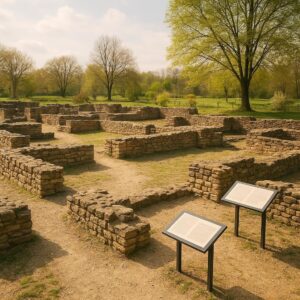
Inside, don’t miss the Polyptych of Saints Crispin and Crispinian by Spanzotti and Ferrari (1498-1504), a masterpiece with eighteen panels. On the counter-façade, a copy of Leonardo’s Last Supper donated by King Charles Albert. The Cappella del Crocifisso (Chapel of the Crucifix) is rich in wooden statues, while in the left transept, the Royal Tribune recalls the Savoy devotion. Beneath the church, the Diocesan Museum preserves the remains of three early Christian basilicas and medieval artifacts.
Art and Spirituality
Inside, don’t miss the Polyptych of Saints Crispin and Crispinian by Spanzotti and Ferrari (1498-1504), a masterpiece with eighteen panels. On the counter-façade, a copy of Leonardo’s Last Supper donated by King Charles Albert. The Cappella del Crocifisso (Chapel of the Crucifix) is rich in wooden statues, while in the left transept, the Royal Tribune recalls the Savoy devotion. Beneath the church, the Diocesan Museum preserves the remains of three early Christian basilicas and medieval artifacts.
Why visit it
Three practical reasons: first, to see the Shroud up close (even when not on display, the reliquary in the left nave is moving). Second, to discover the architecture of Guarini, one of the greatest exponents of Baroque, with his daring dome. Third, the Diocesan Museum lets you walk among the remains of 4th-century churches, a unique historical stratification.
Why visit it
Three practical reasons: first, to see the Shroud up close (even when not on display, the reliquary in the left nave is moving). Second, to discover the architecture of Guarini, one of the greatest exponents of Baroque, with his daring dome. Third, the Diocesan Museum lets you walk among the remains of 4th-century churches, a unique historical stratification.
When to go
The best time is early morning, right when it opens (at 7:00 AM), when light streams through the stained glass and silence fills the nave. In autumn or spring, the city is less crowded, and you can enjoy the square at a leisurely pace. Avoid the midday hours, when tour buses drop off large groups.
When to go
The best time is early morning, right when it opens (at 7:00 AM), when light streams through the stained glass and silence fills the nave. In autumn or spring, the city is less crowded, and you can enjoy the square at a leisurely pace. Avoid the midday hours, when tour buses drop off large groups.
Nearby
Just a few steps away, the Royal Palace (Royal Museums) offers a dive into Savoy history, with the apartments and the Armory. Also unmissable is the Diocesan Museum in the cathedral’s underground, where you can see the early Christian mosaics and the Lombard baptistery. Two stops that enrich your visit without straying from the center.
Nearby
Just a few steps away, the Royal Palace (Royal Museums) offers a dive into Savoy history, with the apartments and the Armory. Also unmissable is the Diocesan Museum in the cathedral’s underground, where you can see the early Christian mosaics and the Lombard baptistery. Two stops that enrich your visit without straying from the center.