Introduction
Just outside Cuglieri, amid the scents of the Mediterranean scrub, lies Cornus-Columbaris, an archaeological site that captivates with its historical layering and understated charm. Don’t expect majestic ruins: here the atmosphere is intimate, almost secluded. The remains of the ancient Punic-Roman city emerge among the olive trees, with the Paleochristian basilica dominating the plateau. The view stretches towards the sea of Santa Caterina, creating a perfect blend of history and landscape. It’s a place that speaks to those who know how to listen, where every stone tells centuries of dominations, trade, and daily life. The absence of tourist crowds makes the visit even more authentic, allowing you to fully immerse yourself in the atmosphere of the place.
Historical Overview
Cornus was founded by the Carthaginians as a strategic outpost, later becoming an important Roman center. During the
Amsicora revolt in 215 BC, it was the scene of crucial clashes between Sardinian-Punic forces and the Romans. In late antiquity, the Christian complex of Columbaris developed, with the basilica possibly dedicated to Saint Efisius. The surrounding necropolises attest to continuous habitation until the early Middle Ages. The city gradually declined, but its remains have been unearthed through excavation campaigns starting in the twentieth century.
- 6th-4th century BC: Punic foundation
- 215 BC: Amsicora revolt
- 4th-5th century AD: Construction of the early Christian basilica
- 8th-9th century: Progressive abandonment
The Paleochristian Basilica
The heart of Columbaris is the three-nave basilica, with a semicircular apse and an adjoining baptistery. The floor mosaics, although fragmentary, display geometric decorations and Christian symbols such as the chrismon. The building stands on Roman foundations, highlighting the continuity of the sacred. Nearby, the baptistery preserves the immersion font, a sign of an organized Christian community. The elevated position was not accidental: it dominated the valley and the road route towards Tharros. Today, the reused columns and capitals tell a story of intelligent material recycling, while the natural acoustics amplify the silence that envelops the place.
The Necropolises and the Funerary Area
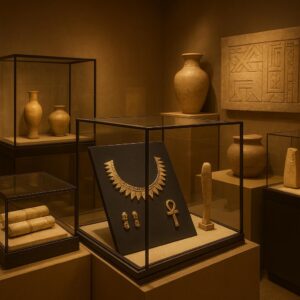
Surrounding the basilica stretch Punic and Roman necropolises, with pit tombs and chamber tombs carved into the rock. The Punic tombs often contained grave goods with Egyptian amulets and ceramics, while the Roman burials show greater standardization. The Christian necropolis, on the other hand, is characterized by “cappuccina” tombs and stone sarcophagi, some with Latin inscriptions. Walking among these burials offers a glimpse into the funerary beliefs and social composition of ancient Cornus. The contrast between the pagan and Christian tombs highlights the cultural evolution of the site, making the area a true open-air archaeology handbook.
Why Visit It
Three concrete reasons not to miss Cornus-Columbaris: first, the early Christian basilica is one of the best preserved in Sardinia, with original mosaics and a clearly legible structure; second, the site is rarely crowded, allowing for a peaceful and reflective visit; third, the panoramic location offers breathtaking views of the Cuglieri coastline and Montiferru. Additionally, the absence of entrance fees makes it accessible to everyone. It’s a unique opportunity to experience the island’s historical stratification firsthand, from the Punic period to the early Middle Ages, without having to deal with queues or mandatory routes.
When to Go
The best time to visit Cornus-Columbaris is late spring, when the Mediterranean scrub is in bloom and temperatures are mild. Avoid the midday hours during summer days, as the area is exposed to the sun and almost devoid of shade. An autumn afternoon can also offer evocative atmospheres, with the slanting light enhancing the volumes of the ruins. In winter, clear days provide exceptional visibility over the sea, but check the forecast: the mistral wind can make the stay uncomfortable. In any case, always bring water and a hat, as services are unavailable.
In the Surroundings
Complete your experience with a visit to the Sanctuary of Santa Maria della Neve in Cuglieri, which houses a Byzantine effigy of the Madonna. For archaeology enthusiasts, Tharros is less than an hour’s drive away and represents the coastal evolution of Punic-Roman settlements. If you prefer contact with nature, the cliffs of Capo Mannu are ideal for a walk overlooking the sea, with the possibility of spotting griffon vultures in flight. Both locations enrich the historical and landscape context of Cornus, showcasing different facets of the Oristano region’s richness.