The Teatro Comunale di Belluno, now named after Dino Buzzati, is a neoclassical gem designed by Giuseppe Segusini. Inaugurated in 1835, it has hosted works by Bellini, Verdi, and Rossini, and after its 1948 renovation boasts two spacious galleries and a capacity of 645 seats. Today it is managed by the Fondazione Teatri delle Dolomiti, offering a rich season of drama, music, dance, and theatre for young audiences.
– Fascinating History: from its origins as Teatro Sociale to 20th-century transformations.
– Neoclassical Architecture: façade with Corinthian columns, lions by Zandomeneghi, and statues by Cassetti.
– Varied Programming: plays, concerts, opera, dance, and family events.
– Central Location: in Piazza Vittorio Emanuele II, in the heart of Belluno.
Evocative Introduction
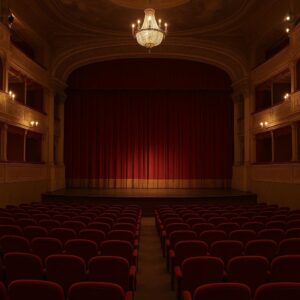
In the heart of Belluno, overlooking Piazza Vittorio Emanuele II, stands a theater that is over 180 years old and still the pulse of the city’s cultural life. It is the Teatro Dino Buzzati, until recently called the Comunale. Its neoclassical facade, with four imposing Corinthian columns and two stone lions flanking the staircase, welcomes you like a temple of art. Inside, the atmosphere is intimate: 647 seats between the stalls and two galleries, with powdery pink velvet and a large rosette chandelier. It is not just a performance venue; it is a piece of Belluno’s history that still breathes, hosting concerts, drama, and dance.
Historical Background
The history of the theater begins in 1832, when local nobles decided to build a new space for opera. The architect Giuseppe Segusini designed the neoclassical building, and on September 26, 1835, it was inaugurated with Norma by Vincenzo Bellini. Inside, 91 boxes on four tiers (later modified). During the world wars it was used as a warehouse. In 1948-1949 the interior was completely redone: the boxes gave way to two large balcony galleries. In 2005, management passed to the Fondazione Teatri delle Dolomiti. On November 7, 2023, it was officially named after Dino Buzzati, a writer from Belluno.
Architecture and Decorations
The façade is a gem: four Corinthian columns support a pediment, and a marble staircase leads you to the entrance. On either side, two stone lions by Pietro Zandomeneghi represent Poetry and Music. In the atrium, bas-reliefs of Orpheus and Eurydice. Above, four 18th-century statues (Hercules, Diana, Adonis, Omphale) attributed to Giacomo Cassetti. Entering, your gaze goes to the large circular chandelier and the Provincial coat of arms above the proscenium arch. The galleries are supported by Doric columns, and the parapets have friezes with Greek masks and musical instruments. Everything in ivory and powder pink. A theater that blends history and restoration with elegance.
A Program for Everyone
Today the theater is managed by the Fondazione Teatri delle Dolomiti and offers a rich season: drama, music, dance, circus, and even shows for young children like Opera Baby. The lineup includes classics and contemporary works: from Boomers by Marco Paolini to the Canadian Machine du Cirque. There’s also the Concerto di San Martino in November and the New Year’s Concert. The program changes every year, but the quality is always high. I went there for an opera, and the acoustics are amazing. If you’re passing through Belluno, check the schedule: you might find something unique.
Why Visit
Three reasons not to miss it. First: the architecture. It is one of the best examples of neoclassical theater in Veneto, with original details and a visible history. Second: the intimate atmosphere. With only 647 seats, every performance feels almost private. You feel part of the scene. Third: the programming. The Fondazione Teatri delle Dolomiti brings top artists, from Paolini to international companies. You don’t need to be an expert: there are events for families, for young people, for everyone. In short, if you are in Belluno, stepping inside is an enriching experience.
When to Go
The theater is alive all year round, but the most enchanting time is the theater season from October to May. In winter, with snow outside and the hall lit up, it’s magical. If you get the chance, the San Martino Concert (November 8) is a Belluno tradition not to be missed. But there are events in summer too. Personally, I prefer autumn evenings, when the city is quiet and the theater is a cultural refuge. Check the Fondazione’s website before you go.
Nearby
After the show, take a stroll in Piazza dei Martiri, just a few steps away. It’s Belluno’s living room, with its arcades and cafés. If you have time, visit the Civic Museum of Belluno in Palazzo Fulcis, a short walk away, to immerse yourself in the city’s history. Or head up to Belluno’s Cathedral, with its Renaissance architecture. Everything is close, everything is beautiful. A tip: stop for dinner at one of the city center’s taverns, perhaps after an opera.