
The Colossus of Saint Charles Borromeo in Arona, standing 23.5 meters tall, is one of Italy’s most imposing statues, crafted from hammered copper in the 17th century. Its unique feature is the opportunity to enter inside and ascend to the head via spiral staircases.
- 23.5-meter-tall copper statue built in the 17th century
- Internal access with climb to the head for panoramic views
- Views of Lake Maggiore, the Borromean Islands, and surrounding mountains
- Located at Sacromonte di Arona with a wooded park and walking trails
Events nearby
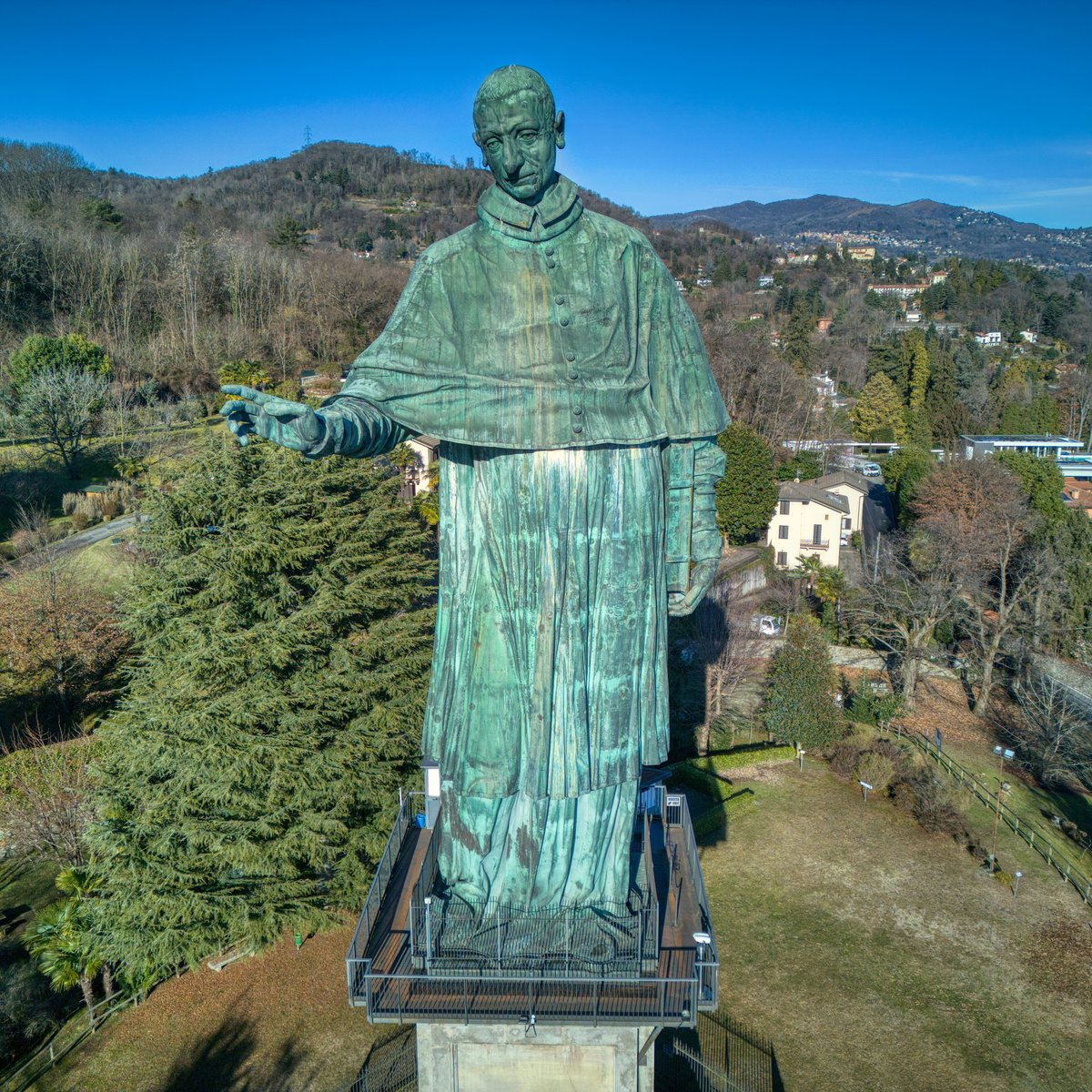
Step inside the Sancarlone statue in Arona and climb up to the head for panoramic views of Lake Maggiore and the Borromean Islands. This 17th-century statue is open to visitors, featuring a structure made of hammered copper.
Good to know
A Giant Dominating the Lake
Arriving in Arona, it’s impossible to miss it: the Colossus of San Carlo Borromeo stands out against the sky, 35 meters tall, dominating the panorama of Lake Maggiore. Known locally as ‘il Sancarlone’, this copper and bronze statue is not just a monument, but a visual landmark visible from kilometers away. Built in the 17th century based on a design by Giovan Battista Crespi, it depicts Saint Charles in a blessing pose, with a book in his left hand. What’s striking is its scale: you can enter inside and climb up to the head, from where you can enjoy a breathtaking view of the lake and surrounding mountains. For pilgrims, it’s a symbol of faith; for travelers, an unforgettable icon of the Novara territory.
History and Devotion
The statue was commissioned by Saint Charles’ cousin, Cardinal Federico Borromeo, to honor the memory of the saint, who was a native of Arona. Construction began in 1614 and was completed in 1698, under the guidance of artists such as Siro Zanella and Bernardo Falconi. Made with hammered copper plates over an iron framework, it was one of the first hollow statues in Europe that could be visited. Saint Charles Borromeo, Archbishop of Milan, is famous for his work during the plague and the Counter-Reformation; the Colossus quickly became a pilgrimage destination, attracting faithful from all over Lombardy and Piedmont. Today, it is a unique monument of its kind in Italy, an example of 17th-century engineering and popular devotion.
- 1614: Construction begins at the behest of Federico Borromeo
- 1698: Completion of the statue after decades of work
- Subsequent centuries: Becomes a religious and tourist symbol of Lake Maggiore
Entering the Giant
One of the most unique experiences is entering the Colossus and climbing the spiral staircase that leads up to the head. The ascent through narrow passages allows you to closely observe the internal iron structure and the joints of the copper plates. Once at the top, windows open in the statue’s eyes and ears, offering breathtaking views of Lake Maggiore, the Borromean Islands, and the Alpine arc. It’s a rare opportunity to see a work of art ‘from the inside’ and understand the craftsmanship of seventeenth-century artisans. Note: The staircase is steep and not recommended for those who suffer from claustrophobia, but for others, it’s an adventure well worth taking.
The Park and Its Setting
The Colossus is not isolated: it stands within the Sacromonte di Arona, a hilly area with a wooded park and trails that invite leisurely walks. Here you can also find the remains of the church dedicated to Saint Charles, destroyed during the Napoleonic era, and a side chapel. The natural setting makes the visit enjoyable in every season, with shade in summer and vibrant colors in autumn. For photography enthusiasts, the best spots to capture the statue are from the lakeside promenade or from boats departing for the Borromean Islands. The perfect blend of art and nature makes it ideal for a rejuvenating day trip.
Why Visit It
Three concrete reasons not to miss the Colossus: first, it’s a statue unique in Italy for its size and internal accessibility, offering a rare interactive experience. Second, the view from the head is among the most beautiful on Lake Maggiore, with glimpses of the Borromean Islands and the Prealps. Third, it combines history, art, and spirituality in one place, suitable for the curious, architecture enthusiasts, and pilgrims. Plus, the entrance ticket is affordable, and its proximity to the center of Arona allows you to combine the visit with a stroll through the village.
When to Go
The most enchanting moment is at sunset, when the golden light bathes the statue and the lake, creating magical atmospheres. In spring and autumn, clear days offer optimal visibility of the mountains, while in summer the lake breeze makes the ascent more pleasant. Avoid the midday summer hours if you’re sensitive to heat, but overall it’s a place that works well in any season, as long as the skies are clear.
In the Surroundings
Complete your day with a visit to Arona’s historic center, with its alleys, the Collegiate Church, and typical local spots. Nearby, embark for the Borromean Islands, such as Isola Bella with its Baroque palace and gardens, reachable with a short boat ride from Arona’s pier.
Itineraries nearby


💡 Did You Know…?
The statue was designed by Giovan Battista Crespi, known as Il Cerano, but its construction was completed by Bernardo Falconi and Siro Zanella after his death. A little-known detail: the internal iron and masonry structure was so well conceived that it has remained intact for over 300 years, surviving storms and harsh weather. Local tradition tells that Lake Maggiore fishermen considered Sancarlone a safe reference point during storms.