
Fragsburg – Castel Verruca is a freely accessible historical site that combines medieval ruins with breathtaking alpine scenery. Its cliffside position overlooking the Passirio Valley offers an immersive historical experience set in nature.
- 13th-century medieval ruins with perimeter walls and main tower
- 360-degree panoramic view of the Passirio Valley and Merano
- Medium-difficulty hiking trail starting from Merano
- Tranquil and secluded atmosphere away from crowds
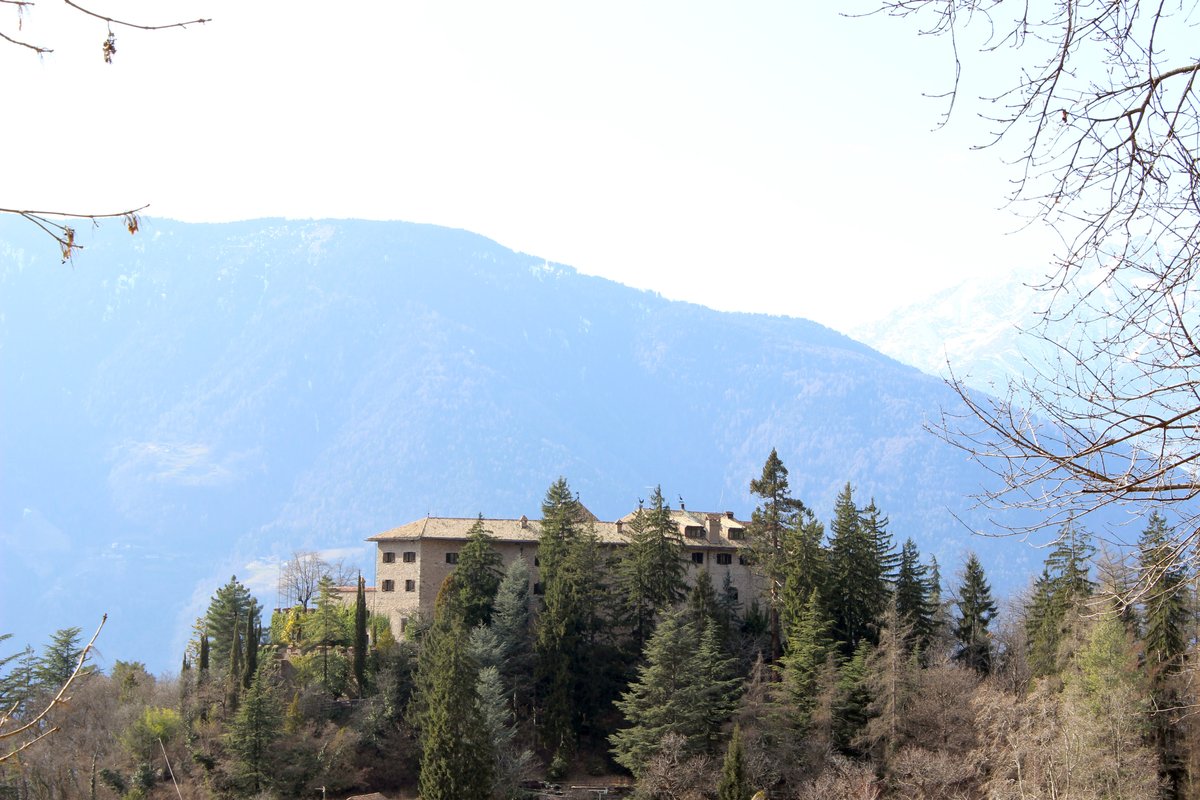
13th-century ruins perched on a rocky spur above Merano, accessible via a hiking trail. 360-degree panorama of the Passirio Valley and surrounding mountains.
- Fragsburgerstraße – Via Castel Verruca, Bolzano (BZ)
- Open in Google Maps
- View on Google Images Fragsburg – Castel Verruca a Bolzano
Good to know
Introduction
Perched on a rocky spur overlooking the Passirio stream, Fragsburg – Castel Verruca is a place that captures both the eye and the imagination. Its medieval ruins, enveloped by vegetation, seem to emerge from the mountain itself, offering a spectacular view of the valley below and the city of Merano. It is not just a castle, but a natural balcony on the history of South Tyrol, perfect for those seeking a peaceful corner away from the crowds, where time seems to have stood still. The feeling you experience upon arriving here is unique: a blend of ancient charm and total immersion in a breathtaking alpine landscape.
Historical Background
The origins of Castel Verruca date back to the 13th century, when it was built as a strategic outpost to control the Passirio Valley and communication routes towards Merano. It belonged to various local noble families, including the Fuchs von Fuchsberg, from which the name ‘Fragsburg’ is believed to derive. Over the centuries, it lost military importance and fell into ruin, becoming a evocative testament to the region’s medieval past. Today, what remains are mainly the perimeter walls and the tower, which stoically withstand the elements, silently recounting centuries of history.
- 13th century: Construction of the castle as a strategic fortification.
- Subsequent centuries: Ownership by various South Tyrolean noble families.
- Decline: Progressive abandonment and transformation into ruins.
- Today: A freely accessible historical site and destination for hikers.
The Trail and the Arrival
Reaching the ruins is an integral part of the experience. Starting from Merano, you follow a well-marked hiking trail that climbs through forests of conifers and larches. The path, of moderate difficulty, offers increasingly expansive views of the city and the valley. Arriving at the castle is a surprise: after one last bend, the grey stone walls suddenly appear, dominated by the main tower that soars towards the sky. Here, the silence is broken only by the wind and the distant rush of the Passirio River. It’s worth carefully exploring the remains, imagining the life that once pulsed within these walls.
The 360-Degree Panorama
The true treasure of Fragsburg is the panoramic view. From the ruins, the gaze spans 360 degrees over a natural amphitheater of rare beauty. To the north, you can admire the profile of the mountains surrounding Merano; to the south, the Passirio Valley winds toward the horizon. On clear days, the view stretches far, offering a sense of absolute freedom. It’s the ideal spot for a contemplative break, to take unforgettable photos, or simply to enjoy the sun illuminating the ancient stones. This privileged vantage point perfectly explains why, centuries ago, this very spur was chosen to build the fortress.
Why Visit It
Visiting Fragsburg – Castel Verruca is worthwhile for three concrete reasons. First, for the unique combination of history and nature: it’s not a closed museum, but an open site where the ruin merges with the alpine landscape. Second, for the absolute tranquility: compared to other more crowded attractions in Merano, here you breathe a secluded and silent atmosphere, ideal for disconnecting from the frenzy. Third, for the rewarding panorama: the effort of the climb is amply repaid by the breathtaking view, which alone justifies the excursion.
When to Go
The most enchanting time for a visit is undoubtedly the early afternoon on a late spring or early autumn day. During these seasons, the light is warm and low-angled, enhancing the colors of the stones and the woods, and the climate is ideal for hiking without the intense summer heat. Arriving around that time allows you to fully enjoy the illuminated view and find the site relatively quiet. In winter, the trail may be icy or snowy, requiring appropriate equipment.
In the Surroundings
To complete the medieval and naturalistic experience, nearby you can combine two thematic visits. In Merano, Castel Tirolo, the provincial museum that delves into the history and culture of South Tyrol, offers a perfect, more structured historical counterpart. For those wishing to extend their contact with nature, a stroll along the Sissi Path in Merano, a thematic trail dedicated to Empress Elisabeth who loved these areas, provides elegant glimpses of the gardens and the Passirio River.
💡 Did You Know…?
The castle, built in the 13th century, owes its name “Verruca” (wart in Latin) to its rocky shape. It was destroyed in the 15th century during wars between Tyrol and Bavaria and never rebuilt. Today, among the ruins, you can still see the remains of the chapel and defensive walls. Local legend has it that the ghost of a knight still protects the treasure hidden among the stones, adding a touch of mystery to the visit.