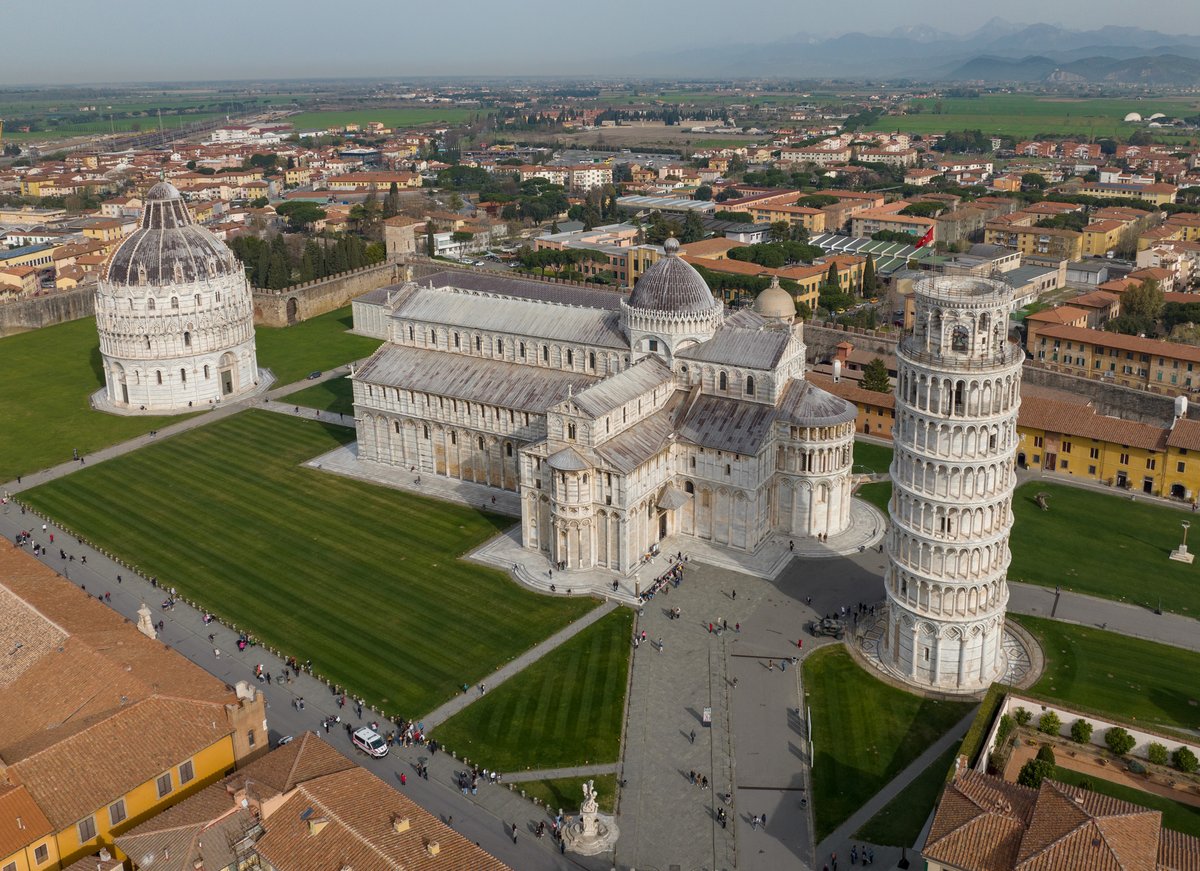
Cathedral Square, known as Piazza dei Miracoli, is a UNESCO World Heritage site featuring Pisan Romanesque monuments. Access to the Leaning Tower requires a timed-entry ticket, while combinations are available for the Cathedral, Baptistery and Cemetery. Booking online in advance helps avoid queues, especially during peak season.
- Leaning Tower: World icon with visible tilt when seen in person
- Pisa Cathedral: White and black striped facade with Giovanni Pisano’s pulpit
- Baptistery: Perfect acoustics under the dome and view from the top
- Monumental Cemetery: Fourteenth-century frescoes and historic cloister
Introduction
The first time you see Piazza del Duomo in Pisa, it takes your breath away. It’s not just the Leaning Tower, which is obviously the most famous sight, but the ensemble of all those white monuments standing out against the green grass. They call it the Square of Miracles, and it’s no exaggeration: it seems almost unreal, like a movie set that’s too perfect. Walking across that vast lawn, with the Cathedral, the Baptistery, and the Camposanto surrounding you, makes you feel both small and fortunate at the same time. It’s a place that has the power to stop time, even if just for a moment. Personally, I still remember the feeling of wonder mixed with disbelief: it really is just like in the photos, but experiencing it is a whole different story. The atmosphere is solemn but not heavy, and there’s always a murmur of voices from every corner of the world.
Historical Overview
This square didn’t come about by chance. Construction began in the 11th century, when Pisa was an immensely wealthy maritime power and wanted to show it off to everyone. The Cathedral was the first building, consecrated in 1118, followed by the Baptistery and the Tower, which began to lean almost immediately due to the soft ground. Fun fact: the Monumental Cemetery was built to house holy soil brought back from the Holy Land after the Crusades. Every building here tells a piece of history, not just religious but also of power and art. The square has been a UNESCO World Heritage Site since 1987, but its fame is millennia old.
The Tower, saved by an engineering intervention in the 1990s, is a miracle of tenacity. Sometimes I wonder how many doubts the builders must have had when they saw it leaning… but today, that’s precisely its charm. Simplified timeline:
- 1063: Construction of the Cathedral begins
- 1118: Consecration of the Cathedral
- 1173: Construction of the Tower begins (and its leaning starts)
- 1278: Completion of the Cemetery
- 1987: UNESCO designation
- 1990-2001: Tower stabilization works
Beyond the Tower: The Surprising Details
Everyone rushes toward the Tower, but if you pause to observe, you’ll discover details that make this place unique. On the Cathedral portal, look for the bronze panels by Bonanno Pisano: they tell biblical stories with a dramatic intensity that captivates you. Inside, Giovanni Pisano’s pulpit is a masterpiece of movement and expression, often overlooked because it’s in dim light. In the Baptistery, don’t just look up: the baptismal font is a single block of marble, and the echo under the dome is something magical. Then there’s the Camposanto, with its frescoes damaged by war but still capable of moving you. I have a soft spot for the ‘Triumph of Death’, a fourteenth-century fresco that sends shivers with its visionary power. These details make the difference between a quick photo and a visit that stays with you.
The Lawn as a Stage
That perfect grassy expanse isn’t just a backdrop: it’s an integral part of the experience. People sit, have picnics, read, observe. It’s a living space, not a museum display case. From here, you can admire the harmonious proportions of the buildings, which from a distance reveal all their elegance. In spring, the grass is a brilliant green that contrasts with the white marble; in summer, in the evening, it becomes a cool gathering spot. I’ve seen couples lying down to watch the stars, children running, artists sketching watercolors. This lawn softens the solemnity of the place, makes it accessible. A tip: take some time to sit and watch how the light changes on the monuments. It’s a simple luxury you can afford in Pisa.
Why Visit It
First: it’s one of those iconic places that exceeds every expectation. Seeing the Tower in person, with its actual tilt, is an experience no photo can match. Second: the concentration of masterpieces in such a compact space is rare. In just a few hours, you can traverse centuries of art and history, from Pisan Romanesque to Gothic, without moving around. Third: despite its worldwide fame, the square maintains an intimate atmosphere. It’s not chaotic like other super-touristy destinations, especially if you avoid peak hours. And let’s face it, climbing the Tower (with prior booking!) gives you a unique perspective on the city and the red roofs of Tuscany. It’s one of those once-in-a-lifetime experiences that stays with you.
When to Go
The most enchanting time? The hour before sunset, especially in late spring or early autumn. The light is warm, golden, and the monuments glow with reddish reflections. The crowds begin to thin, the air grows cooler, and the atmosphere becomes almost intimate. In summer, definitely avoid midday: it’s hot, crowded, and you risk enjoying everything less. In winter, clear mornings have a crystalline light that enhances the white of the marble, but bring a jacket because the wind can be biting. I have a beautiful memory of a visit in November, with dry leaves fluttering on the lawn and an unreal quiet. It’s a place that changes face with the seasons, and every moment has its reason.
In the Surroundings
Leaving the square, immerse yourself in the real Pisa. Just a stone’s throw away is Borgo Stretto, a medieval street with arcades and historic shops, perfect for a stroll and a coffee. A little further, along the Arno, the Lungarni offer a romantic view with colorful palaces reflected in the water. If you’re looking for something unusual, seek out the small Church of Santa Maria della Spina, a Gothic gem on the riverbank, so intricate it looks like marble lace. It’s an interesting contrast to the solemnity of the Duomo. And if you enjoy greenery, the Giardini di Scotto, a former fortress, is a tranquil oasis just a few minutes’ walk away.