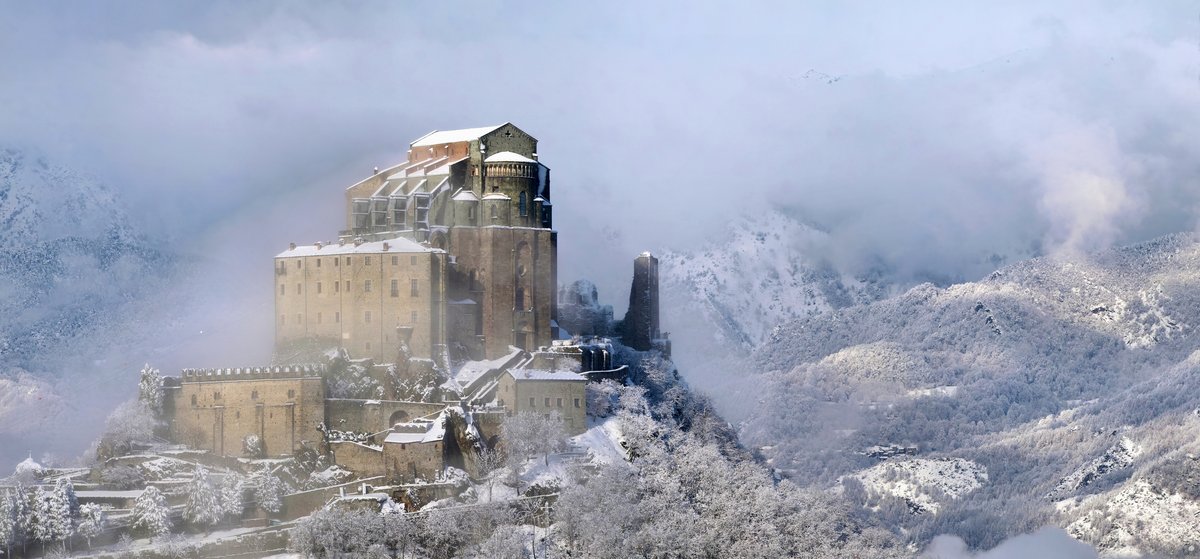
The Sacra di San Michele is a millennial abbey that dominates the Susa Valley from Mount Pirchiriano at 962 meters above sea level. It represents the symbolic monument of Piedmont and is depicted on the license plates of the Turin province. The structure combines history, spirituality, and breathtaking panoramas in a mystical atmosphere suspended between sky and earth.
- Staircase of the Dead: A path carved into the rock with ancient tombs leading to the Zodiac Portal, a Romanesque masterpiece
- Tower of Bell’Alda: A panoramic viewpoint with spectacular views over the Susa Valley and the Cottian Alps
- Austere interiors: Church with 14th-century frescoes, remains of the House of Savoy, and an atmosphere of contemplative silence
- Millennial history: A spiritual center along the Via Francigena with legends such as that of Bell’Alda and the Line of Saint Michael
Introduction
The first time you see the Sacra di San Michele, it takes your breath away. It’s not just an abbey, it’s a colossus of stone clinging to Mount Pirchiriano, dominating the Susa Valley with an almost menacing air. Getting there means tackling a challenging climb, but when you turn around and see that view stretching from the Alps to the plain, you understand why the monks chose this rocky spur. The atmosphere is mystical, suspended between sky and earth. Personally, I paused for a moment on the Stairway of the Dead, with those tombs carved into the rock, and felt a shiver. This is not a place to visit casually: it demands attention, almost respect.
Historical Background
Its history begins around the year 1000, although legends trace it back to a vision of the Archangel Michael. For centuries, it was a fundamental
spiritual and power center along the Via Francigena, controlled first by the Benedictines and later by the Rosminians. It has hosted pilgrims, nobles, and even some conflicts, such as when it was partially destroyed in 1379. Today, it is a symbolic monument of Piedmont and, although no longer an active monastery, retains a palpable aura of sacredness. The timeline helps understand its transformations:
- 983-987: First evidence of a religious settlement on the mountain.
- 11th-12th centuries: Construction of the church and abbey in Romanesque-Gothic style.
- 1379: Partial destruction during the struggles between the Marquises of Monferrato and the Savoys.
- 1836: Entrusted to the Rosminian Fathers, who restored and preserved it.
- 1994: Recognized as a symbolic monument of Piedmont.
Stairway of the Dead and Tower of Bell’Alda
Two elements that tell dramatic stories. The Stairway of the Dead climbs steeply toward the church, flanked by ancient tombs carved into the rock. It’s named so because monks were once buried there, and climbing it today, with those empty spaces watching you, is an intense, almost claustrophobic experience. At the top, the view rewards every effort. Then there’s the Tower of Bell’Alda, tied to a tragic legend: it’s said that a young woman, to escape soldiers, threw herself from the tower and died, but then miraculously appeared alive days later, only to truly die in a second leap to prove the miracle. The tower is now truncated, but the story still lingers. I was there with a bit of fog, and the atmosphere was perfect for imagining the tale.
Interiors: Between Silence and Grandeur
Entering the church is like crossing a threshold in time. The interior is bare, austere, illuminated by few windows that create evocative plays of light. There are no flamboyant frescoes, only stone and silence. The massive columns support cross vaults, and the main altar, simple in design, invites contemplation. In the crypt, which is older, the atmosphere feels even more intimate. I noticed details like the capitals carved with vegetal and animal motifs, small elements that speak of the skill of medieval artisans. Sometimes footsteps echo, but mostly a profound quiet reigns, interrupted only by the wind whistling through the cracks. This is not a place for those seeking Baroque decorations, but for those who appreciate an essentiality that speaks for itself.
Why Visit It
Three concrete reasons: first, the breathtaking view over the Susa Valley, which alone is worth the trip, especially on clear days when you can see the snow-capped Alps. Second, the architecture: it’s a rare example of a perched Romanesque-Gothic complex, with elements like the Zodiac Door that are sculptural masterpieces. Third, the atmosphere: it’s not just a monument, but a place that conveys a sense of peace and mystery, ideal for a reflective break away from the hustle and bustle. Plus, it’s a living piece of Piedmont’s history, linked to pilgrimages and legends that make it unique.
When to Go
I would avoid the midday hours during summer days, when the sun beats down hard on the ascent and the air can be muggy. Instead, early morning or late afternoon are magical times: the light is softer, the valley colors come alive, and you’ll encounter fewer visitors. In autumn, with the leaves changing color, the spectacle becomes even more enchanting, though it can be cool. In winter, if there’s no ice, the snow makes the landscape fairy-tale-like, but always check the weather conditions because the wind at higher altitudes can be biting. I visited in October, with a light haze, and the atmosphere was perfect for savoring the silence.
In the Surroundings
To complete the experience, head down to Sant’Ambrogio di Torino, the village at the foot of the mountain, where you can stop for a coffee or sample local products at one of the typical trattorias. Not far away, there’s the Certosa di Montebenedetto in Villar Focchiardo, another ancient monastery nestled in the woods, perfect for a nature walk and offering a more intimate atmosphere. Both places allow you to delve into the valley’s religious and rural history without straying too far from the visit’s theme.