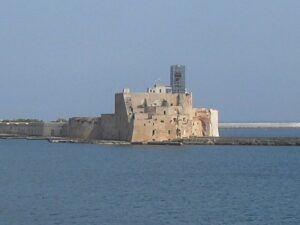
The Swabian Castle of Bari, founded by the Normans and rebuilt by Frederick II of Swabia in 1233, dominates the seafront with massive walls and a moat. Today, it is a vibrant cultural hub hosting temporary exhibitions and the Gipsoteca, a collection of plaster casts of Apulian sculptures. Its strategic location immediately immerses you in the alleys of Bari Vecchia after your visit.
- Living History: admire the mixed Norman, Swabian, and Angevin architecture in a building transformed over the centuries from fortress to prison to cultural center.
- Atmospheric Halls: explore the Angevin Hall with its vaulted ceiling, the Bona Sforza Hall, and the underground areas with historical inscriptions on the walls.
- Unique Views: climb the Semaphore Tower for a view of the Adriatic Sea and the rooftops of Bari Vecchia, especially evocative at sunset.
- Strategic Location: just steps from the Basilica of Saint Nicholas, the seafront, and the alleys where fresh handmade orecchiette are prepared.
Introduction
The Swabian Castle of Bari welcomes you like a stone giant in the heart of the old city, overlooking the Adriatic Sea. It’s not just a fortress, but a true symbol dominating the seafront panorama. Its grandeur strikes you immediately, with those massive walls that seem to tell centuries of history. Upon entering, you breathe a particular atmosphere, a mix of majesty and mystery. Personally, I’ve always been fascinated by how this castle has managed to survive so many transformations, becoming today a vibrant cultural hub. It’s not a static museum, but a place that continues to pulse, hosting exhibitions and events. The view from its towers over the sea and the rooftops of Old Bari is something you don’t easily forget.
Historical Background
The history of the Swabian Castle reads like a true novel. Founded by the Normans in the 12th century, it owes its name to Frederick II of Swabia, who rebuilt it in 1233 after its destruction.
Frederick II transformed it into a fortified residence, adding elements such as the Semaphore Tower. Over the following centuries, it served various purposes: an Angevin fortress, a prison under Aragonese rule, and even a barracks. In the 20th century, it was restored and now houses the Gipsoteca, a collection of plaster casts of Apulian sculptures. The timeline summary:
- 1131: Norman foundation
- 1233: reconstruction under Frederick II
- 16th century: conversion into a prison
- 1937: restoration and establishment as a cultural center
The Rooms That Tell Stories
Visiting the castle means getting lost among rooms that have different stories to reveal. The Angevin Hall, with its vaulted ceiling, is perhaps the most evocative, and often hosts temporary exhibitions of contemporary art – a contrast that works well. Then there’s the Bona Sforza Hall, dedicated to the duchess who lived here in the sixteenth century. But what struck me most are the underground areas, where you can almost breathe a mysterious air. They are not always accessible, but when they are, they are worth exploring. Pay attention to the details: look closely at the carvings on the walls, some date back to the period when the castle was a prison. It’s a bit like reading a secret diary on stone.
The Courtyard and the Towers
The inner courtyard is an open space that offers a moment of respite after the halls. Here, you can admire the castle’s mixed architecture, where Norman, Swabian, and Angevin elements blend together. But the real spectacle is climbing the towers. The ascent can be a bit steep, but the view rewards every effort. From the Semaphore Tower, commissioned by Frederick II, your gaze sweeps over the Adriatic Sea and the alleys of Bari Vecchia. In the evening, as the lights come on, it’s magical. A tip? Bring a camera, because the views are incredible. Sometimes I wonder what it must have been like to live here centuries ago, with that panorama all to oneself.
Why Visit It
Visiting the Swabian Castle of Bari is worthwhile for at least three concrete reasons. First, it’s a journey into Apulian history without needing books, with Frederick II seeming still present within the walls. Second, the temporary exhibitions are often high-quality and change regularly, always offering something new. Third, the location is strategic: after your visit, you’re already in the heart of Bari Vecchia, ready to explore the alleyways and taste the orecchiette. Plus, it’s a family-friendly place, with spacious areas where children can run around a bit. In short, it’s not just for history enthusiasts, but for anyone wanting to understand the soul of Bari.
When to Go
The best time to visit the castle? I prefer the late afternoon hours, when the warm sunlight caresses the stones and the sea glitters in the distance. In summer, avoid the hottest hours because it can get stuffy inside, although the thick walls offer some relief. In spring and autumn, on the other hand, it’s perfect at any time, with fewer crowds and a more peaceful atmosphere. In the evening, during cultural events, the castle comes alive with a special energy. If you want to avoid queues, weekdays are generally quieter. But honestly, even with a bit of a crowd, the place retains its charm.
In the Surroundings
After the castle, the fun continues in the surrounding area. Just a stone’s throw away is the Basilica of St. Nicholas, a Romanesque masterpiece of Apulia that houses the relics of the patron saint of children—the atmosphere is truly evocative. Then, for an authentic culinary experience, lose yourself in the alleys of Bari Vecchia, where grandmothers prepare fresh orecchiette pasta right outside their front doors. If you’re in the mood for the sea, a stroll along the Nazario Sauro waterfront offers beautiful glimpses of the coastline. And don’t forget the Teatro Margherita, not far away, often hosting interesting exhibitions. In short, the castle is just the beginning of a day full of discoveries.