The Villa of the Papyri in Herculaneum is one of the most sumptuous Roman villas buried by the eruption of 79 AD, known for its exceptional library of over 1,800 carbonized papyrus scrolls. Although currently closed for restoration, its artifacts are displayed at the National Archaeological Museum of Naples, and a faithful virtual reconstruction can be visited at the MAV. The villa, 250 meters long and structured on terraces, offers an extraordinary glimpse into the luxury and culture of the Roman elite.
– Only intact library from the ancient world, with Epicurean texts deciphered using AI.
– Luxurious architecture: atrium, peristyle with 64 columns, 66-meter pool, and sea-view terraces.
– Over 80 bronze and marble sculptures, including the Drunken Satyr, Hermes, and the Runners.
– The Paul Getty Museum in Malibu is a faithful reproduction of the villa.
Introduction
There’s a place in Herculaneum you can’t visit, but which is perhaps the most fascinating of all. The Villa of the Papyri is still there, buried under 30 meters of volcanic material, guardian of the only intact library from the ancient world. Today it is closed for restoration, but its treasures – statues, carbonized papyri, frescoes – can be admired at the MANN in Naples or in virtual form at the MAV. A place that lives in your imagination, between myth and reality.
Historical Background
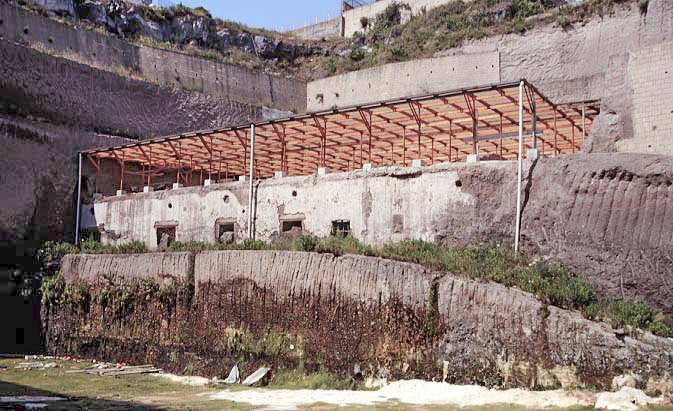
Built between 60 and 50 BC, the villa likely belonged to Lucius Calpurnius Piso Caesoninus, father-in-law of Julius Caesar and patron of the philosopher Philodemus of Gadara. Damaged by the earthquake of 62 AD, it was never restored: the eruption of Vesuvius in 79 AD buried it under mud and lapilli. Rediscovered in 1750 by Bourbon excavators, it was explored through tunnels by Karl Weber, who produced a detailed plan in 1754. In the 1990s, open-air excavations resumed, bringing to light the atrium and the seaside pavilion.
- 60-50 BC: construction of the villa
- 62 AD: damaged by the earthquake
- 79 AD: buried by the eruption of Vesuvius
- 1750: accidentally rediscovered during the construction of a well
- 1754: Karl Weber creates the first floor plan
- 1764: interruption of the Bourbon excavations
- 1996-1998: excavations of the atrium and the eastern quarter
- 2007: excavation of the seaside pavilion
The Only Intact Library
The true treasure of the villa is the over 1,800 papyrus scrolls found there, the only ancient book collection to have survived to this day. Carbonized by the eruption, they were initially mistaken for charcoal and many were destroyed. Today the papyri are kept at the National Library of Naples, and thanks to modern techniques – X-rays, CT scans, and artificial intelligence – it is now possible to read the texts without unrolling them. The “Vesuvius Challenge” has already deciphered over 2,000 Greek characters. These are mostly Epicurean writings by Philodemus, but there is hope of finding Latin texts as well.
Architecture and Artifacts: A Dream Villa
250 meters long and developed over four floors of terraces overlooking the sea, the villa was a masterpiece. The entrance was preceded by a portico with columns, the atrium housed eleven fountain statuettes, and the peristyle – 100 meters by 37 – had 64 columns and a central pool. Here, over 80 statues were found, in marble and bronze, including the Drunken Satyr, the Hermes at Rest, the Runners, and busts of philosophers like Epicurus and Seneca. Today these works are at the MANN in Naples, while a faithful reproduction of the villa is at the Getty Museum in Malibu.
Why Visit (Even If Closed)
Even though the Villa of the Papyri is closed, it deserves a spot on your itinerary for three reasons: first, at the MAV of Herculaneum you can experience an immersive virtual reconstruction of the villa, with interiors and exteriors recreated in 3D. Second, at the MANN in Naples you’ll see original statues and papyri up close, with a tour that reveals the luxury of the ancient Roman elite. Third, Herculaneum itself is an extraordinary site, with perfectly preserved houses and shops. You don’t need to enter the villa to feel its presence: just walk above it.
When to Go
The best time? Early morning, when the Herculaneum excavations are still quiet. The air is cool, the light soft, and you can imagine the villa as it must have looked at dawn. If you go to the MANN, avoid weekends: it’s busier. For the MAV, any time is fine, but if you can, choose a weekday. In general, spring and fall are the ideal seasons to visit the area, with mild temperatures and fewer tourists.
In the Area
After exploring Herculaneum, two stops are a must. In Naples, the National Archaeological Museum (MANN) houses the extraordinary collection of artifacts from the villa, including the Drunken Satyr and the papyri. In Herculaneum itself, the MAV – Virtual Archaeological Museum lets you relive the Villa of the Papyri in 3D: an immersive experience that compensates for the impossibility of visiting the original. Alternatively, a trip to Mount Vesuvius offers a breathtaking view of the Bay of Naples and completes the geological picture of the area.