Evocative Introduction
Perched on the hill of Girgenti, the Cathedral of San Gerlando welcomes you with an imposing staircase and a view that stretches to the sea. The mix of styles immediately strikes you: Norman, Gothic, Renaissance, and Baroque follow one another in every corner. But the real surprise is inside: a whisper at the entrance is heard clearly in the apse, 85 meters away. An acoustic phenomenon that leaves you breathless. It is not just a church; it is a journey through the history of Agrigento, among layers of eras and legends like that of Brandimarte. Get ready to discover a place that has witnessed centuries of faith and art.
Historical Background
Construction began before 1100 at the behest of Gerlando of Besançon, the first Norman bishop after the reconquest, and was initially dedicated to the Assumption of Mary. Earthquakes and landslides damaged it multiple times: a collapse in 1198, a landslide in 1244, and a threat in 1966 that led to its closure. It wasn’t until 2019, after restoration, that it fully reopened. Today it is a national monument and minor basilica. Here are the key moments:
- 1087 Norman conquest of Agrigento
- 1096-1102 Construction in Arab-Norman style
- 1198 Collapse and reconstruction
- 1315 Dedication to San Gerlando
- 15th century Unfinished bell tower
- 1966 Landslide threatens the structure
- 2014-2019 Partial and full reopening
Architecture and Styles Compared
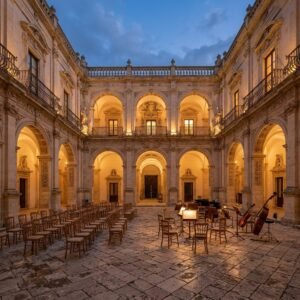
As you enter, you are immediately struck by a wooden coffered ceiling decorated with Renaissance motifs and 16th-century painted trusses. The floor plan is a Latin cross, with three naves divided by pointed arches on octagonal pillars – a clear Norman influence. But your gaze is drawn to the 15th-century bell tower, left unfinished, with its blind lancet windows with Arabic arches and a Gothic balcony. The facade, remodeled in the Baroque period, features a Gothic-Catalan portal that stands out against the sober lines of the tuff stone. Inside, the transept houses a dome with trompe-l’œil frescoes, while the apse bursts with Baroque stuccoes featuring putti and garlands. Every corner tells a different era, and you feel as if you are in an art history book.
Artistic Treasures and Relics
In the right nave, the Chapel of San Gerlando holds the remains of the patron saint in a silver urn crafted by Michele Ricca in 1639. Further along, admire the marble statue of the Madonna and Child by Stefano di Martino (1495), which seems to gaze at you with tenderness. Don’t miss the four Roman and Greek sarcophagi in the north nave, featuring mythological scenes. And then there’s the Mascioni organ from 1933, still functional and used for concerts. Each work has a story: like the so-called ‘Tomb of Brandimarte,’ which is actually the embalmed body of San Felice Martire. For details, the diocesan museum (MUDIA) next door offers a journey through these masterpieces.
Why Visit It
1. Magical Acoustics: the ‘whispering gallery’ phenomenon is unique – try whispering at the entrance and you’ll hear the echo in the apse, but not the other way around. A sensory experience that makes you feel part of history. 2. An Open-Air Museum: among overlapping styles, ancient sarcophagi, and Baroque paintings, each visit reveals a new detail. 3. Breathtaking View: from the nearby belvedere, the Valley of the Temples and the sea stretch out before you. A sight that makes the climb worth it. And if you want, you can also attend an organ concert.
When to Go
The best time is late afternoon, when the golden light of sunset filters through the arches and illuminates the wooden ceiling. In spring or autumn, you’ll avoid the midday heat and summer crowds. If possible, choose a weekday: early morning the cathedral is almost empty and the acoustics are better. On Sundays there is 8pm mass, an opportunity to experience the place like locals. Avoid the central hours in summer when the heat is oppressive.
Nearby
As you descend the staircase, you find yourself in the heart of Agrigento’s historic center. A few steps away is the Church of Santa Maria dei Greci, built on the ruins of a Greek temple, with columns still visible. Don’t miss the Valley of the Temples, a UNESCO World Heritage site: the sunset seen from the cathedral’s belvedere is a preview of the spectacle awaiting you among the Doric temples. If you have time, stop at a typical trattoria to taste pasta with sardines or cassata.