
Discover the historic fountains of Messina with a one-day walking itinerary among seven medieval and baroque masterpieces. Starting from Piazza del Duomo, you’ll admire the Fontana di Orione (1553) and the Fontana del Nettuno, then continue to the 15th-century Fontana Falconieri and others hidden in the downtown avenues. This route is about 3 km, flat, and suitable for everyone: families, couples, and solo travelers. Along the way, you’ll find charming corners, historic buildings, and lively squares like Piazza Cairoli and Piazza Unione Europea. Don’t miss the Fontana di Gennaro and the monumental Fontana del Montenegro, symbols of the city’s water wealth. Ideal for a day trip or a long weekend, this tour combines culture, photography, and relaxation. Bring comfortable shoes and a camera: a day of beauty and history awaits, with water jets and open-air artworks.
🗺️ Your trip at a glance
A fascinating journey to discover Messina’s historic fountains, blending art and architecture. Perfect for those wanting to immerse themselves in the city’s culture in half a day.
- Ideal for: art history enthusiasts and curious travelers.
- Highlights: well-marked itinerary, restored fountains, pedestrian paths.
- Who it’s for: couples, families with children, photographers.
Itinerary stops
Stop no. 1
Orion Fountain: The Masterpiece That Opens the Parade
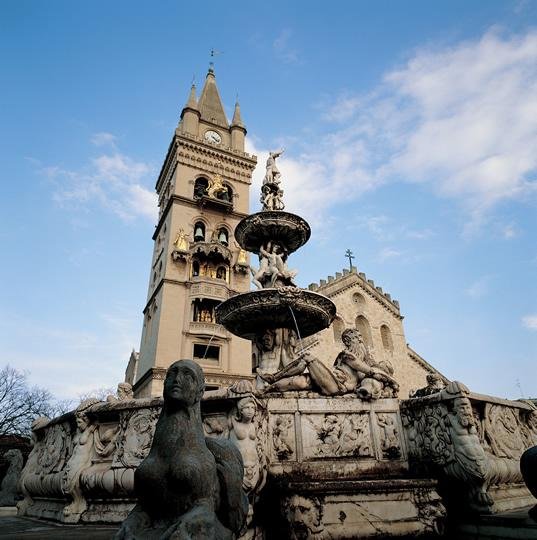 We begin our itinerary right here, in front of the Duomo, where the Orion Fountain welcomes you with all its majesty. Created between 1547 and 1553 by Giovanni Angelo Montorsoli, a pupil of Michelangelo, this monumental fountain was commissioned by the Messina Senate to celebrate the city’s first aqueduct, which brought water from the Camaro and Bordonaro streams. Art historian Bernard Berenson called it ‘the most beautiful fountain of 16th-century Europe,’ and as soon as you see it, you’ll understand why. The structure is pyramidal: at the top stands Orion, the mythical founder of Messina, with his dog Sirius at his feet. Below, four cherubs ride dolphins, then naiads and tritons hold ever-larger basins. At the base, a dodecagonal basin houses the statues of the rivers Nile, Tiber, Ebro, and Camaro, with bas-reliefs inspired by Ovid’s Metamorphoses. Water flows everywhere, creating a relaxing sound that invites you to linger. It’s the perfect starting point to discover the other six historic fountains you’ll encounter today.
- Piazza Duomo, Messina (ME)
- Open in Google Maps
- View on Google Images

You should go if…
Stop no. 2
Senatorial Fountain: A Dive into the 1600s
 Leave the Duomo behind and take Via Consolato del Mare. Here, next to the town hall, awaits the Senatorial Fountain. It’s not just a fountain: it’s a piece of Messina’s history. Built in 1615 (or 1619, sources disagree) by order of the city Senate, it traveled around the city before settling here in 1937. The large circular marble basin, the ribbed bowl with seven engraved plaques bearing the senators’ names, and the pinecone at the top – a symbol of immortality – tell you a story of civic pride. Pay attention to details: the original dolphins disappeared during the moves. I was there on a sunny morning, and the flowing water seemed almost to whisper the ancient names. A traveler’s tip: stop for a moment, sit on the edge (if allowed), and watch the Messinese people go by. It’s a quiet corner, just steps from the center’s chaos.
- Via Consolato del Mare, Messina (ME)
- Open in Google Maps
- View on Google Images
You should go if…
Stop no. 3
Fontana Falconieri: A Neoclassical Masterpiece in Piazza Basicò
 Continuing your walk, you arrive at Piazza Basicò, where the Fontana Falconieri awaits. Designed by Carlo Falconieri in 1842 for the eighteenth centenary of the Madonna della Lettera, it is a Neoclassical gem. Initially located in Piazza Ottagona, it survived the 1908 earthquake and was relocated here in 1957. The octagonal marble base is surrounded by four cast-iron figures from the Oretea Foundry in Palermo: sirens with lion heads, a man, a griffin, and a dolphin—symbols of the elements. At the center, a stele with animal and plant bas-reliefs supports two oval basins, the topmost crowned by shells from which water flows. The contrast between white marble and dark iron is captivating. I stopped to observe the details: the acanthus leaves, the sea monsters, the refinement of the whole. A place that deserves more attention but offers an authentic experience to those who know how to seek it.
- Piazza Basicò, Messina (ME)
- Open in Google Maps
- View on Google Images
You should go if…
Stop no. 4
The Aquarius Fountain Hidden Among the Trees
 Leave the Falconieri Fountain behind; the path leads you to a small square at the intersection of Corso Cavour and Via XXIV Maggio. Here, nearly hidden by tree branches, you’ll find the Fountain of Gennaro, a seventeenth-century Mannerist gem. Attributed to Rinaldo Bonanno, it depicts a water-bearing putto seated on a celestial globe encircled by the zodiac band. Water once flowed from two opposite amphorae and four masks at the base, symbolizing the sign of Aquarius. The name “Gennaro” recalls January, when the sun enters that constellation. Having survived the 1908 earthquake, it was dismantled and stored at the Regional Museum, then reinstalled here in 1932. A further restoration in 2015 restored its luster. Stop to observe the details: the globe, the zodiac, the serene expression of the putto. This fountain speaks of astronomy and mythology, perfect for those who love hidden surprises.
- Via Ventiquattro Maggio, Messina (ME)
- Open in Google Maps
- View on Google Images
You should go if…
Stop no. 5
Pinecone Fountain
 Continuing towards the square named after Giuseppe Seguenza, you’ll be greeted by the elegant Pinecone Fountain, an 18th-century masterpiece in white marble. Crafted by local artisans, it originally stood in the courtyard of the old archbishop’s seminary and, after various travels due to earthquakes and traffic, found its home here in 1988. The fountain is rich in symbolism: three stacked basins, scrolls, and shells that evoke the Camino de Santiago, water spouting from grotesque masks, and a large pinecone at the top. This element references the pineal gland, which Descartes considered the seat of the soul, and symbolizes spirituality and immortality. Observe the details: dolphin heads, rococo curls, floral fluting. It’s a quiet corner, far from the chaos, perfect for stopping and reflecting. It’s not every day you find an artwork that speaks of both philosophy and nature.
- Largo Giuseppe Seguenza, Messina (ME)
- Open in Google Maps
- View on Google Images
You should go if…
Stop no. 6
Fontana Bios
 Leaving behind the refined Fontana della Pigna, I continue along Viale della Libertà until I come across the Fontana Bios, an explosion of concrete and modern symbolism. Created in 2005 by Messina-born artist Ranieri Wanderlingh, it was donated to the city by the newspaper La Gazzetta del Sud for its fiftieth anniversary. Two large concrete spindles – one above the other – tell the continuous cycle of life: water flows from the upper body to the lower one, which spreads it into the basin filled with river pebbles. It is 18 meters long and almost 7 meters high, and it seems poised to dive into the Strait that serves as its backdrop. The spot is perfect for a break: the salty air, the sound of the waves, and the coming and going of families and young people make everything feel more alive. Before this, there was an abandoned fountain here; today it is a design corner that invites reflection on nature’s regeneration.
- Viale della Libertà, Messina (ME)
- Open in Google Maps
- View on Google Images
You should go if…
Stop no. 7
Neptune Fountain: Mastery Over the Sea
 End your itinerary in style at the Neptune Fountain in Piazza Unità d’Italia (via Vittorio Emanuele II). Created in 1557 by Giovanni Angelo Montorsoli, a pupil of Michelangelo, it is the oldest of Italy’s three monumental fountains dedicated to Neptune (predating those in Bologna and Florence). At the center, the god’s statue with a trident dominates the chained monsters Scylla and Charybdis, an allegory of the city holding the forces of the Strait at bay. Note: the Neptune and Scylla you see are 19th-century copies by Gregorio Zappalà and Letterio Subba; the originals are in the Museo Regionale. The fountain originally faced inland, but after the 1908 earthquake it was moved here in 1934 and rotated 180°: now it gazes out to sea, as if protecting Messina. A popular legend claims it depicts a giant fisherman who, on a bet, captured the two monsters. But whatever the story, the effect is majestic: the water flowing among dolphins, seahorses, and imperial emblems will leave you awestruck.
- Via Vittorio Emanuele II, Messina (ME)
- Open in Google Maps
- View on Google Images
You should go if…


