Collegiate Church of Santa Maria Assunta in Camaiore: 13th-Century Romanesque Architecture

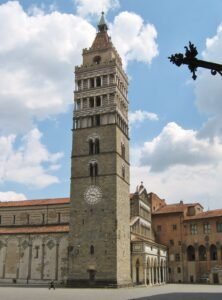
The Collegiate Church of Santa Maria Assunta in Camaiore is a 13th-century church with a Romanesque white stone facade and a medieval bell tower. The three-nave interior preserves artworks such as paintings and sculptures. It is situated in Piazza San Bernardino in the historic center of Camaiore, perfectly integrated into the life of the village.

  • White stone facade with Tuscan Romanesque style and central rose window
  • Three-nave interior with an intimate atmosphere and centuries-old artworks
  • Medieval bell tower towering over the village of Camaiore
  • Central location in Piazza San Bernardino in the heart of the historic center

Copertina itinerario Collegiate Church of Santa Maria Assunta in Camaiore: 13th-Century Romanesque Architecture
The Collegiate Church of Santa Maria Assunta in Camaiore features a Romanesque white stone facade and a three-nave interior with paintings and sculptures. It is located in Piazza San Bernardino in the historic center of Versilia.

Good to know


Introduction

Have you ever turned a corner and been left breathless? In Camaiore, in the heart of Versilia, that’s exactly what happens with the Collegiate Church of Santa Maria Assunta. It’s not just a church; it’s a sight that stops you in your tracks. The white stone facade, that clean and severe Tuscan Romanesque style, seems to tell ancient stories even before you step through the door. And that slender bell tower rising above the village rooftops… it immediately gives you your bearings, like a beacon in the historic center. I first saw it in passing, returning from the beach, and I told myself: ‘I absolutely have to stop.’ It’s one of those places that captures your gaze and invites discovery, without needing any grand announcements.

Historical Notes

Its history is an intertwining of faith and power. The first certain records date back to 1278, when it is mentioned as a parish church, but its foundations could be older. Consider that for centuries it was the most important religious reference point in the area, before the nearby Badia di San Pietro took over part of that role. It is not a cathedral, but it has the dignity of a mother church. It has undergone transformations and restorations (one significant in the nineteenth century), but has maintained that medieval essence that makes it authentic. There are no tales of princes or epic battles, but its continuity through time is in itself a small epic.

  • 13th century: First documented attestations as a parish church.
  • Subsequent centuries: Religious center of reference for Camaiore.
  • 19th century: Important restoration interventions that preserve its style.
  • Today: Symbolic monument of the village, perfectly integrated into the life of the town.

The Façade: A Book in Stone

Pause for a moment in front of the façade before entering. It’s not just beautiful; it’s informative. That rigorous geometry, the blind arches running beneath the roof, the central rose window… these are all classic elements of Lucchese Romanesque architecture, interpreted here with a certain sobriety. Look closely at the portal: it’s simple, without excessive decoration, and perhaps that’s precisely its merit. It conveys a sense of solidity, of peace. To me, it somewhat recalls certain countryside churches in the area, but in an ‘urban’ version, more majestic. It’s interesting to note how the materials – that local stone – blend perfectly with the architecture of the surrounding historic center. It never clashes; it seems as if it has always been there.

Within the Walls: Atmosphere and Details

Once you cross the threshold, the atmosphere changes. Light filters through the rose window and side windows, creating a soft, almost intimate illumination. The interior with its three naves is spacious but not empty. Don’t expect the unrestrained baroque of other Italian churches; here a certain austerity prevails, interrupted by some elements that capture your attention. There are paintings, side altars that deserve a closer look. For me, for example, the feeling of quiet was striking, even when outside there’s the bustle of the square. It’s a place that invites a pause, a moment of reflection, even if you’re not particularly religious. You’ll probably notice a slight scent of incense and wax, that typical fragrance of sacred buildings which has something reassuring about it.

Why Visit It

For at least three concrete reasons. First: it’s a perfect and accessible example of Romanesque architecture in Versilia, without having to queue or pay for tickets. Second: its location in the center of Camaiore makes it a must-see stop on any tour of the village; you can’t miss it, and once you see it, you’ll understand why it’s the symbol of the town. Third: it offers a pleasant contrast with the holiday atmosphere of the coast. After a morning at the sea or shopping in boutiques, finding yourself in front of this stern stone structure is an experience that enriches the day, adding a cultural element effortlessly. It’s living history, not preserved in a museum.

When to Go

My honest advice? In the late afternoon, especially during the shoulder seasons. Why? The low, warm sunlight gently caressing the white stone facade is a sight to behold. Colors warm up, shadows lengthen, and the atmosphere becomes magical. In summer, midday can be very hot, and the light is too harsh to appreciate the details. In winter, the short days gift you that low, golden light that highlights every sculpture. You might want to avoid Mass times if you prefer to explore in peace, but even then, attending can be an authentic experience to see the place in its living function.

In the Surroundings

Stepping out of the Collegiate Church, you’re already in the heart of Camaiore. Perfect for continuing your exploration. A suggestion? Take a short walk to the Museum of Sacred Art, which houses some treasures from the church itself, such as vestments and liturgical objects. It’s an ideal complement. If you prefer a complete change of scenery, but still on the theme of ‘ancient beauty’, head towards the Abbey of San Pietro, just outside the center. It’s an older, more isolated monastic complex, nestled in greenery, with its own aura of mystery and peace. Two sides of the same religious and historical coin of the area.

💡 Did You Know…?

A little-known fact: the Collegiate Church stands on an area that in Roman times was probably dedicated to pagan worship. During some restoration work, traces of earlier structures emerged, testifying to the site’s long historical layering. Additionally, the bell tower, about 33 meters high, is not just a visual landmark; according to some local sources, its bells have a particular sound, linked to an ancient tradition of community signaling. If you visit during a religious holiday, you might hear their characteristic chime, which still marks the time of Camaiore today.