The Roca Vecchia Archaeological Area, in the municipality of Melendugno, is one of Salento’s most important sites due to its historical stratification spanning from the 2nd millennium BC to the Middle Ages. The entrance fee includes a guided tour and access to the nearby Grotta della Poesia, a natural karst pool with ancient inscriptions. The site is open year-round, but the ideal season is spring or autumn to avoid the summer crowds.
• Imposing Bronze Age fortifications with Aegean influences
• Grotta della Poesia: natural pool with Messapian, Greek, and Latin inscriptions
• Remains from Messapian, Roman, and medieval periods, including a castle and a church
• Rocky beaches and coves for snorkeling and relaxation
Introduction
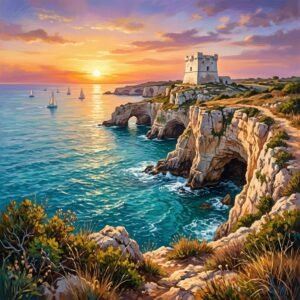
If there’s one place in Salento that manages to blend millennia of history and natural beauty in one go, it’s Roca Vecchia. Imagine a rocky promontory plunging into the Adriatic, between San Foca and Torre dell’Orso, where the past emerges from every layer of earth. Here, just steps from the Grotta della Poesia – a karst natural pool with crystal-clear waters – stretches an archaeological area that tells over three thousand years of history. Minoans, Messapians, Romans, Basilian monks, and Angevin knights: all have left their mark. The best part is you can visit with a guide who explains the Bronze Age fortifications, Messapian inscriptions, and the remains of the medieval castle. And then, perhaps, take a dip (if allowed) in the cave, or simply enjoy the cliff. A place that seems suspended in time.
Historical Overview
The history of Roca Vecchia is a sequence of destruction and rebirth. The first fortifications date back to the Bronze Age (15th–11th century BC), with Minoan-Mycenaean influences. A fire destroyed them as early as the 15th century BC, but they were rebuilt. In the Messapian period (4th–3rd century BC) the site flourished: an unfinished city wall was built, along with tombs and kilns; the city was possibly Thuria Sallentina. After a Roman abandonment, in the early Middle Ages Byzantine hermits carved out cave dwellings. In the 14th century, Count Walter of Brienne turned it into a fortified city, but in 1480 the Turks sacked it. In 1544, Governor Ferrante Loffredo razed it to the ground, and it has remained uninhabited ever since. Today, excavations by the University of Salento continue to unearth artifacts. Here are the key moments:
The Cave of Poetry: An Open-Air Sanctuary
Just a few meters from the archaeological area lies the Cave of Poetry, an elliptical open-air karst cavity (about 30×18 meters). Its name comes from the Greek “posìa,” meaning freshwater spring. It’s not a romantic poem, but a sacred place: in 1983, thousands of inscriptions in Messapic, Greek, and Latin were discovered on its walls, dedicated to the god Taotor (or Thador). The cave was a coastal sanctuary, and its mixture of fresh and seawater made it unique. Access is included in the archaeological area ticket, but note: swimming is not allowed (though it was permitted in the past). You can still look over and admire the water’s changing colors. A smaller Cave of Poetry, just south, completes the picture with additional inscriptions.
A journey through the walls: from the Bronze Age to the Middle Ages
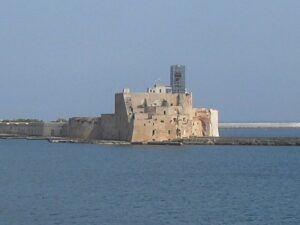
The archaeological area extends over three hectares and showcases unique stratifications. Start with the Cyclopean walls of the Bronze Age (15th century BC), up to 10 meters high in places, bearing witness to contacts with the Aegean world. Then move on to the Messapian structures: an unfinished city wall, chamber tombs, and pottery kilns. The medieval period is represented by the remains of the Angevin castle overlooking the sea and a semi-underground church, the Sanctuary of Maria Santissima delle Grazie, built over a Byzantine cave. The 1568 watchtower, square-based, completes the coastal defenses. Each layer tells a story: sieges, fires, reconstructions. Excavations are still ongoing, and every year new details emerge. A guided tour (mandatory) ensures you don’t miss a thing.
Why Visit It
1. An Archaeological Unicum: Roca Vecchia is considered one of the most important sites in the Mediterranean for its stratification. In a few square meters, you can go from the Bronze Age to the Middle Ages. 2. The Grotta della Poesia: even without swimming, it is a spectacle of nature. The ancient inscriptions on the walls make it an open-air museum. 3. A Full Day: you combine culture and sea. After the visit, you can choose one of the nearby beaches (Pascariello, Zolfara, Punta Sapone) to relax. And in summer, the ticket includes access to both the excavations and the cave. In short, it’s not just an archaeological site: it’s an experience that immerses you in the history of Salento.
When to Go
The best time is late spring or early autumn: the days are long and the heat is not yet oppressive. In summer (June–August) the site is very busy, but with a guided tour you can avoid the crowds. If you want to take photos without tourists, aim for early morning (opens at 9). The sunset over the cliff is spectacular, but keep in mind that closing times may not allow you to stay until sunset. In winter, the site may have reduced hours or be closed due to bad weather; better to check. Personally, I found the opening hour magical, when the low light illuminates the ancient walls and the Grotta della Poesia reflects the sky.
Nearby
After the visit, I suggest two stops. The first is Torre dell’Orso, a few kilometers south: a white sandy beach with crystal-clear sea and two sea stacks (the Due Sorelle) emerging from the water. It is one of the most beautiful in Salento. The second is the Santuario di Maria Santissima delle Grazie, right in Roca Vecchia: a semi-underground church with Roman columns and an effigy of the Madonna in Lecce stone. Every May a procession is held. If you have time, take a kayak to explore the rocky coast and the Grotta della Poesia Piccola. Or simply walk along the cliff: the smell of the sea and the view of the Adriatic are worth the stop.