
The Roman Amphitheatre of Lecce is a national monument in the heart of the city, in Piazza Sant’Oronzo. Dating back to the Augustan age, it could hold up to 25,000 spectators and was used for gladiator fights and animal hunts. After a restoration in 2023, it is once again open to visitors, offering a unique experience in the historic center.
Central location: in Piazza Sant’Oronzo, steps away from Lecce’s Baroque architecture.
Historic capacity: up to 25,000 spectators, among the largest in Italy.
Recent restoration: reopened in 2023 with new accessible pathways.
Summer events: concerts and shows in the ancient arena.
Events nearby



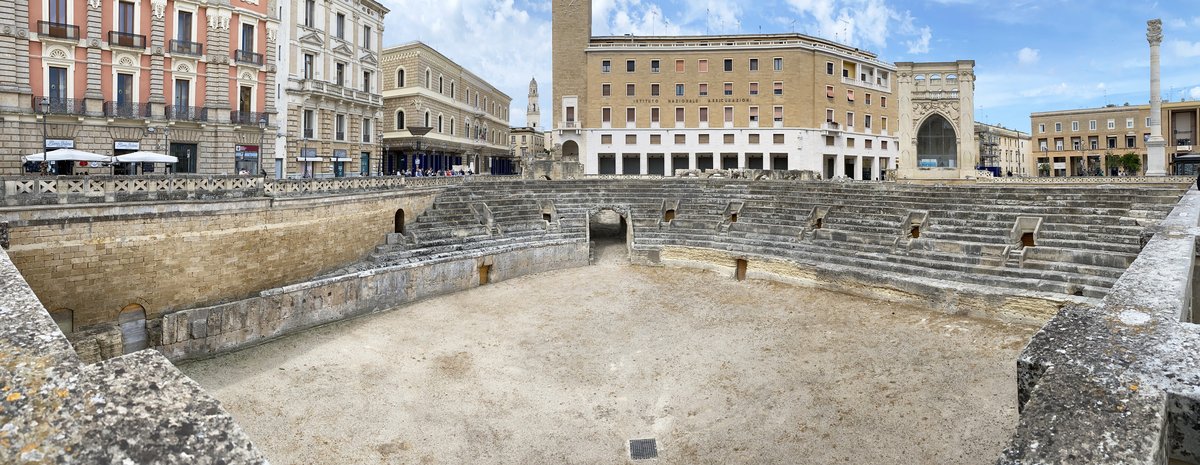
The Roman Amphitheatre of Lecce, located in Piazza Sant’Oronzo, is an Augustan-era monument. Explore the arena, uncover the history and intriguing facts of this symbol of Roman Lupiae.
- Piazza Sant’Oronzo, Lecce (LE)
- +39 080 5285210
- Open in Google Maps
- View on Google Images Anfiteatro Romano di Lecce a Lecce
Good to know
Introduction
Historical Background
- 1st century BC–2nd century AD: construction under Augustus and Hadrianic restorations
- Middle Ages: stripping and abandonment, materials reused in the crypt of Otranto
- 1901–1940: excavations by Cosimo De Giorgi
- 2023: reopening after restoration
Architecture and Curiosities
Life and Spectacles
Why Visit
When to Go
Nearby
Itineraries nearby


💡 Did You Know…?
Fun fact: during the early 20th-century excavations, the priest of the nearby Church of Santa Maria delle Grazie opposed the removal of rubble, preventing the full structure from being unearthed. To this day, one third of the amphitheatre remains buried beneath the square and the church. Additionally, the venationes (animal hunts) began in the morning, and animals such as lions and bears arrived at the port of San Cataldo.