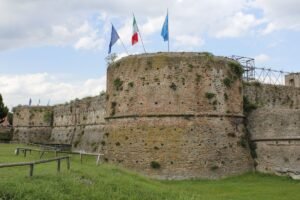
Malatesta Fortress of Verucchio: Archaeological Museum and Panoramic Sea View

The Malatesta Fortress of Verucchio is a perfectly preserved medieval castle dominating the Valmarecchia valley from its 330-meter-high position. It houses an Archaeological Museum with Villanovan and medieval artifacts and offers panoramic views stretching from the hills to the Adriatic Sea. The site is authentic and away from tourist crowds, ideal for an immersive cultural experience.

  • Archaeological Museum with Villanovan and medieval artifacts from the region
  • Panoramic view from the tower over Valmarecchia and the Adriatic Sea
  • Inner courtyard with a perfectly preserved ancient well
  • Authentic 12th-13th century medieval structure, expanded by the Malatesta family

Copertina itinerario Malatesta Fortress of Verucchio: Archaeological Museum and Panoramic Sea View
12th-13th century medieval fortress at 330 meters elevation with Villanovan Archaeological Museum, inner courtyard with ancient well, and views over Valmarecchia valley to the Adriatic Sea.

Good to know


Introduction

The Rocca Malatestiana in Verucchio is not just a castle; it’s an experience that takes your breath away. As you approach from the valley floor, you see it towering on a rocky spur, a stone colossus that seems to defy gravity. The location is spectacular, dominating the entire Valmarecchia with a visual control that immediately makes you understand why the Malatesta family chose it. This isn’t one of those fortresses restored to the point of looking fake—here, you can still breathe in the Middle Ages, with its rough stones and silences heavy with history. When you climb up to the inner courtyard, the view takes your breath away—you see cultivated fields stretching like a green carpet to the horizon, framed by the rolling hills of Romagna. Personally, I paused for a moment to take in that landscape and thought: this is why it’s worth coming all the way up here.

Historical Overview

This fortress has witnessed centuries of battles, intrigues, and power struggles. Built in the 13th century by the Malatesta family, who profoundly shaped this area of Romagna, it served not only as a noble residence but also as a strategic military outpost. Here, Malatesta da Verucchio was born, the founder of the dynasty, and it is said that the famous Sigismondo Pandolfo Malatesta also grew up within these walls. In subsequent centuries, it came under the control of the Papal States, which transformed it into a prison—a function it retained until the 20th century. Today, after careful restoration, it houses the Archaeological Museum, which tells the story of the region. Yet, walking through its halls, one can still sense the echoes of the lives that unfolded here.

  • 13th century: Construction by the Malatesta family
  • 1462: Conquest by Papal troops
  • 16th–19th centuries: Use as a prison
  • 1990s: Restoration and opening to the public as a museum

The Courtyard of Wonders

One of the corners that struck me the most is the inner courtyard. It’s not very large, but it has a particular atmosphere, almost intimate despite being surrounded by imposing walls. At the center stands an ancient well still perfectly preserved, with its wooden pulley that seems ready to lower the bucket. I imagined the soldiers who gathered here, or perhaps the prisoners who came for a breath of fresh air. What makes this space special is how the light plays with it: during the midday hours, the sun beats strongly on the light-colored stones, while at sunset the shadows lengthen, creating suggestive plays of light. In summer, they also hold performances and concerts here—I haven’t seen them personally, but I imagine the natural acoustics of the walls must be unique. If you visit the fortress, take five minutes to sit on one of the benches and absorb the atmosphere: it’s one of those details that makes the difference between ‘seeing a castle’ and ‘experiencing a place’.

The View from the Tower

If you don’t climb the tower, you haven’t truly visited the Rocca Malatestiana. I know, the stairs are steep and a bit narrow—it’s not ideal for those with vertigo or mobility issues—but the reward at the top is priceless. From up there, the Valmarecchia unfolds in all its beauty: you can see the river winding through the fields, the villages perched on the nearby hills, and on the clearest days, even the Adriatic Sea on the horizon. What surprised me is how from the tower, you can perfectly understand the castle’s defensive logic: every strategic point is controlled, every possible access route is monitored. I counted at least five villages visible without needing binoculars. A tip? Bring a decent camera because the photos from up here are worth the admission ticket alone. And if you’re with children, keep an eye on the little ones because the openings between the battlements are wide.

Why Visit It

Three concrete reasons why this fortress deserves a visit? First: it’s authentic. It hasn’t been prettied up for tourists, maintaining that rough and genuine character that truly makes you feel like you’re in a medieval castle. Second: the view is among the most beautiful in the entire province of Rimini—and there are plenty of spectacular vistas here, so that’s no small compliment. Third: the visit is perfect for families because it combines history, architecture, and nature in an experience that lasts a couple of hours at most, without tiring the children too much. Oh, and there’s a fourth reason that might be worth more than the others: here you truly understand what power meant in medieval Romagna, not through boring explanatory panels but by walking on the same stone slabs trodden by warlords and prisoners.

When to go

The best time? An autumn afternoon, when the air is crisp but the sun still warm, and the surrounding hills are painted with warm colors. In summer it gets very hot, especially during the midday hours, and the light is so intense it’s almost blinding – beautiful for photos, less so for enjoying the visit at a leisurely pace. Spring is magnificent, with fields in bloom, but you risk encountering more crowds. Autumn, on the other hand, has that golden light that enhances the stones of the fortress, and the atmosphere becomes more intimate. If you absolutely must go in summer, choose early morning or late afternoon, when the heat is more bearable and the long shadows make everything more evocative. It’s open in winter, but always check the hours as they may vary.

In the Surroundings

Verucchio is a village worth exploring in its entirety, not just for its fortress. The historic center is a jewel of cobblestone alleys, ancient doorways, and small squares where time seems to have stood still. Stroll leisurely, step into artisan workshops, and sample local cheeses. Not far away, in Santarcangelo di Romagna, there’s another Malatesta fortress equally interesting, though less spectacular in location but rich in history. And if you’re looking for a different yet thematically connected experience, in the Verucchio area there are several farms producing oil and wine—some offer tastings with views over the hills, a lovely way to end the day after visiting the castle.

💡 Did You Know…?

Legend has it that Malatesta da Verucchio, the founder of the dynasty known as ‘the Centenarian’ for his longevity, was born here. The chapel preserves a 14th-century fresco of the Madonna and Child, attributed to the Rimini school. During excavations, intact Villanovan burial sites with funerary objects were uncovered, now displayed in the museum. In summer, concerts and historical reenactments take place in the courtyard, recreating the Medieval atmosphere.