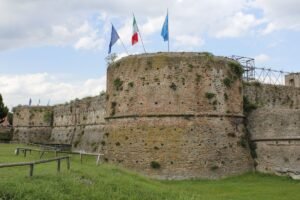
Malatesta Fortress of Mondaino: Medieval Fortress with Paleontological Museum and Valconca Valley View

The Malatesta Fortress of Mondaino is a perfectly preserved medieval fortress located in the village of Mondaino, in the province of Rimini. Built in the 15th century by the Malatesta family, it houses a Paleontological Museum with local fossils and offers a 360-degree panoramic view of the Valconca Valley from its tower. The visit allows you to explore the courtyard with Renaissance loggias and a historic well, immersed in an authentic atmosphere away from tourist crowds.

  • Perfectly preserved 15th-century medieval fortress with a Renaissance courtyard
  • Paleontological Museum inside with fossils of prehistoric sharks found in the area
  • Panoramic tower with 360-degree view of Valconca Valley, surrounding villages, and distant sea
  • Strategic hilltop location, ideal for day trips from the Rimini coast without queues

Copertina itinerario Malatesta Fortress of Mondaino: Medieval Fortress with Paleontological Museum and Valconca Valley View
Malatesta Fortress of Mondaino: Perfectly Preserved 15th-Century Fortress with Paleontological Museum, Renaissance Courtyard, and Panoramic Tower Overlooking Valconca Valley. Ideal for Day Trips from the Rimini Coast.

Good to know


Introduction

As soon as you arrive in Mondaino, the Malatesta Fortress greets you with its imposing bulk dominating the village. It’s not just a castle, but a piece of medieval history that seems straight out of a fairy tale book, perfectly preserved among the Rimini hills. The feeling is like stepping back in time, with walls that tell centuries of battles and lordships. Personally, I was struck by how authentic it has remained, without too many restorations that would alter its appearance. Walking in the inner courtyard, with that silence broken only by the wind, is an experience that makes you feel part of something ancient and precious. The view from the tower then, well, offers a 360-degree panorama over the Valconca valley that alone makes the visit worthwhile. This isn’t your typical tourist castle; here you can still breathe the atmosphere of times past.

Historical Overview

The Rocca di Mondaino has a rich and eventful history, closely tied to the Malatesta family, the powerful dynasty that left its mark on this area. The original structure dates back to the 13th century, but it was in the 15th century that it took on the form we see today, with the Malatesta transforming it into a defensive fortress. It later passed to the Montefeltro family, their historical rivals, after prolonged battles for control of the territory. One detail worth noting: the Treaty of Mondaino in 1459 was signed here, a peace agreement between the two families that temporarily calmed the waters. In the 18th century, it became the municipal residence, and today it houses the Paleontological Museum, featuring fossils discovered in the area. A brief timeline:

  • 13th century: initial fortifications
  • 15th century: reconstruction under the Malatesta
  • 1459: Treaty of Mondaino
  • 18th century: conversion into town hall
  • Today: museum and visitable site

The Courtyard and Its Stories

Entering the courtyard of the Rocca is like opening a box of medieval memories. The space is vast, surrounded by Renaissance loggias that add a touch of elegance to the severity of the walls. Public assemblies were held here, and according to some sources, even feasts and tournaments. The well in the center is not just decorative: it truly served for water supply during sieges. I stopped to observe the details of the arches, some with faded coats of arms that evoke thoughts of knights and ladies. In summer, the courtyard hosts events and performances, and imagining the life that pulsed here centuries ago sends a shiver down the spine. It’s one of those places where you only need to close your eyes to hear the echo of the past.

The Tower and the View

Climbing the tower of the Rocca is a must, even if the stairs are a bit steep – but it’s worth it. Once at the top, you’re greeted with a panorama that embraces the entire Valconca valley, from the gentle hills to the distant sea on the clearest days. You can clearly see other villages like Saludecio and Montegridolfo, as if they were drawn on a living map. The tower itself, with its arrow slits and battlements, gives you a sense of how strategic it was for controlling the territory. I spent a quarter of an hour up there, trying to spot landmarks, and realized that this view explains why the Malatesta family valued this place so much. Bring a camera, because the photos from here are spectacular.

Why Visit It

Visiting the Malatesta Fortress of Mondaino offers three things that few other places deliver so well. First, authenticity: it’s not an over-restored castle, but retains that rugged medieval charm, with stones that have witnessed centuries of history. Second, the Paleontological Museum inside, which adds unexpected value with local fossils – perfect if you’re traveling with curious children. Third, the location: it’s conveniently accessible from the Rimini coast, yet immerses you in a completely different atmosphere, far from tourist crowds. And then, there’s the satisfaction of discovering a lesser-known gem, unfamiliar to many but leaving a vivid memory.

When to Go

The best time to visit the fortress? I’d recommend going on a late spring or early autumn day, when the air is fresh and the afternoon light gently caresses the stones, creating a golden atmosphere. In summer, it can get hot, but if you go early in the morning, you’ll avoid the crowds and enjoy the silence. In winter, with a bit of mist over the hills, the castle takes on a mysterious air that has its own charm. Avoid peak-season weekends if you don’t like crowds, as organized groups sometimes visit. Personally, I preferred a Thursday afternoon in September: there was almost no one around, and I could explore at my leisure.

In the Surroundings

After visiting the fortress, it’s worth exploring the surroundings of Mondaino to complete the medieval experience. Just a few minutes away is Saludecio, a well-preserved village with walls and gateways that seem frozen in time, famous for its 19th-century music festival. Alternatively, if you’re interested in nature, take a trip to the Onferno Nature Reserve, with its caves and trails among the gullies – a perfect contrast to the history of the fortress. Both places are easily accessible and offer another side of this area full of surprises.

💡 Did You Know…?

The Malatesta Fortress of Mondaino hides a unique detail: it houses the Paleontological Museum with fossils of prehistoric sharks found in the area, evidence of when this land was submerged by the sea. During your visit, look for traces of the Malatesta family, the powerful dynasty that had it built in the 15th century: their symbols are still visible. In summer, the inner courtyard often hosts events and concerts, transforming the fortress into a natural stage. Don’t miss the walk along the walls to admire the view of the surrounding countryside.