
Syracuse Cathedral, in the heart of Ortigia, is a unique monument that tells over 2,500 years of history. Built on the remains of the Greek temple of Athena (5th century BC), it preserves the original monumental Doric columns. Transformed into a Christian church, an Arab mosque, and then a Norman cathedral, after the 1693 earthquake it acquired its spectacular Baroque façade. Today it is a UNESCO World Heritage site.
Why visit it:
Original Doric columns: 36 columns from the Greek temple visible both inside and out.
Baroque façade: Masterpiece by Andrea Palma with statues by Ignazio Marabitti.
Effigy of Saint Lucy: Silver statue of the patron saint, heart of the city’s devotion.
Piazza Duomo: One of Sicily’s most beautiful squares, surrounded by noble palaces.
Events nearby

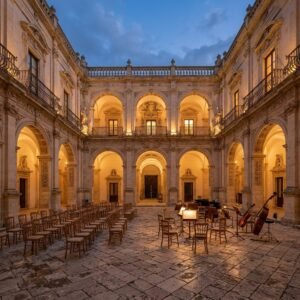

In the heart of Ortigia, Syracuse Cathedral rises on the ancient Temple of Athena. Admire the Doric columns and Baroque façade, a UNESCO site.
- Piazza Minerva, Siracusa (SR)
- Open in Google Maps
- View on Google Images Cattedrale di Siracusa a Siracusa
Good to know
Introduction
Historical Overview
- 480 BC – Temple of Athena
- 7th century – Conversion into a church
- 878-1091 – Arab mosque
- 1085 – Norman reconsecration
- 1693 – Earthquake and Baroque reconstruction
- 2005 – UNESCO
The Doric Columns of the Temple of Athena
The Baroque Facade and Artworks
Why Visit It
When to Go
Nearby
Itineraries nearby


💡 Did You Know…?
During World War II, a bomb fell on the chapel of Saint Lucy without exploding: it is still visible today as an ex-voto. Tradition holds that the Madonna del Piliere, a Byzantine icon preserved inside, protected the city from bombings. Every December 13, the silver statue of Saint Lucy is carried in procession through the streets of Ortigia, amid faith and folklore.