
🧭 What to Expect
Ideal for: a 2-3 day city break Culture and history: Baroque, theaters, and archaeological sites Food and wine: fish market and street food Authentic atmosphere: away from the crowds, a mix of tradition and modernity Easy to explore: compact historic center, walkable
Events nearby

Catania is a city that surprises you. Just steps from the sea and a stone's throw from Etna, its historic center is a labyrinth of alleys where Sicilian Baroque blends with everyday life. If you're looking for what to see in Catania in one day, I suggest starting at Piazza Duomo, the city's beating heart, with the Cathedral of Sant'Agata and the Elephant Fountain. Then get lost in the Fish Market (Pescheria), a sensory experience among colorful stalls and sea scents. Don't miss Castello Ursino, which tells the Norman story, and the Teatro Massimo Bellini, an opera temple. For a green break, the Botanical Garden offers an oasis of peace. And for archaeology lovers, the Roman Amphitheater and Greek Theater testify to ancient grandeur. Catania is also street food: try arancini, cannoli, and granita. In this article you'll find a practical itinerary to discover the best of the city, with tips on hours and tickets. Ready to go?
Overview
- St. Agatha Cathedral: The Baroque Heart of Catania
- Teatro Massimo Bellini: a jewel of sound and history
- Ursino Castle: A Fortress Between History and Street Food
- Roman Amphitheater: Catania's Hidden Giant
- Piazza Duomo: the baroque heart of Catania
- A Dive into Green at the Catania Botanical Garden
- Monastery of San Nicolò l'Arena: The Sicilian Versailles
- Palazzo Biscari: the jewel of Catania's baroque
- Greek Roman Theatre: Catania’s Hidden Gem
- Basilica Maria Santissima dell'Elemosina: The Baroque Collegiate Church
- Elephant Fountain: Catania's Black Symbol
- Porta Garibaldi: A Triumphal Entrance Steeped in History and Symbolism
- Villa Bellini: Catania's Green Heart
- Amenano Fountain: The Sheet of Water That Enchants
- University Square: Baroque, Legends, and Nightlife
Itineraries nearby


St. Agatha Cathedral: The Baroque Heart of Catania
- Go to the page: Saint Agatha Cathedral: The Baroque Duomo of Catania
- Via Francesco Raddusa, Catania (CT)
- Open in Google Maps
- View on Google Images
 If there's one place that captures the soul of Catania, it's the St. Agatha Cathedral. Standing since 1094, this Norman church has been destroyed by earthquakes and rebuilt many times, culminating in the last Baroque rebirth designed by Vaccarini in the 18th century. The façade of white marble and volcanic stone is a triumph of Corinthian columns, statues, and details that leave you speechless. As you enter, your gaze immediately goes to the Chapel of St. Agatha on the right, where a 14th-century silver bust holds the relics of the patron saint. Nearby, the tomb of Vincenzo Bellini – yes, the composer of Norma – is a moving tribute. The interior with three naves blends marble, frescoes, and a 16th-century wooden choir. If you have time, go down to the underground: the remains of the Roman Achillean Baths are open for a fee. The cathedral is open daily (free entry, but remember to cover your shoulders and knees). And after all that beauty? Exit, and in less than a minute you're at the Fish Market, Catania's liveliest fish market. Here street food rules: arancini, fried fish, granita – the true Catania spirit. A tip: come early in the morning, when light filters through the stained glass windows and the city wakes up. An experience that combines Baroque and flavors, just as the title promises.
Teatro Massimo Bellini: a jewel of sound and history
- Go to the page: Teatro Massimo Bellini Catania: Perfect Acoustics and the Triumph of Music Fresco
- Via Leonardi, Catania (CT)
- https://www.teatromassimobellini.it/
- Open in Google Maps
- View on Google Images
- +39 095 7306111
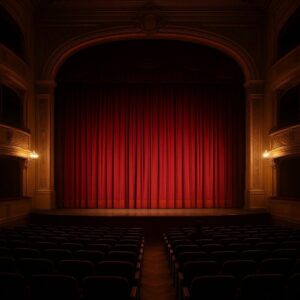
 In the heart of Catania, a stone's throw from Piazza Stesicoro, stands the majestic Teatro Massimo Bellini, a temple of lyric opera named after the Catania-born composer Vincenzo Bellini. Inaugurated on May 31, 1890, with his Norma, it is a masterpiece of French Second Empire eclecticism, designed by Milanese architect Carlo Sada. The façade, with its elegant portico for carriages and wrought iron gates, already promises wonders. Inside, the horseshoe-shaped auditorium seats 1,200 across four tiers of boxes and a gallery, with acoustics so perfect that tenor Beniamino Gigli called it the best in the world. Every detail is sumptuous: the ceiling frescoed by Ernesto Bellandi celebrates the composer and his most famous works – Norma, La sonnambula, I puritani, and Il pirata – while the historic curtain by Giuseppe Sciuti depicts the victory of the Catania over the Libyans. Legends such as Maria Callas, Luciano Pavarotti, and Plácido Domingo have graced its stage, along with conductors like Riccardo Muti and Zubin Mehta. Today, the theater offers a rich season of opera, symphony, and dance, as well as guided tours to discover the secrets of this treasure chest. The box office is open daily from 9 AM to 5 PM, with tickets ranging from €5 to €35 depending on the event. A traveler's tip: if you're in Catania, don't just photograph the façade; step inside, even just to breathe in the atmosphere of a place where music feels at home.
Ursino Castle: A Fortress Between History and Street Food
- Go to the page: Ursino Castle: Civic Museum in Frederick II's Castle in Catania
- Piazza Federico di Svevia, Catania (CT)
- Open in Google Maps
- View on Google Images
 Ursino Castle is one of those places that surprises you. You arrive thinking of a normal medieval castle, but then you discover it's much more. Built at the behest of Frederick II of Swabia between 1239 and 1250, designed by Riccardo da Lentini, it was a bastion defending the gulf. Today, after the 1669 eruption and the 1693 earthquake, it finds itself inland, surrounded by buildings and wide avenues. Its square plan of about 50 meters per side is imposing, with four circular towers (up to 30 meters high) and 2.5-meter thick lava stone walls. The main entrance is still protected by a drawbridge, and above the arch stands a Swabian eagle clawing a hare – symbol of imperial power. Inside, the courtyard welcomes you with a Gothic-Renaissance staircase, and the four large cross-vaulted halls make you feel like you're in a historical movie. But the most fascinating part? The graffiti left by prisoners between the 16th and 19th centuries: coats of arms, boats, prayers. The oldest legible date is 1526. It houses the Civic Museum with the Biscari collections. A visit here is a dive into history, perhaps with an arancino in hand bought somewhere in the city center.
Roman Amphitheater: Catania's Hidden Giant
- Go to the page: Roman Amphitheatre of Catania: history, opening hours and tickets
- Via Alessandro Manzoni, Catania (CT)
- Open in Google Maps
- View on Google Images
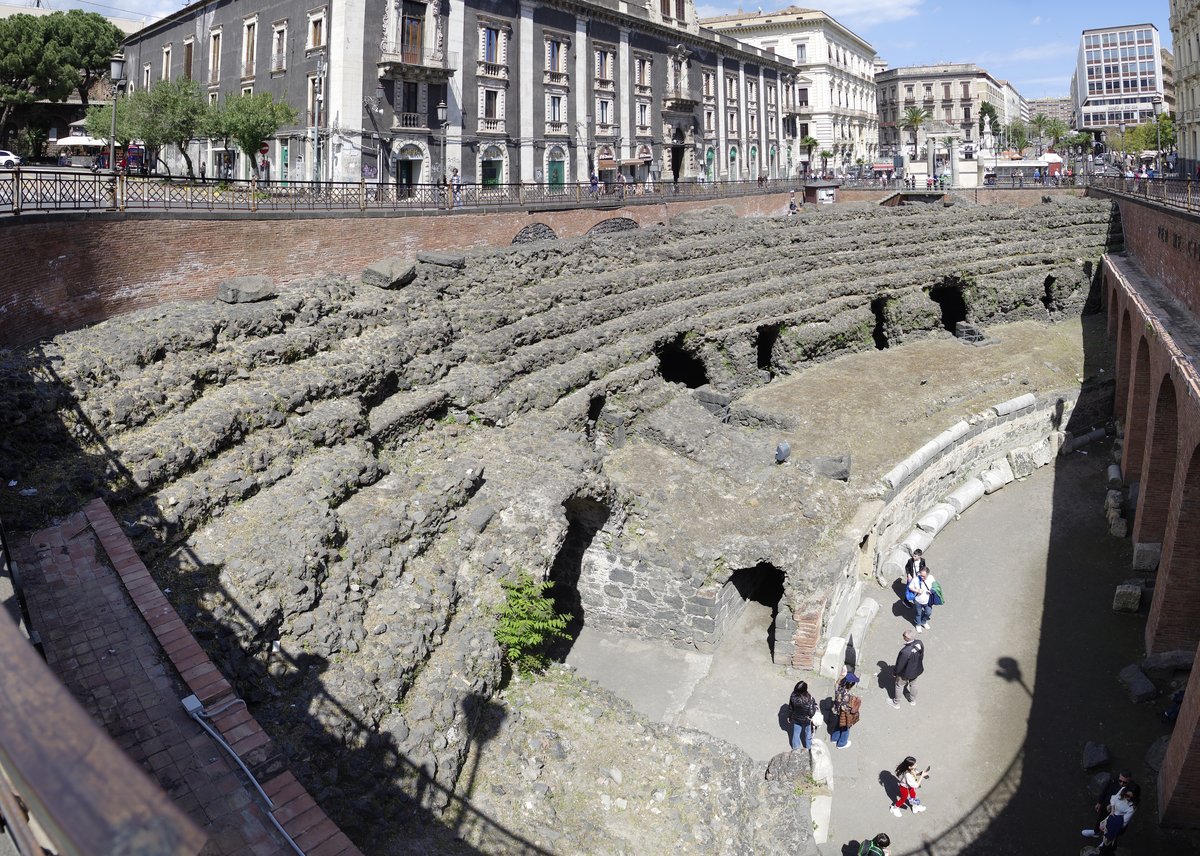 If you walk through Piazza Stesicoro, you'll immediately notice a large dip in the pavement. It's the Roman Amphitheater, one of the largest in Sicily, but buried under earth and houses for centuries. Built in the 2nd century AD under Emperors Hadrian and Antoninus Pius, it could hold 15,000 seated spectators, double that if you add the scaffolding. Today, only a tenth is visible: the rest sleeps under Via Neve, Via Manzoni, and Via Penninello. The structure is made of Etna's volcanic stone with red bricks and marbles; there are 14 tiers divided into three orders. As you stroll through the corridors (ambulacra), you can almost hear the roar of the crowd cheering the gladiators. Then, in the 5th century, the amphitheater became a stone quarry: its columns ended up in the Cathedral of Sant'Agata, commissioned by Roger II. The earthquake of 1693 buried it completely. Only in the 18th century did the Prince of Biscari begin excavations, and in 1907 the area was opened to the public. After the War of the Vespers, the entrances were walled up, and during World War II, the hypogea served as air raid shelters. Since July 3, 2024, management has passed to the Municipality of Catania, with hours that vary: 9:00 AM – 7:00 PM from April to October, 9:00 AM – 5:00 PM in winter, closed on December 25. Tickets cost 4 euros (reduced 3 euros), free for under 10, disabled visitors and their companion. One small drawback: it is not wheelchair accessible. I recommend visiting early in the morning, when the low light illuminates the bricks and lava, and you can enjoy the silence before the crowds arrive. Bring a bit of imagination: that hole in the ground was the arena where wild beasts dueled. And if you look up, imagine the velarium that protected from the sun.
Piazza Duomo: the baroque heart of Catania
- Catania (CT)
- Open in Google Maps
- View on Google Images
 You're at the very center of everything. Piazza Duomo is Catania's living room, a triumph of black and white that tells the story of rebirth after the 1693 earthquake. At its center stands u Liotru, the lava stone elephant supporting an Egyptian obelisk: a symbol of the city, between legend and history. Around it, the Cathedral of Sant'Agata with its baroque façade by Vaccarini, the Palazzo degli Elefanti (town hall), and the Fountain of Amenano, where locals toss coins. From here starts Via Etnea, straight towards Mount Etna. But the real spectacle is the atmosphere: the bustling crowd, the cafés lining the square, and just a few steps away the Pescheria, the city's liveliest fish market. I recommend stopping for a taste of street food: arancini, cartocciate, and fried fish. If you have time, go down beneath the square to the Terme Achilliane, Roman baths from the 4th century, where the Amenano river still flows. A day here is a dive into Catania's history and flavors.
A Dive into Green at the Catania Botanical Garden
- Go to the page: Catania Botanical Garden: A Green Oasis of Succulents and Ancient Palms
- Catania (CT)
- http://ortobotanico.unict.it/
- Open in Google Maps
- View on Google Images
- +39 095 430901
 After the chaos of the city center, a stop at the Catania Botanical Garden is just what you need. Founded in 1858 by the Benedictine monk Francesco Tornabene, this 16,000 m² garden is a hidden corner of peace on Via Etnea. As soon as you enter, the air changes: the scent of earth and leaves, the rustle of palms. The garden is divided into two parts: the Hortus Generalis, with geometric flowerbeds and exotic plants, and the Hortus Siculus, dedicated to the spontaneous flora of Sicily. Here stands the very rare Zelkova sicula, a species at risk of extinction. The succulent plant collection is amazing: over 2,000 species, with centuries-old specimens of Echinocactus grusonii. Don't miss the Tepidarium, the greenhouse made of iron and glass rebuilt in 2008, where coffee and papaya grow. If you come in spring, you might catch the 'Orto in fiore' event (Sundays at 11 am, ticket €7.50) with sensory-guided tours and a peek at the bees. Admission is free Monday to Friday (9 am–5 pm, Saturday 9 am–1 pm, closed Sunday). For me, it was a breath of fresh air: highly recommended for taking a break from the baroque tour.
Monastery of San Nicolò l'Arena: The Sicilian Versailles
- Go to the page: San Nicolò l'Arena Monastery: Baroque Cloisters and Etna History in Catania
- Via Biblioteca, Catania (CT)
- Open in Google Maps
- View on Google Images
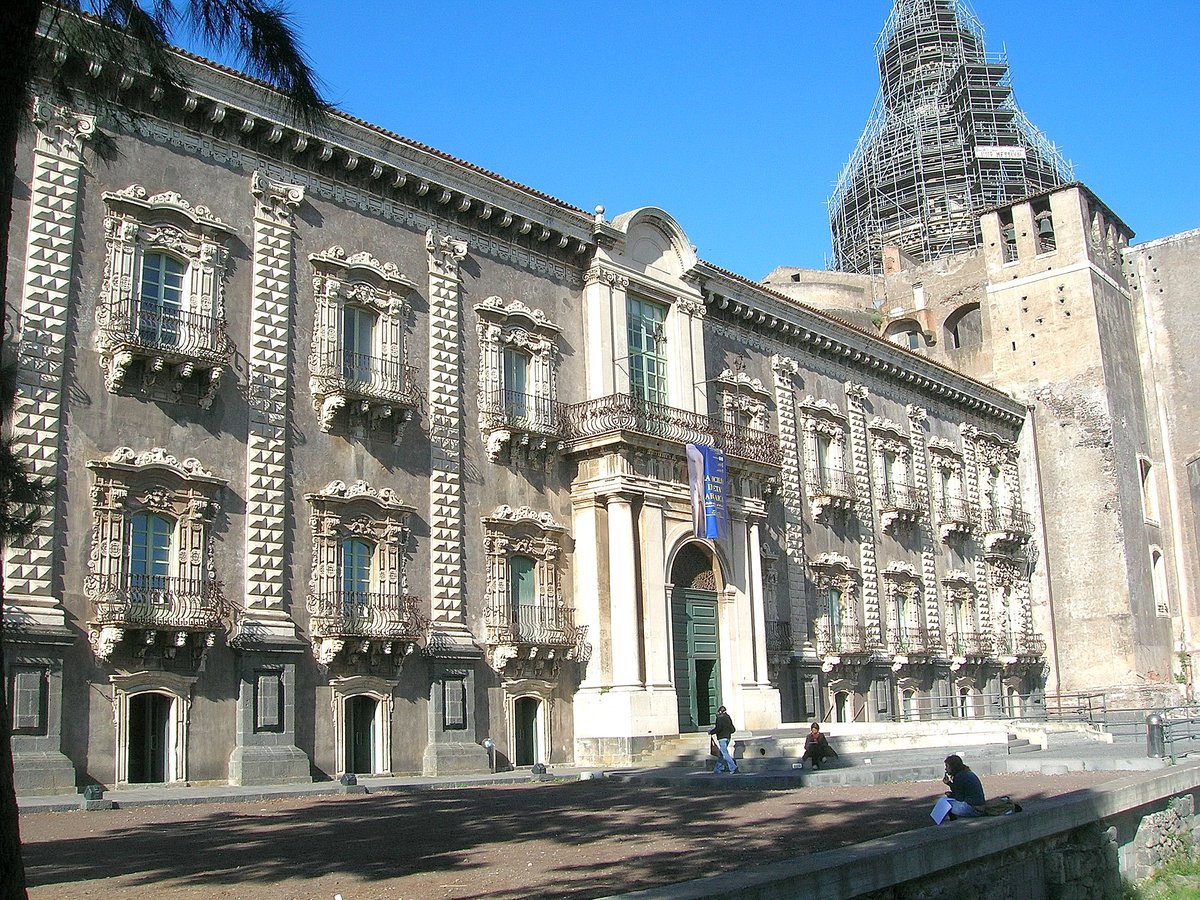 If you think you've seen everything in Catania, get ready to think again. The Monastery of San Nicolò l'Arena, second in Europe only to the one in Mafra, is an experience that sweeps you through centuries of history. Here, within the walls that now house the Department of Humanities, you can still breathe the air of a past marked by eruptions, earthquakes, and rebirths. Founded in 1558 by Benedictine monks fleeing from Nicolosi, the complex was rebuilt after the 1669 eruption and the 1693 earthquake, and today it displays all its late Baroque splendor.
Enter through the portal on Piazza Dante and let yourself be amazed by the unfinished church façade: the columns stop halfway, a reminder of ambitions too grand. Inside, the Latin cross layout stretches for 105 meters in length, and your eye travels to the 62-meter dome designed by Stefano Ittar. Don't miss the grand Baroque organ by Donato Del Piano, with 2,378 pipes, and the 40-meter-long sundial that marks time with precision.
But the true heart is the monastery: two cloisters – the Cloister of the Marbles with Ionic columns and a fountain, and the Levant Cloister with its delightful Caffeaos – connected by the 214-meter-long Hall of the Clock. In the undergrounds, accessible by guided tour, lie a Roman domus from the 2nd century AD and the "Belly," a 32-meter-deep well. A tip: book the tour so you don't miss the most secret corners. Hours: daily 9:00 AM–5:00 PM (closed Sundays). Full ticket €10, but worth every cent.
Palazzo Biscari: the jewel of Catania's baroque
- Go to the page: Palazzo Biscari: Catania's Private Baroque Jewel
- Via Museo Biscari, Catania (CT)
- https://www.palazzobiscari.it/
- Open in Google Maps
- View on Google Images
- +39 095 32872 01
 If there is one place that embodies the spirit of Catania's baroque, it is undoubtedly Palazzo Biscari. Located in the Civita neighborhood, overlooking the marina, this private palace is the most important in the city. Built after the 1693 earthquake at the behest of the Princes of Biscari, it was completed in 1763. The rear facade, with its seven large decorated windows, is a triumph of allegories: Abundance, Prosperity, Fertility, and Wisdom. But it is as soon as you step inside that you are left breathless. The inner courtyard is dominated by a majestic double staircase, leading to the halls. The highlight is the Ballroom, in rococo style, with mirrors, stuccoes, and a central fresco celebrating the family. Above, a 'cloud flake' staircase led the orchestra. Not to be missed is the Picture Gallery, with 17th and 18th-century works, and the Bird Gallery, with decorated panels and ceramic floors. Also curious is the Don Quixote Room. Today the palace is still inhabited by descendants and can be visited. I opted for the unguided tour (€8, no reservation needed), which allows you to wander at your leisure. If you are in a group, the guided one is better (€60 for 1-4 people, €15 per person for larger groups). Keep an eye on opening hours: they vary depending on events. A tip: early morning there are fewer people. And yes, it is the same palace where the film 'I Viceré' was shot and where Goethe stayed in 1787. In short, a dive into history that will not disappoint you.
Greek Roman Theatre: Catania’s Hidden Gem
- Go to the page: Greco-Roman Theatre of Catania: History, Tickets & How to Visit
- Via Teatro Greco, Catania (CT)
- Open in Google Maps
- View on Google Images
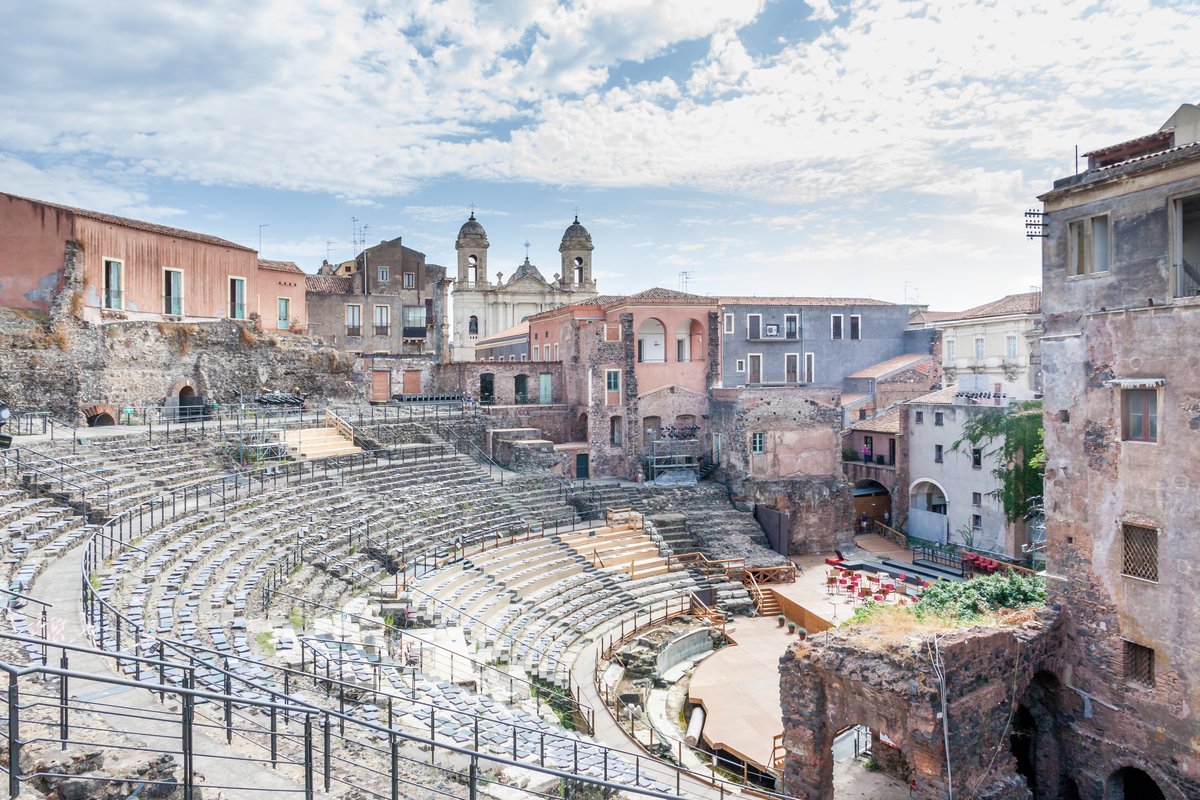 Walking along Via Vittorio Emanuele, you wouldn't expect to come across a Roman theatre. Yet there it is, the Greek Roman Theatre, nestled among Catania's Baroque buildings. Dating back to the 2nd century AD, this theatre sits on a previous Greek structure from the 5th-4th century BC – it is said that Alcibiades himself gave a speech there. With a diameter of almost 100 meters, it could hold up to 7,000 spectators. Today, the grand structure's cavea (seating area), orchestra, and remains of the stage are clearly visible. What strikes you is the combination of materials: Etna's volcanic stone, limestone, and precious marbles that once adorned every corner. Under the cavea, the vaulted corridors (ambulacra) are still walkable and give an idea of the building's complexity. Right next door, don't miss the Odeon, a smaller theatre used for concerts, which now hosts summer performances. The visit takes about an hour: I recommend coming early in the morning, when the light illuminates the seating and the contrast with the Baroque rooftops is spectacular. The ticket costs €6 (reduced €3) and also includes entry to the Antiquarium. Beware: the orchestra is often flooded by the water table of the Amenano river – a suggestive effect that however prevents modern performances. A place steeped in history, to be enjoyed at a leisurely pace.
Basilica Maria Santissima dell'Elemosina: The Baroque Collegiate Church
- Go to the page: Basilica of the Alms in Catania: Baroque Art and Spirituality in the Historic Center
- Via Collegiata, Catania (CT)
- Open in Google Maps
- View on Google Images
 If you're strolling down Via Etnea, you can't miss it: the Basilica Maria Santissima dell'Elemosina, better known as the Collegiata, is one of the symbols of Catania's Baroque. Its facade, designed by Stefano Ittar, is a triumph of curves and volutes that seem to dance upward. Yes, I admit it, I was struck immediately: that pincer staircase, the statues of St. Agatha and St. Apollonia, the loggia with St. Peter and St. Paul… a true spectacle.
The history here is layered. Beneath your feet lie the remains of a Roman temple dedicated to Proserpina, then a Byzantine church. In 1198, it was the scene of the Palm Sunday Conspiracy, and in 1396 it became the Royal Chapel of the Aragonese sovereigns. The 1693 earthquake razed it to the ground, but the reconstruction – with its axis shifted to face the new Via Etnea – gave the city this masterpiece.
Step inside and let yourself be enveloped by the solemn atmosphere. The three naves are dominated by the frescoes of Giuseppe Sciuti (1896) on the vault and dome: a burst of light and color that tells biblical stories. Don't miss the side chapels: Olivio Sozzi and Francesco Gramignani Arezzi have left precious paintings. The high altar houses a copy of the Byzantine icon of the Madonna dell'Elemosina, while the wooden choir with 36 stalls is an 18th-century gem.
A small practical note: the basilica is open daily from 9:00 AM to 9:00 PM, free admission (though some sources mention a ticket, I wasn't asked for one). It's located at 23 Via Etnea, just a few steps from the Duomo. After your visit, treat yourself to a snack at one of the many cafés along the street: Catania's street food awaits!
Elephant Fountain: Catania's Black Symbol
- Via Giuseppe Garibaldi, Catania (CT)
- Open in Google Maps
- View on Google Images
 At the heart of Piazza Duomo, the Elephant Fountain is the beating heart of Catania and its most authentic symbol. Created between 1735 and 1737 by Giovanni Battista Vaccarini, it combines a black basalt statue – called "U Liotru" – with an Egyptian-style granite obelisk 3.66 meters tall. The elephant, facing the Cathedral of Sant'Agata, has a mysterious history: according to the Arab geographer Idrisi, it was already in the city in the 12th century, and perhaps dates back to the Byzantine era. Its hind legs, shattered by the 1693 earthquake, were restored by Vaccarini, who added eyes and tusks in white stone. On the base, two statues represent the Simeto and Amenano rivers, while a saddlecloth with the coats of arms of Sant'Agata hangs from the elephant's sides. Atop the obelisk, a sphere, a palm, and a lily branch symbolize martyrdom and purity, and a metal plaque bears the acronym "MSSHDEPL" – "Mente sana e sincera, per l'onore di Dio e per la liberazione della sua patria" (A sound and sincere mind, for the honor of God and the liberation of his homeland). The name "Liotru" comes from the legend of Heliodorus, an 8th-century noble who, according to tradition, made idols and rode the elephant to travel to Constantinople. In 1239, the elephant became the official symbol of Catania, and today you can find it on the municipal coat of arms, on the university's crest, and as the mascot of local sports teams. The fountain is free and always visible: nearby, don't miss the Cathedral, the Palazzo dei Chierici, and the Basilica Collegiata. A tip? Go at sunset, when the warm light caresses the lava stone and the elephant seems to come alive.
Porta Garibaldi: A Triumphal Entrance Steeped in History and Symbolism
- Via Calanna, Catania (CT)
- Open in Google Maps
- View on Google Images
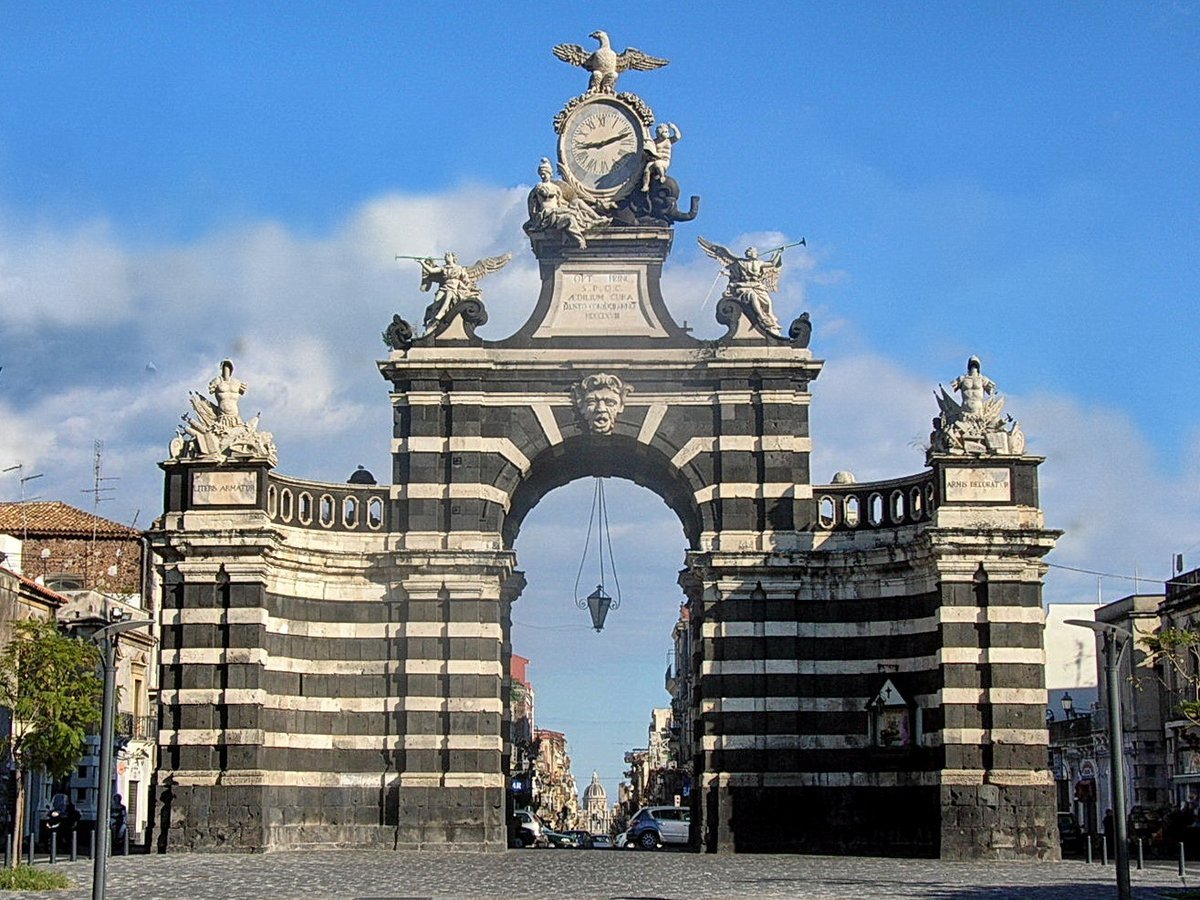 Stepping through Porta Garibaldi is like diving into the past. Built in 1768 to a design by Stefano Ittar and Francesco Battaglia, this gate was erected to celebrate the wedding of Ferdinand IV of Bourbon and Maria Carolina of Austria, hence its original name, Porta Ferdinandea. After Italian unification, it was renamed in honor of Garibaldi, who made a triumphant entry here in 1862.
What strikes you immediately is the color contrast: black lava stone from Mount Etna alternating with white limestone from Syracuse or Lentini, a true masterpiece of Sicilian Baroque. Above, a clock sits atop an eagle and an elephant, symbols of the city. But the detail that moved me most is the phoenix with the inscription "Melior de cinere surgo" (I rise better from the ashes): a motto that speaks to Catania's resilience after eruptions and earthquakes.
The gate marked the western entrance to the city and was part of a defensive system of which only the neighborhood's name remains: Fortino ("u Futtinu" in dialect), from a 17th-century fort that has since vanished. The area has been redeveloped, though some connecting buildings were demolished in the 1930s, leaving a slight asymmetry.
Visiting is easy: free, outdoors, open 24/7. You can reach it on foot from the center in about 15 minutes, or by bus (lines 9, 14, 29, 341). During the Feast of Saint Agatha, the procession passes under the arch, a spectacle I recommend to everyone. I found it a bit smaller than I imagined, but that only makes it more intimate and meaningful. If you're passing by via Garibaldi, stop for a moment: history is all there, carved in stone.
Villa Bellini: Catania's Green Heart
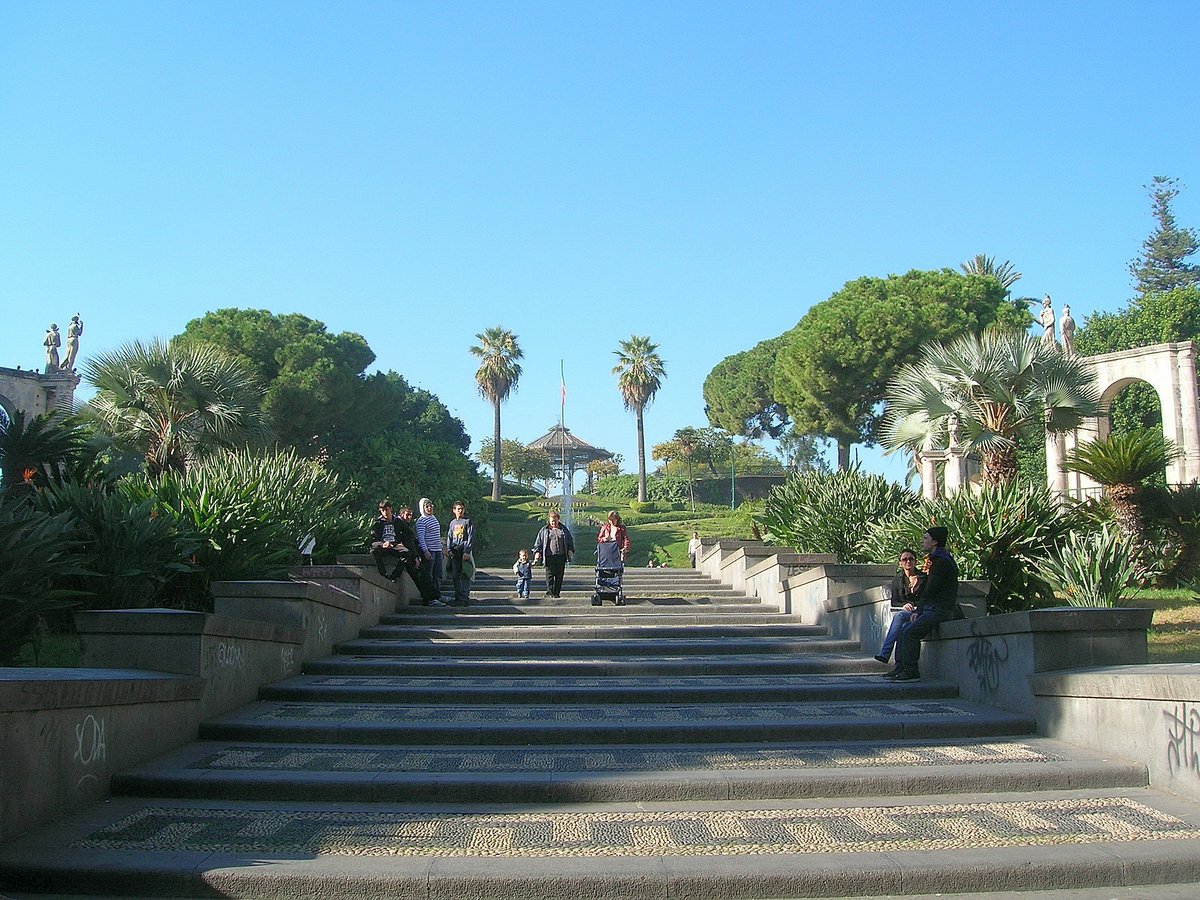 If there’s one place the people of Catania simply call 'a Villa, it’s Giardino Bellini. A huge green lung of over 70,000 square meters right in the middle of Via Etnea, where time seems to slow down. Entering through that monumental 1932 gate is like stepping back in time, among once meticulously kept flowerbeds and wide avenues shaded by towering palms and ficus trees.
Its origins date back to the 18th century: it was the private garden of the Prince of Biscari, complete with a curious hedge maze. Then in 1854 the city bought it and opened it to the public, officially inaugurating it on January 6, 1883.
Two small hills dominate the scene: on the southern one stands the wrought-iron Chiosco dei Concerti in Moorish style, which hosted classical music concerts until the 1950s. On the other hill there was a Chinese pavilion made of cherry wood, sadly destroyed by a fire in 2001. But walking to the top rewards you with an incredible view of Mount Etna, especially when it’s snow-capped.
Then there’s the Viale degli Uomini Illustri, with busts of Verga, Capuana, Mazzini... And don’t miss the monumental tree, a Ficus macrophylla 30 meters tall with a circumference of almost 15 meters: one of the largest in Sicily.
The park is open every day, with varying hours depending on the season. Entry is free. A tip: if you can, visit on Sunday morning to discover the 18th-century underground cryptoporticus, open free from 9:30 to 12:30.
Sure, some corners show a bit of wear, but the atmosphere is authentic. It’s the perfect spot for a break after street food in the city center: sit on a bench and watch life go by, with children playing and elderly chatting. And if you’re lucky, you might catch an impromptu concert at the Chiosco della Musica.
Amenano Fountain: The Sheet of Water That Enchants
- Piazza Duomo, Catania (CT)
- Open in Google Maps
- View on Google Images
 In front of the majestic Palazzo degli Elefanti, on the southern side of Piazza del Duomo, there is a corner that seems to have come out of a dream: the Fontana dell'Amenano. Created in 1867 by the Neapolitan sculptor Tito Angelini from Carrara marble, this fountain is not just a monument but a piece of everyday life. The central statue depicts a young man holding a cornucopia, from which water flows into a shell-shaped basin. But the magic is in the effect: the water overflows creating a continuous cascade that the people of Catania affectionately call “acqua a linzolu”, meaning a sheet of water. A name that tells both its shape and historical memory: once, the neighborhood women used to wash clothes here. Behind it, a lava stone staircase leads directly to the Pescheria, the lively fish market, where the scent of the sea mingles with the sound of water. The fountain is also a symbol of the Amenano River, which flows underground about two meters below the square, and here resurfaces for a moment. Among the details not to be missed, the two tritons on the sides blowing into conch shells, and the city's coat of arms engraved on the base. Tip: visit early in the morning, when the light illuminates the marble and the water seems even fresher. And if you want a good luck charm, they say that wetting your feet brings good luck… but better to wear comfortable shoes for the walk.
University Square: Baroque, Legends, and Nightlife
- Catania (CT)
- Open in Google Maps
- View on Google Images
 University Square is one of those squares that grabs you right away. Overlooking Via Etnea, less than a hundred meters from Piazza Duomo, it's the meeting point for students, tourists, and true Catania locals. Its name comes from the Palazzo dell’Università (the Siculorum Gymnasium) that dominates the west side, founded in 1434 by Alfonso the Magnanimous and rebuilt after the 1693 earthquake. Across from it, Palazzo San Giuliano (1738) and Palazzo Gioeni d’Angiò complete the Baroque backdrop. The pavement is all volcanic stone, with the city's coat of arms in the center. But the real eye-catcher is the four bronze lampposts at the corners, created in 1957 by Mimì Maria Lazzaro and Domenico Tudisco. Each lamppost tells a legend: Gammazita throwing herself into a well to escape a soldier, the Pii brothers saving their parents from the eruption, the paladin Uzeta defeating giants, and Colapesce, the swimmer who holds up Sicily. In the evening, the square lights up: venues set up outdoor tables, street performers entertain, and the atmosphere becomes festive. It's the perfect spot for an aperitif or a gelato while admiring the illuminated palaces. A must-stop before diving into Catania's street food, maybe with an arancino or a granita from one of the nearby bars.