
The Temple of Athena at Paestum is one of the three best-preserved Greek temples in the world, inscribed on the UNESCO list since 1998. Built around 500 BC on an artificial hill, it represents a masterpiece of harmony between Doric and Ionic orders. Today, thanks to private patrons, it has been restored and offers new visiting perspectives.
• Location: Northern sanctuary of Paestum (Capaccio Salerno)
• Architecture: 6 front columns and 13 side columns, pronaos with Ionic columns
• Discovery: Artificial hill revealed by georadar surveys in 2017
• Restoration: Extraordinary maintenance in 2019 with Art Bonus
Events nearby

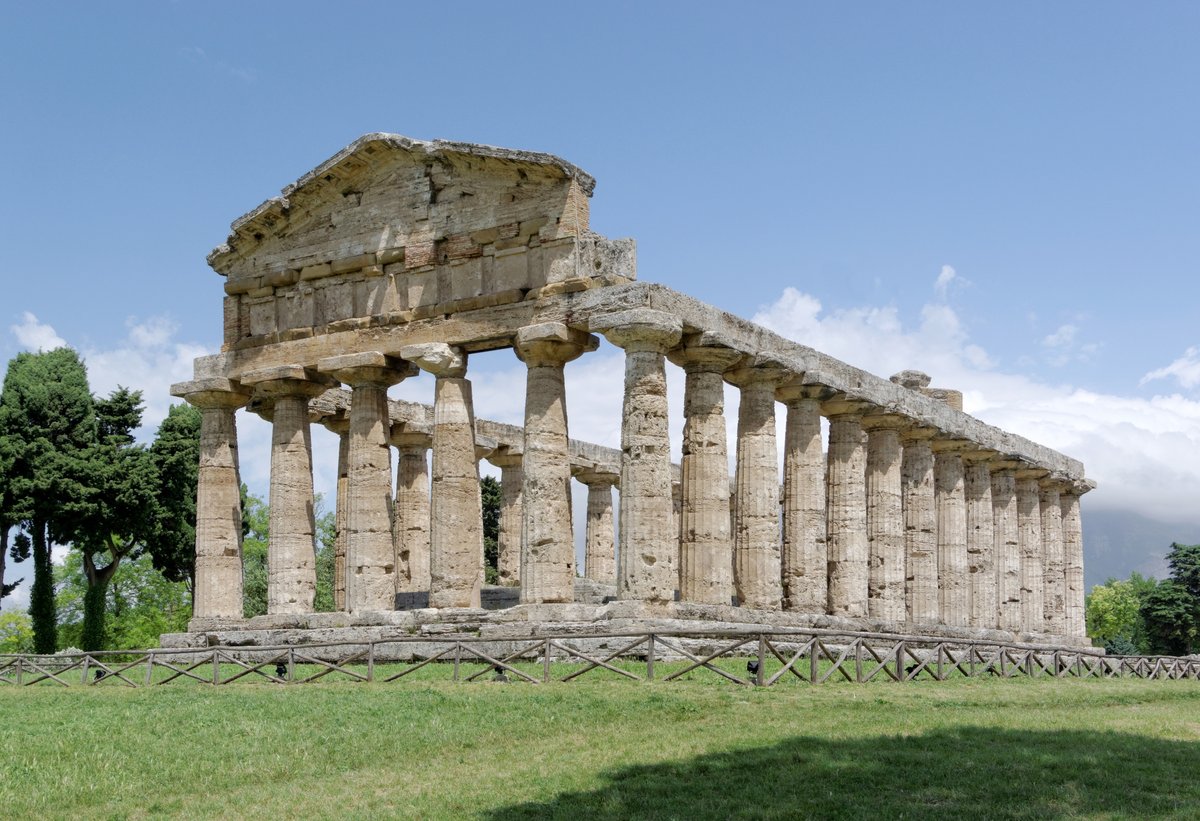
The Temple of Athena at Paestum, a UNESCO World Heritage site since 1998, stands on an artificial hill. A journey through history, Doric-Ionic architecture, and recent archaeological discoveries.
- Via Magna Graecia, Salerno (SA)
- Open in Google Maps
- View on Google Images Tempio di Athena a Salerno
Good to know
Introduction: A Temple on a Hill That Didn’t Exist
From the goddess Athena to the church: a 2,500-year history
- 500 BC – Construction of the Temple of Athena
- 8th century – Conversion into a church
- 1937 – Excavations by Amedeo Maiuri and discovery of terracottas
- 1998 – UNESCO inscription
- 2017 – Georadar surveys reveal the artificial hill
- 2019 – Restoration with Art Bonus funds
The Artificial Hill: An Ancient Engineering Work
A Mix of Styles: First Example of Mixed Orders
Three Reasons Not to Miss It
The Right Time to Visit
What to See Nearby
Itineraries nearby



💡 Did You Know…?
According to recent studies, the hill on which the temple stands may have been artificially raised to emulate the Greek acropolises, a titanic work ante litteram. During the excavations by Amedeo Maiuri in 1937, statuettes of Athena were found that allowed identification. In the 8th century, the temple was converted into a church, with burials in the south ambulatory, later removed.