Villa Capra La Rotonda is the universal icon of Palladian architecture, a Renaissance masterpiece that charms with its perfect symmetry. Designed by Andrea Palladio for the canon Paolo Almerico, the villa is a unique example of a central plan with a dome, surrounded by four identical pronaoi. Today owned by the Valmarana family, it is open to the public and offers an unforgettable cultural experience.
– Central plan with dome: unique of its kind, inspired by the Pantheon.
– Frescoes and stuccoes by Maganza, Dorigny, and Rubini.
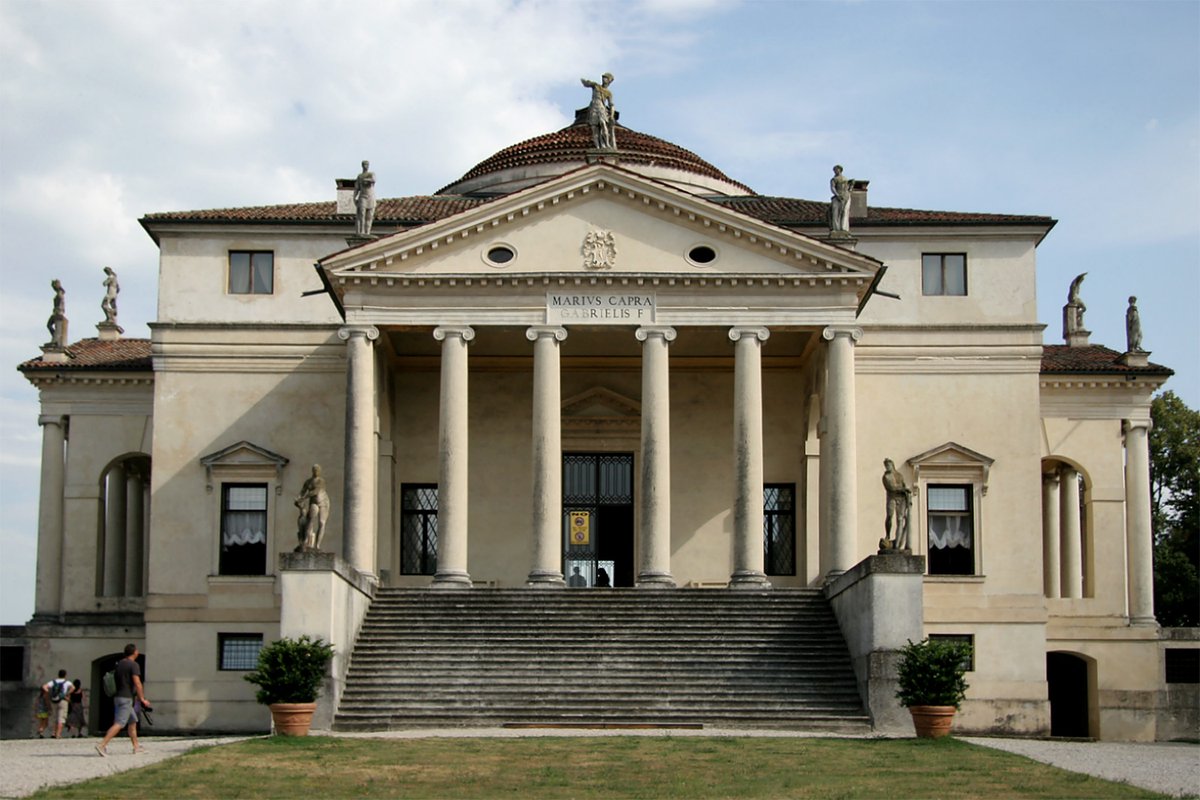
– Four identical façades with hexastyle pronaos and statues by Lorenzo Rubini.
– Park and view over the Sanctuary of Monte Berico and the Vicentine hills.
Introduction
The moment you see it, you understand why it’s an icon. Villa Capra La Rotonda is a perfect cube with four identical façades, each with a portico that looks like it came from an ancient temple. It stands on a hill, surrounded by rolling hills and cultivated fields, and when you arrive, it feels like stepping into a painting. Palladio designed it in 1565 for a canon who wanted a retreat near Vicenza. Today it’s a UNESCO World Heritage site (since 1994), and you can visit the main floor and the park. It’s not huge, but every detail is designed to impress: the statues by Rubini, the frescoes by Maganza, the dome that recalls the Pantheon. It’s a place that takes your breath away, even if you’ve seen it a hundred times in photos.
Introduction
The moment you see it, you understand why it’s an icon. Villa Capra La Rotonda is a perfect cube with four identical façades, each with a portico that looks like it came from an ancient temple. It stands on a hill, surrounded by rolling hills and cultivated fields, and when you arrive, it feels like stepping into a painting. Palladio designed it in 1565 for a canon who wanted a retreat near Vicenza. Today it’s a UNESCO World Heritage site (since 1994), and you can visit the main floor and the park. It’s not huge, but every detail is designed to impress: the statues by Rubini, the frescoes by Maganza, the dome that recalls the Pantheon. It’s a place that takes your breath away, even if you’ve seen it a hundred times in photos.
Historical Notes
The Rotonda was built at the behest of Canon Paolo Almerico, who after years in Rome returned to Vicenza and entrusted the project to Andrea Palladio in 1565. Construction began in 1567, and by 1569 the villa was already habitable. After Almerico’s death in 1589, it passed to his son Virginio and then to the Capra brothers, who completed it with the help of Vincenzo Scamozzi. In 1912, it was purchased by the Valmarana counts, who restored it and opened it to the public in 1980. It has been a UNESCO World Heritage site since 1994.
Timeline:- 1565 – Commission to Palladio
- 1567-1569 – Construction and first inhabitation
- 1591 – Transfer to the Capra brothers
- c. 1620 – Completion by Scamozzi
- 1912 – Acquisition by the Valmarana family
- 1980 – Opening to the public
- 1994 – Inscription as a UNESCO site
Historical Notes
The Rotonda was built at the behest of Canon Paolo Almerico, who after years in Rome returned to Vicenza and entrusted the project to Andrea Palladio in 1565. Construction began in 1567, and by 1569 the villa was already habitable. After Almerico’s death in 1589, it passed to his son Virginio and then to the Capra brothers, who completed it with the help of Vincenzo Scamozzi. In 1912, it was purchased by the Valmarana counts, who restored it and opened it to the public in 1980. It has been a UNESCO World Heritage site since 1994.
Timeline:- 1565 – Commission to Palladio
- 1567-1569 – Construction and first inhabitation
- 1591 – Transfer to the Capra brothers
- c. 1620 – Completion by Scamozzi
- 1912 – Acquisition by the Valmarana family
- 1980 – Opening to the public
- 1994 – Inscription as a UNESCO site
Architecture and Perfect Symmetry
La Rotonda is a square with four identical facades, each featuring an Ionic portico and a staircase. The building is oriented with its corners facing the cardinal points, and at the center rises a hemispherical dome like the Pantheon. It is a brilliant idea: Palladio blends a classical temple with a Veneto villa, creating something unique. The three levels (ground floor, piano nobile, and attic) are legible from the outside thanks to the stringcourses. The central hall is round, and from it branch off four side rooms and four vestibules. There are no traditional foundations: the entire ground floor serves as a base. Every detail is calibrated to create harmony, and as you walk around you always see the same beauty, but from different angles. The four identical facades are its hallmark: an obsession with symmetry that works perfectly.
Architecture and Perfect Symmetry
La Rotonda is a square with four identical facades, each featuring an Ionic portico and a staircase. The building is oriented with its corners facing the cardinal points, and at the center rises a hemispherical dome like the Pantheon. It is a brilliant idea: Palladio blends a classical temple with a Veneto villa, creating something unique. The three levels (ground floor, piano nobile, and attic) are legible from the outside thanks to the stringcourses. The central hall is round, and from it branch off four side rooms and four vestibules. There are no traditional foundations: the entire ground floor serves as a base. Every detail is calibrated to create harmony, and as you walk around you always see the same beauty, but from different angles. The four identical facades are its hallmark: an obsession with symmetry that works perfectly.
Frescoed Interiors and Restored Gardens
As soon as you enter, your gaze goes upward: the dome is decorated with frescoes by Alessandro Maganza (late 16th century) and on the walls of the round room there are eight Olympic deities painted by Louis Dorigny in the 18th century, a trompe-l’oeil that expands the space. The four corner rooms have frescoed ceilings and stuccoes from different periods, while the small rooms reflect the tastes of various owners. Note: photography is not allowed inside, but it’s worth taking your time to look. Outside, the park has recently been restored with PNRR funds: the grove and former citrus orchard have become a sensory garden with citrus pots and new pathways. The English garden offers a view of the Sanctuary of Monte Berico. One tip: don’t miss the elliptical stone staircase built by Francesco Muttoni in the 18th century.
Frescoed Interiors and Restored Gardens
As soon as you enter, your gaze goes upward: the dome is decorated with frescoes by Alessandro Maganza (late 16th century) and on the walls of the round room there are eight Olympic deities painted by Louis Dorigny in the 18th century, a trompe-l’oeil that expands the space. The four corner rooms have frescoed ceilings and stuccoes from different periods, while the small rooms reflect the tastes of various owners. Note: photography is not allowed inside, but it’s worth taking your time to look. Outside, the park has recently been restored with PNRR funds: the grove and former citrus orchard have become a sensory garden with citrus pots and new pathways. The English garden offers a view of the Sanctuary of Monte Berico. One tip: don’t miss the elliptical stone staircase built by Francesco Muttoni in the 18th century.
Why Visit It
1. A masterpiece that inspired the world: La Rotonda is the model for famous buildings like the White House and Chiswick House. Coming here means seeing the original that changed architecture. 2. An immersive experience between art and nature: The restored park, with its grove and sensory garden, offers a relaxing walk with spectacular views. 3. UNESCO heritage without the queues: Unlike other attractions, here you can enjoy the villa at a leisurely pace, especially on weekdays. Plus, the ticket includes both the interiors and the park – a great deal for what’s on offer.
Why Visit It
1. A masterpiece that inspired the world: La Rotonda is the model for famous buildings like the White House and Chiswick House. Coming here means seeing the original that changed architecture. 2. An immersive experience between art and nature: The restored park, with its grove and sensory garden, offers a relaxing walk with spectacular views. 3. UNESCO heritage without the queues: Unlike other attractions, here you can enjoy the villa at a leisurely pace, especially on weekdays. Plus, the ticket includes both the interiors and the park – a great deal for what’s on offer.
When to Go
The best time? Early morning in spring, when the low light caresses the porticoes and the park is in bloom. Or at sunset, between September and October, when the hills turn orange and the villa seems even more majestic. Avoid Easter weekend and summer holidays, because there are more people. If you come in autumn, the grove offers stunning colors. And if you’d like a guided tour, on Friday afternoons (from 3:30 pm) there is the Smart tour, which lasts 50 minutes and reveals the secrets of the villa.
When to Go
The best time? Early morning in spring, when the low light caresses the porticoes and the park is in bloom. Or at sunset, between September and October, when the hills turn orange and the villa seems even more majestic. Avoid Easter weekend and summer holidays, because there are more people. If you come in autumn, the grove offers stunning colors. And if you’d like a guided tour, on Friday afternoons (from 3:30 pm) there is the Smart tour, which lasts 50 minutes and reveals the secrets of the villa.
Nearby
Just a few steps away is Villa Valmarana ai Nani, another Palladian villa (though not by Palladio) with frescoes by Giambattista Tiepolo. It’s a gem for lovers of 18th-century art. Also nearby, the Santuario di Monte Berico offers spectacular views of Vicenza and the surrounding hills. You can even walk there with a short stroll. Two stops that complete the day: culture and panorama, no car needed (the villa has parking, but if you’re in the city you can take bus 3 or 70).
Nearby
Just a few steps away is Villa Valmarana ai Nani, another Palladian villa (though not by Palladio) with frescoes by Giambattista Tiepolo. It’s a gem for lovers of 18th-century art. Also nearby, the Santuario di Monte Berico offers spectacular views of Vicenza and the surrounding hills. You can even walk there with a short stroll. Two stops that complete the day: culture and panorama, no car needed (the villa has parking, but if you’re in the city you can take bus 3 or 70).