A Gothic gem in the heart of Verona
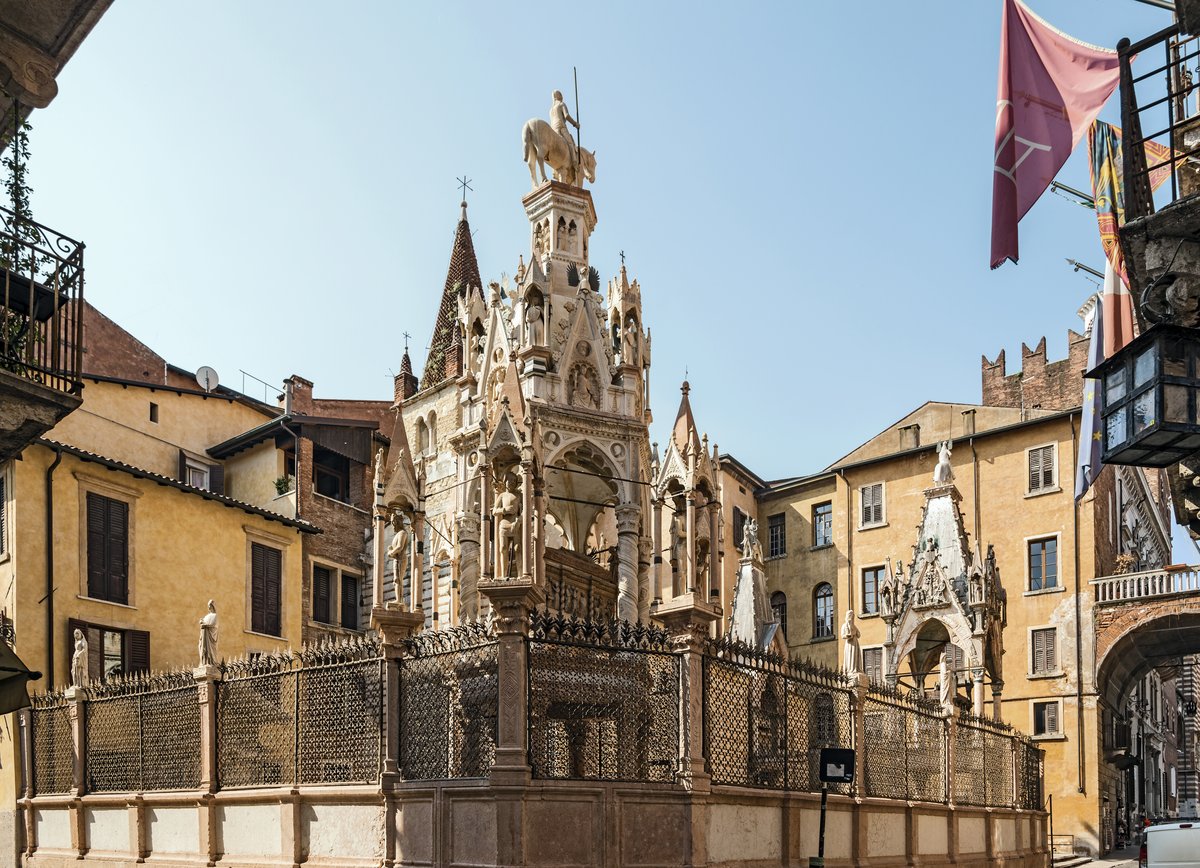
If you stroll through the center of Verona, between Piazza Erbe and Piazza dei Signori, you come across a corner suspended in time: the Arche Scaligere. They are not simple tombs, but an incredible Gothic funerary complex that tells the story of the power of the Della Scala family. Here, next to the church of Santa Maria Antica, red marble sarcophagi and equestrian statues rise like a monumental cemetery. The wrought iron gate, with the motif of the staircase, marks the boundary between the city bustle and the memory of an era. It is impossible not to stop and admire the tomb of Cangrande above the door, with the dogs holding the sarcophagus. It is a place that immediately strikes you for its verticality and minute details, a concentration of art and history in the open air.
A Gothic gem in the heart of Verona
If you stroll through the center of Verona, between Piazza Erbe and Piazza dei Signori, you come across a corner suspended in time: the Arche Scaligere. They are not simple tombs, but an incredible Gothic funerary complex that tells the story of the power of the Della Scala family. Here, next to the church of Santa Maria Antica, red marble sarcophagi and equestrian statues rise like a monumental cemetery. The wrought iron gate, with the motif of the staircase, marks the boundary between the city bustle and the memory of an era. It is impossible not to stop and admire the tomb of Cangrande above the door, with the dogs holding the sarcophagus. It is a place that immediately strikes you for its verticality and minute details, a concentration of art and history in the open air.
History in a Nutshell
The Della Scala family ruled Verona from 1262 to 1387, turning it into a political and cultural powerhouse. The first tomb, that of Mastino I, was laid in 1277, simple and unadorned. Yet it was with
Cangrande I (lord from 1308, patron of Dante) that the cemetery took on a monumental character: his ark, dating to 1329, was placed above the church entrance, compelling worshippers to pass beneath it as a gesture of reverence. The arks of Mastino II (1351) and Cansignorio (1375) followed, each more elaborate than the last. In 1359, the hanging ark of Giovanni was added. The iron enclosure was commissioned by the final lord, Antonio. A succinct timeline:
- 1277: Tomb of Mastino I
- 1301: Sarcophagus of Alberto I
- 1329: Ark of Cangrande I
- 1351: Ark of Mastino II
- 1359: Hanging ark of Giovanni
- 1375: Ark of Cansignorio
History in a Nutshell
The Della Scala family ruled Verona from 1262 to 1387, turning it into a political and cultural powerhouse. The first tomb, that of Mastino I, was laid in 1277, simple and unadorned. Yet it was with
Cangrande I (lord from 1308, patron of Dante) that the cemetery took on a monumental character: his ark, dating to 1329, was placed above the church entrance, compelling worshippers to pass beneath it as a gesture of reverence. The arks of Mastino II (1351) and Cansignorio (1375) followed, each more elaborate than the last. In 1359, the hanging ark of Giovanni was added. The iron enclosure was commissioned by the final lord, Antonio. A succinct timeline:
- 1277: Tomb of Mastino I
- 1301: Sarcophagus of Alberto I
- 1329: Ark of Cangrande I
- 1351: Ark of Mastino II
- 1359: Hanging ark of Giovanni
- 1375: Ark of Cansignorio
Cangrande, Mastino and Cansignorio: Three Masterpieces
The tombs of Cangrande, Mastino II, and Cansignorio are the most spectacular. Cangrande is the most famous: the sarcophagus supported by four dogs (alluding to the name ‘big dog’) and the equestrian statue atop the canopy are an icon of Verona. Mastino II has a more complex structure: pillars, columns, a tall canopy, and statues of the Virtues at the corners. On the lid, Mastino is depicted twice: once with a serene face, the other kneeling. Cansignorio is the richest, designed by the Lombard Bonino da Campione: hexagonal base, six tabernacles with warrior saints, and a profusion of decorations. It cost over 10,000 florins. Each tomb has a copy of the equestrian statue outside; the originals are at the Castelvecchio Museum.
Cangrande, Mastino and Cansignorio: Three Masterpieces
The tombs of Cangrande, Mastino II, and Cansignorio are the most spectacular. Cangrande is the most famous: the sarcophagus supported by four dogs (alluding to the name ‘big dog’) and the equestrian statue atop the canopy are an icon of Verona. Mastino II has a more complex structure: pillars, columns, a tall canopy, and statues of the Virtues at the corners. On the lid, Mastino is depicted twice: once with a serene face, the other kneeling. Cansignorio is the richest, designed by the Lombard Bonino da Campione: hexagonal base, six tabernacles with warrior saints, and a profusion of decorations. It cost over 10,000 florins. Each tomb has a copy of the equestrian statue outside; the originals are at the Castelvecchio Museum.
Symbols and Sculptures to Discover
Looking closely, you will discover surprising details. On Cangrande’s ark, bas-reliefs depict the conquered cities – Vicenza, Padua, Feltre, Belluno, Marostica, Treviso, Verona – while the statue of the deceased dying on the lid has an enigmatic smile. On Mastino II’s ark, the tympana illustrate biblical scenes: the temptation of Adam and Eve, the killing of Cain, the mocking of Noah. Cansignorio, instead, wanted six statues of warrior saints – Ludovico, Martin, Sigismund, Valentine, George, Louis of France – to protect his sarcophagus, where Gospel episodes are narrated. The wrought iron gate, made by order of Antonio della Scala, features the ladder motif, a heraldic symbol repeated everywhere. Each element tells the devotion and power of the family.
Symbols and Sculptures to Discover
Looking closely, you will discover surprising details. On Cangrande’s ark, bas-reliefs depict the conquered cities – Vicenza, Padua, Feltre, Belluno, Marostica, Treviso, Verona – while the statue of the deceased dying on the lid has an enigmatic smile. On Mastino II’s ark, the tympana illustrate biblical scenes: the temptation of Adam and Eve, the killing of Cain, the mocking of Noah. Cansignorio, instead, wanted six statues of warrior saints – Ludovico, Martin, Sigismund, Valentine, George, Louis of France – to protect his sarcophagus, where Gospel episodes are narrated. The wrought iron gate, made by order of Antonio della Scala, features the ladder motif, a heraldic symbol repeated everywhere. Each element tells the devotion and power of the family.
Three Great Reasons
1) Free entry with VeronaCard: if you have the card or a ticket from another civic museum, you can enter for free. 2) Unique Gothic art: the Scaliger Tombs are one of the finest examples of Gothic sculpture in Italy, a true open-air museum. 3) Close to other attractions: they are a stone’s throw from Piazza dei Signori and Piazza Erbe, perfect for a cultural break during your historic center tour. Plus, the tomb of Cangrande is linked to Dante, who was his guest and dedicated the Paradiso to him.
Three Great Reasons
1) Free entry with VeronaCard: if you have the card or a ticket from another civic museum, you can enter for free. 2) Unique Gothic art: the Scaliger Tombs are one of the finest examples of Gothic sculpture in Italy, a true open-air museum. 3) Close to other attractions: they are a stone’s throw from Piazza dei Signori and Piazza Erbe, perfect for a cultural break during your historic center tour. Plus, the tomb of Cangrande is linked to Dante, who was his guest and dedicated the Paradiso to him.
The Best Time
My advice? Visit the Scaliger Tombs in the late afternoon, just before closing. The warm light of autumn or spring caresses the red marble and equestrian statues, creating spectacular contrasts. Moreover, the tourist crowd thins out and you can enjoy the silence. Avoid Mondays, when the complex is closed (except for special openings). If you’re in town for a weekend, Sunday morning is ideal: start with the Tombs and then head to Piazza Erbe.
The Best Time
My advice? Visit the Scaliger Tombs in the late afternoon, just before closing. The warm light of autumn or spring caresses the red marble and equestrian statues, creating spectacular contrasts. Moreover, the tourist crowd thins out and you can enjoy the silence. Avoid Mondays, when the complex is closed (except for special openings). If you’re in town for a weekend, Sunday morning is ideal: start with the Tombs and then head to Piazza Erbe.
What to See Nearby
Just a short walk away you’ll find Piazza dei Signori with Dante’s statue and the Palazzo della Ragione, and Piazza Erbe with its market and the Lamberti Tower. Don’t miss the Church of Santa Anastasia (featuring a fresco by Pisanello) and the Castelvecchio Museum, where the original equestrian statues of Cangrande and Mastino II are preserved. If you have time, take a quick trip to the Verona Arena, about a 10-minute walk away.
What to See Nearby
Just a short walk away you’ll find Piazza dei Signori with Dante’s statue and the Palazzo della Ragione, and Piazza Erbe with its market and the Lamberti Tower. Don’t miss the Church of Santa Anastasia (featuring a fresco by Pisanello) and the Castelvecchio Museum, where the original equestrian statues of Cangrande and Mastino II are preserved. If you have time, take a quick trip to the Verona Arena, about a 10-minute walk away.