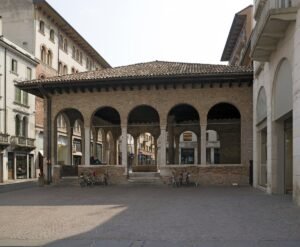
If you have only one day to explore Treviso, this walking itinerary takes you to the heart of the city among walls, museums, and canals. Starting from Porta San Tomaso, follow the ancient fortifications to Porta Altinia, with unmissable stops: the Convent of San Nicolò, a Gothic masterpiece frescoed by Tommaso da Modena; the Santa Caterina Museum, housing works from the Middle Ages to the 20th century; the Civic Tower, for breathtaking views; and Casa dei Carraresi, hosting temporary exhibitions. The route is flat and full of picturesque spots, ideal for art and history lovers. Don’t forget to taste a tiramisù or local radicchio. Treviso, a one-day walking itinerary: walls, museums, and canals await you.
🗺️ Your trip at a glance
A compact yet comprehensive itinerary that gives you the essence of Treviso in one day: art, history, and Venetian atmosphere.
- Ideal for those who want a cultural city break on foot, among museums and monuments.
- What you do: stroll along walls and canals, visit three museums, and discover hidden corners.
- Why it’s different: a route off the usual tourist trail, with selected stops for art enthusiasts.
Itinerary stops
Stop no. 1
Porta San Tomaso: Treviso’s Monumental Gateway
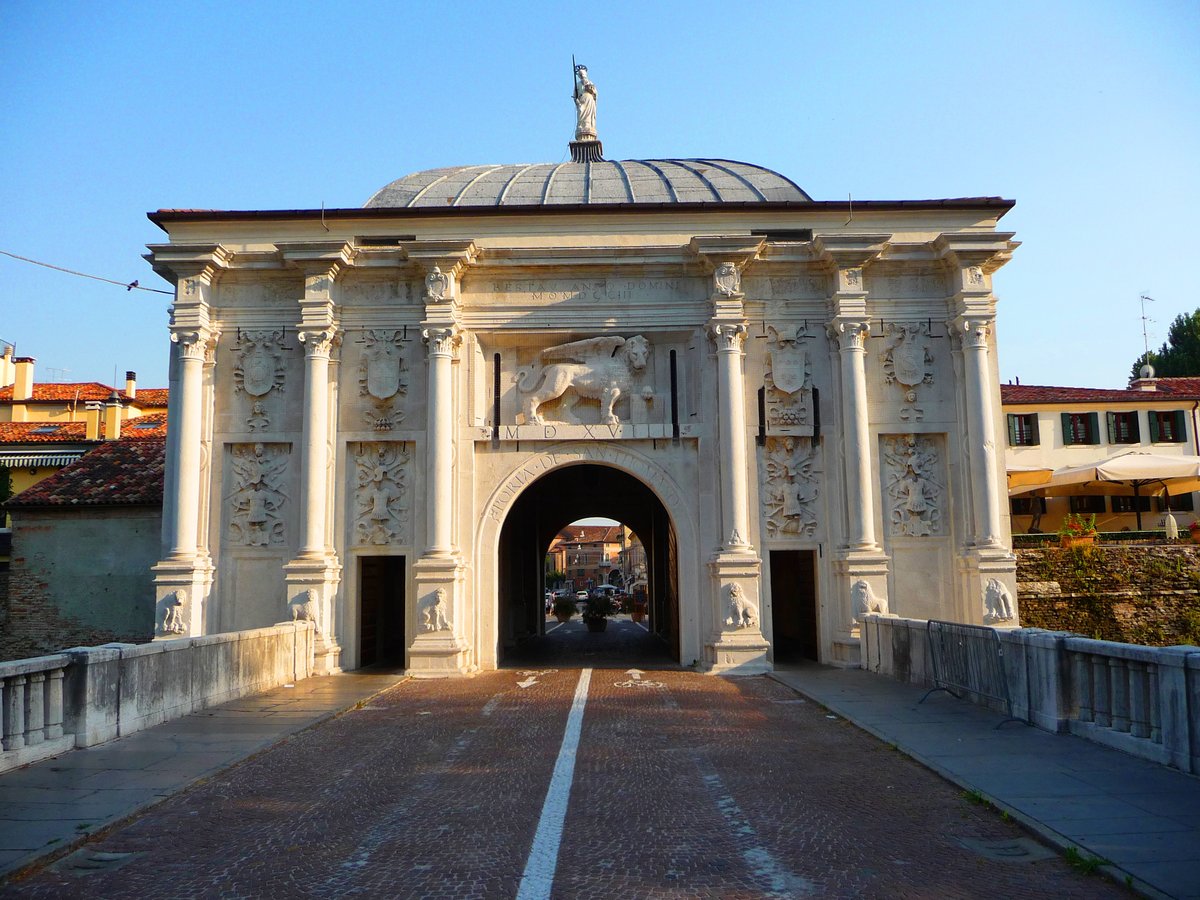 Our itinerary begins right here, at Porta San Tomaso, the most imposing of Treviso’s three city gates. Built in 1518 on plans attributed to Fra’ Giovanni Giocondo (or perhaps Guglielmo D’Alzano), this structure in Istrian stone is a true Renaissance triumphal arch. But take note: the statue at the top does not depict San Tomaso, but rather San Paolo, in honor of the podestà Paolo Nani, who wanted to dedicate the gate to himself. On the outer side, facing the countryside, the inscription in Venetian dialect reads “Porta de San Thomaso,” while on the inner side, facing the city, it appears in Latin as “Porta Sancti Thomae” – a detail that underscores the cultural divide between center and periphery. After conservative restoration completed in 2012, the area under the arch has been pedestrianized, offering visitors a silent and evocative entrance. Look at the stones: you’ll notice masons’ marks (glyptography) that tell the story of the materials’ origins. A perfect start to discovering Treviso.
- Go to the page: Porta San Tomaso Treviso: Renaissance arch from 1518 with Venetian coats of arms
- Porta San Tomaso, Treviso (TV)
- Open in Google Maps
- View on Google Images

You should go if…
Stop no. 2
San Nicolò Convent and Its Frescoes
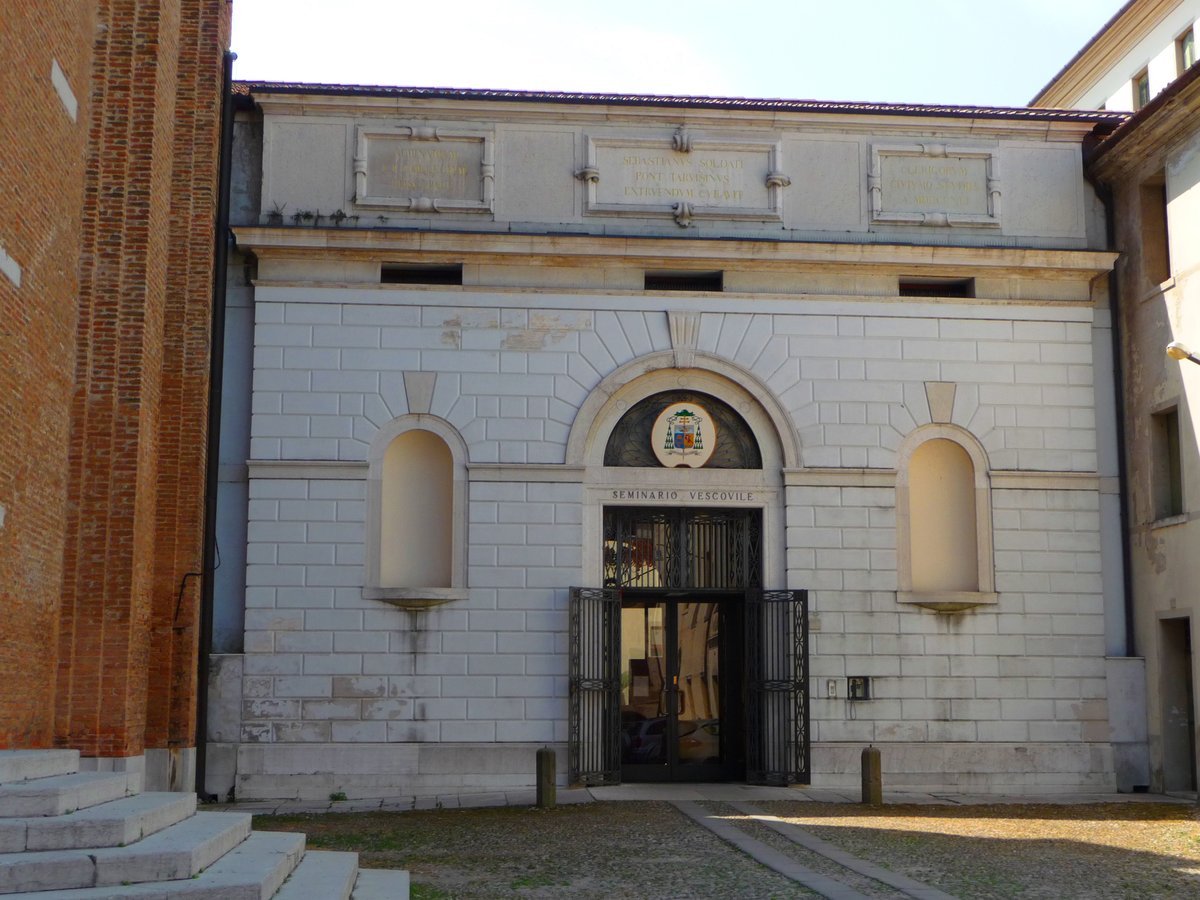 After Porta San Tomaso, you’re in for a dive into the most fascinating 14th century. The Convent of San Nicolò, now the Bishop’s Seminary, is much more than an ancient religious building. Strolling through the airy cloister, you immediately notice that art and history blend in surprising ways. The real gem is the Chapter Hall, frescoed in 1352 by Tomaso da Modena. Forty illustrious Dominicans are portrayed in their studies, with a realism that anticipates modern painting by centuries. Keep your eyes open: among them stand out Cardinal Ugo di Saint-Cher, immortalized with a pair of glasses, and Cardinal Nicolò di Rouen with a magnifying glass – the world’s first artistic representations of these tools. A detail that leaves you speechless. The adjacent church, the largest in Treviso, is worth a visit for its Gothic naves and the Callido organ. The convent also houses a library with over 250,000 volumes and three small museums (zoological, ethnographic, and archaeological), perfect for a curious break. In this treasure chest of culture, you feel privileged to discover secrets few know.
- Piazzetta Benedetto undicesimo, Treviso (TV)
- Open in Google Maps
- View on Google Images
You should go if…
Stop no. 3
Santa Caterina Museum
 Leaving the convent of San Nicolò, you enter another Treviso treasure: the former Santa Caterina complex, now home to the Civic Museums. Here, the past speaks through three distinct souls. The archaeology section takes you back 100,000 years, with artifacts from prehistory to Roman times. Then head upstairs to the noble floor: the Picture Gallery welcomes you with about 150 works from the 13th to the 18th century, including masterpieces by Lorenzo Lotto, Titian, and Giovanni Bellini. But the real heart-stopper is the deconsecrated church, where Tomaso da Modena painted the Cycle of St. Ursula around 1355. The frescoes are vivid, rich in detail. Notice how the painter depicts the saint with an almost modern expression. The museum is open Tuesday to Sunday, 10 AM–6 PM (closed Monday). A tip: check if there’s a temporary exhibition – they host top-level shows here, from Rodin to Van Gogh.
- Piazzetta Mario Botter, Treviso (TV)
- Open in Google Maps
- View on Google Images
You should go if…
Stop no. 4
Treviso Civic Tower
 After the Museo di Santa Caterina, Piazza dei Signori welcomes you with the slender silhouette of the Civic Tower. At 48 meters tall, it is the highest point in Treviso and has dominated the square since 1218, when it was built during the communal era. In 1877, a restoration gave it its current appearance, with neo-Gothic Ghibelline battlements and a two-handed clock. At the top flies the city’s banner, while in the bell chamber, the civic bell rings every hour: 2,700 kg of bronze, the third largest in Veneto. During World War II, the siren that announced the bombing of April 7, 1944, was sounded from here. Is the tower open to visitors today? Not yet, but the administration plans to make it accessible to offer a breathtaking panorama. In the meantime, by looking up, you can imagine centuries of history intertwining above you. A tip? Take a photo from the center of the square to capture all its grandeur.
- Piazza dei Signori, Treviso (TV)
- Open in Google Maps
- View on Google Images
You should go if…
Stop no. 5
Fountain of the Breasts
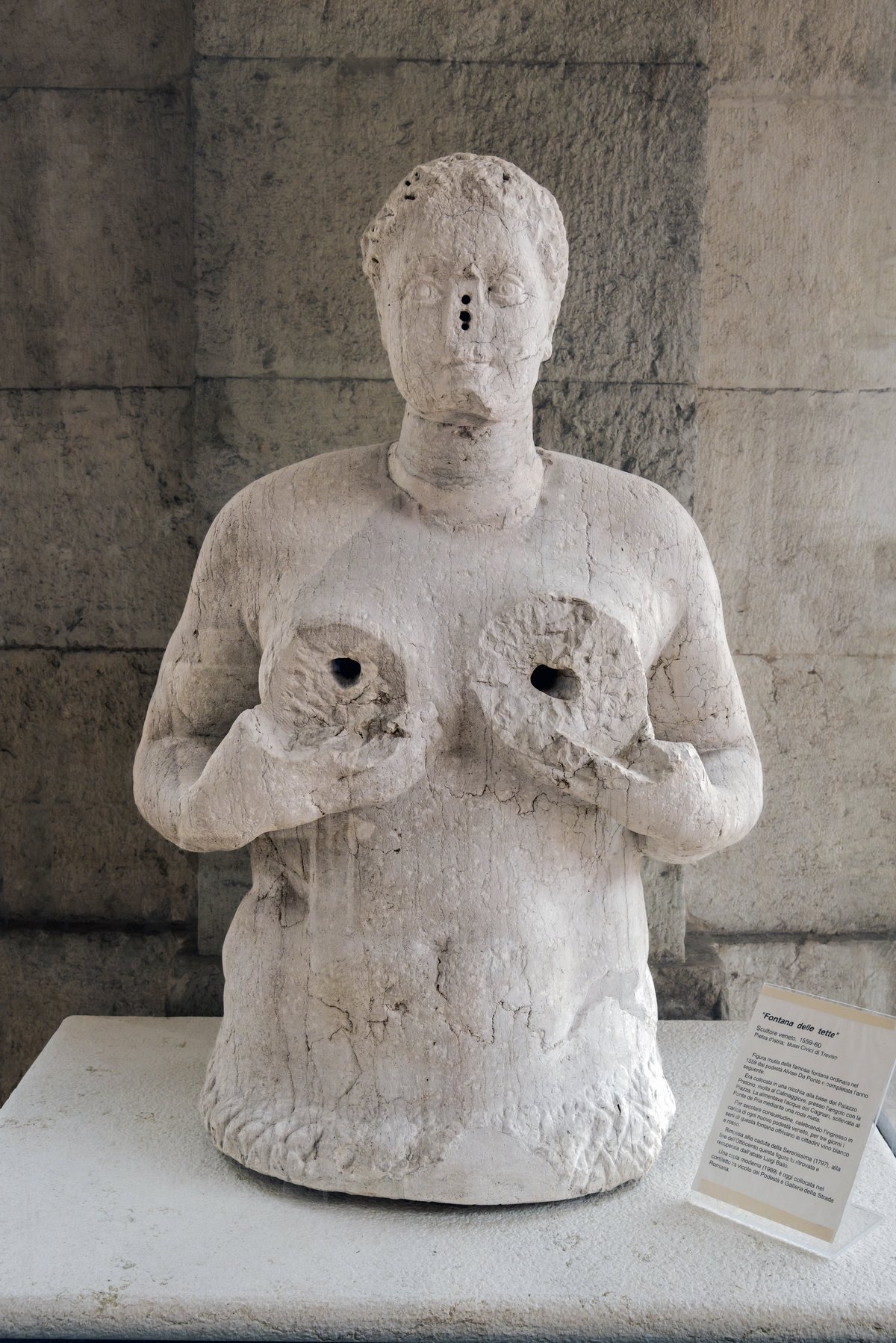 A few steps from the Civic Tower, a truly original stop awaits you: the Fountain of the Breasts. It’s not just any fountain. A 1989 copy of the original from 1559, it is located in the courtyard of Palazzo Zignoli, accessible from the Galleria della Strada Romana. The story? In the 16th century, to celebrate the election of the podestà, white and red wine flowed from the statue’s breasts for three days. A popular festival symbolizing abundance. Then Napoleon’s soldiers arrived and damaged it. Today, the original is in a display case under the Loggia dei Trecento. The copy, made of Istrian stone, has become an unmissable destination: touching it brings good luck, they say. And as the water flows, you almost feel the echo of those Venetian banquets. A place combining history, legend, and a touch of irony.
- Galleria della Strada Romana, Treviso (TV)
- Open in Google Maps
- View on Google Images
You should go if…
Stop no. 6
Casa dei Carraresi: From Medieval Inn to Temple of Art
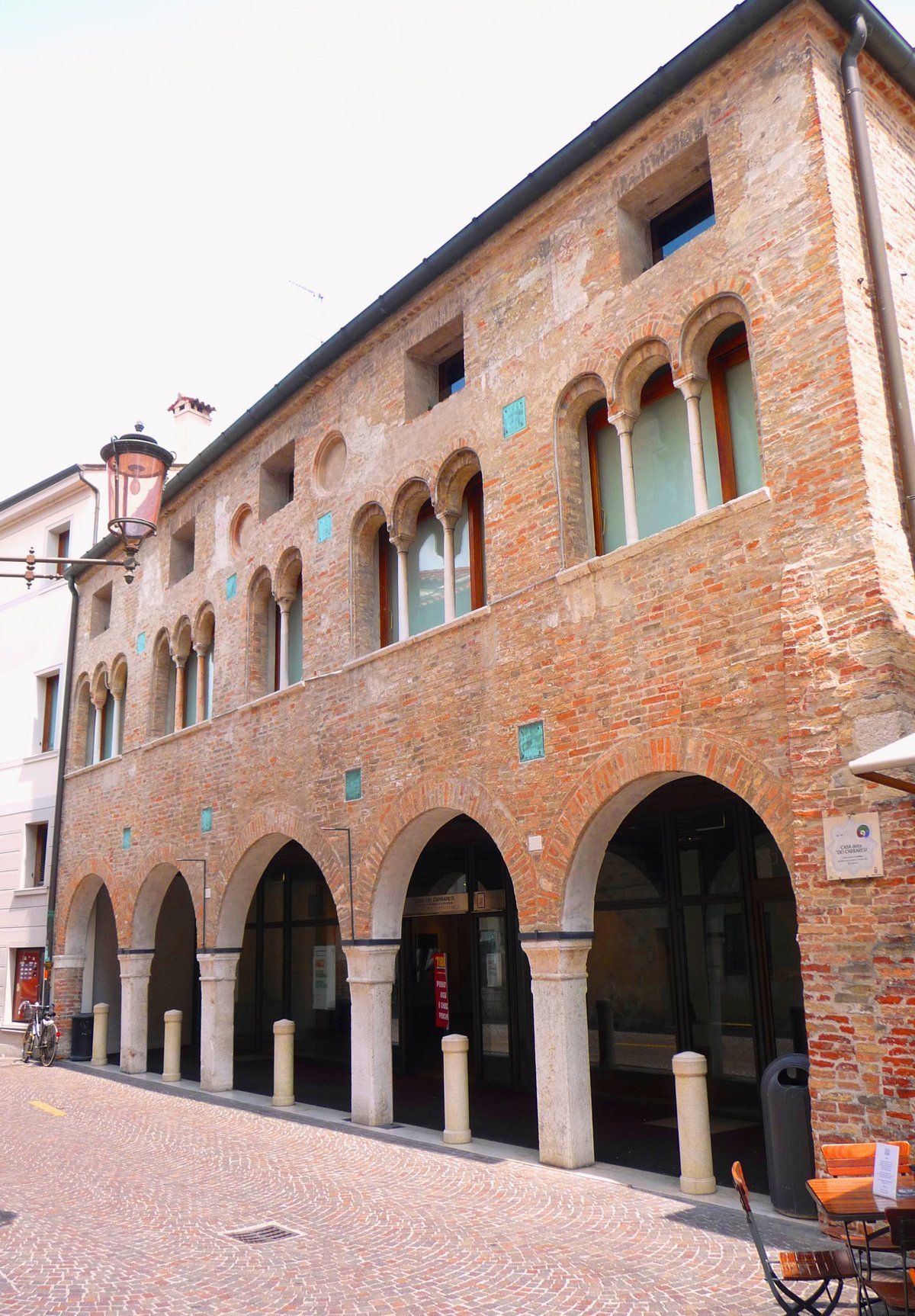 The final stop on our itinerary is a medieval gem that will surprise you. Casa dei Carraresi, now the exhibition center of the Fondazione Cassamarca, was originally an inn: in 1354 it was called Osteria alla Croce, a resting place for travelers and merchants from Germany and Austria. Then the lords of Padua, the Carraresi, requisitioned it as a base for officials and soldiers—hence the name. After their expulsion, the coats of arms on the facade were erased in spite, but they were brought to light during restorations in the 20th century. Today the building impresses with its exposed brick architecture: under the portico on Via Palestro, five round arches; above, symmetric mullioned and triple windows. Overlooking the Cagnan river, it features a terrace with a marble basin that seems to float on the water. Since 1987, over 500 exhibitions have been held here, from Cézanne to Warhol, and more than 5,000 events. Don’t miss the medieval frescoes in neighboring Casa Brittoni, including a Madonna and Child from the early 15th century. Opening hours vary depending on exhibitions, usually Monday 10 AM–7:30 PM, Tuesday–Sunday 10 AM–8 PM. A place where ancient history meets contemporary art.
- Via Palestro 33/35, Treviso (TV)
- https://www.casadeicarraresi.it/
- Open in Google Maps
- View on Google Images
You should go if…
Stop no. 7
Porta Altinia: Venice’s Ancient Gateway
 We conclude the itinerary at Porta Altinia, the oldest of Treviso’s three Renaissance gates, built between 1514 and 1515. It is the only surviving passage from the medieval walls, later incorporated into the 16th-century fortifications. Its name derives from Altino, the ancient Roman city toward which it was oriented. Goods destined for Venice that did not follow the Sile River passed through here. The external façade is sober, with exposed brick and a defaced Lion of St. Mark after the French occupation of 1797. Inside, frescoes attributed to Pomponio Amalteo depicted Attila’s attack, thwarted by Bishop Elviano: hence the legend of Attila’s throne and the popular corruption of the name into “Porta Attilia.” Today, the gate houses a hospitality facility, but the atmosphere remains that of a martial bulwark. Don’t miss the trace of the lion’s removal on the stone: a tangible mark of history. A perfect finale to savor the millennial bond between Treviso and the Serenissima.
- Porta Altinia, Treviso (TV)
- Open in Google Maps
- View on Google Images
You should go if…