
🧭 What to Expect
- Ideal for: art and architecture enthusiasts, mountain lovers, families seeking outdoor adventures
- Highlights: UNESCO World Heritage Palladian villas, pristine plateaus, caves and waterfalls, authentic food and wine traditions
- Must-see: Villa Capra "La Rotonda", Basilica Palladiana, Marostica's Chess Square, Leiten Shrine, Oliero Caves
- Best time: spring and autumn for mild weather, summer for the plateaus
Events nearby

The Province of Vicenza is a concentration of wonders: Renaissance architecture by Palladio, vast plateaus where you can breathe pure air, and a culinary tradition that can surprise. In this article, I'll get straight to the point: what you absolutely must see, from UNESCO gems like Villa Capra "La Rotonda" and the Teatro Olimpico in Vicenza, to the breathtaking panoramas of the Asiago Plateau and authentic villages like Marostica with its famous living chess game. Outdoor experiences are not lacking: excursions to Monte Pasubio, visits to the Oliero Caves, and relaxation at the Recoaro Terme. For food and wine enthusiasts, a must-stop is Bassano del Grappa for its distillate and local products. Every corner of the province tells a story, between Palladian villas scattered in the countryside and fortresses of the Great War. Ready to discover one of the most fascinating areas of Veneto?
Overview
- Villa Capra 'La Rotonda': the Palladian masterpiece
- Villa Capra 'La Rotonda': the Palladian masterpiece
- Basilica Palladiana: Vicenza's Symbol Where History Meets Beauty
- Teatro Olimpico: Palladio's Masterpiece in Vicenza
- Teatro Olimpico: Palladio's Masterpiece in Vicenza
- Piazza degli Scacchi: The Medieval Heart of Marostica
- Asiago Astrophysical Observatory
- Leiten War Memorial: A Dive into Memory
- Schio Castle
- A Soldier's Life in the Great War: An Intimate Museum in Recoaro Terme
- Pasubio Ossuary: A Beacon of Memory on Colle Bellavista
- Oliero Caves: A Dive into the Karst Heart of Veneto
- Villa Pisani in Lonigo: A Palladian Masterpiece
- Villa Pisani in Lonigo: A Palladian Masterpiece
- Villa Saraceno: Palladio's Hidden Gem
- Forte Verena: The Master of the Highlands
- Cappeller Wildlife Park: Animals, Botany, and Prehistory
- Monte Lungo: The Roof of the Berici Hills, Where Nature Meets Panoramic Views
Itineraries nearby


Villa Capra 'La Rotonda': the Palladian masterpiece
- Go to the page: Villa Capra La Rotonda: Central-plan Palladian architecture with views over Vicenza
- Via della Rotonda, Vicenza (VI)
- https://www.villalarotonda.it/
- Open in Google Maps
- View on Google Images
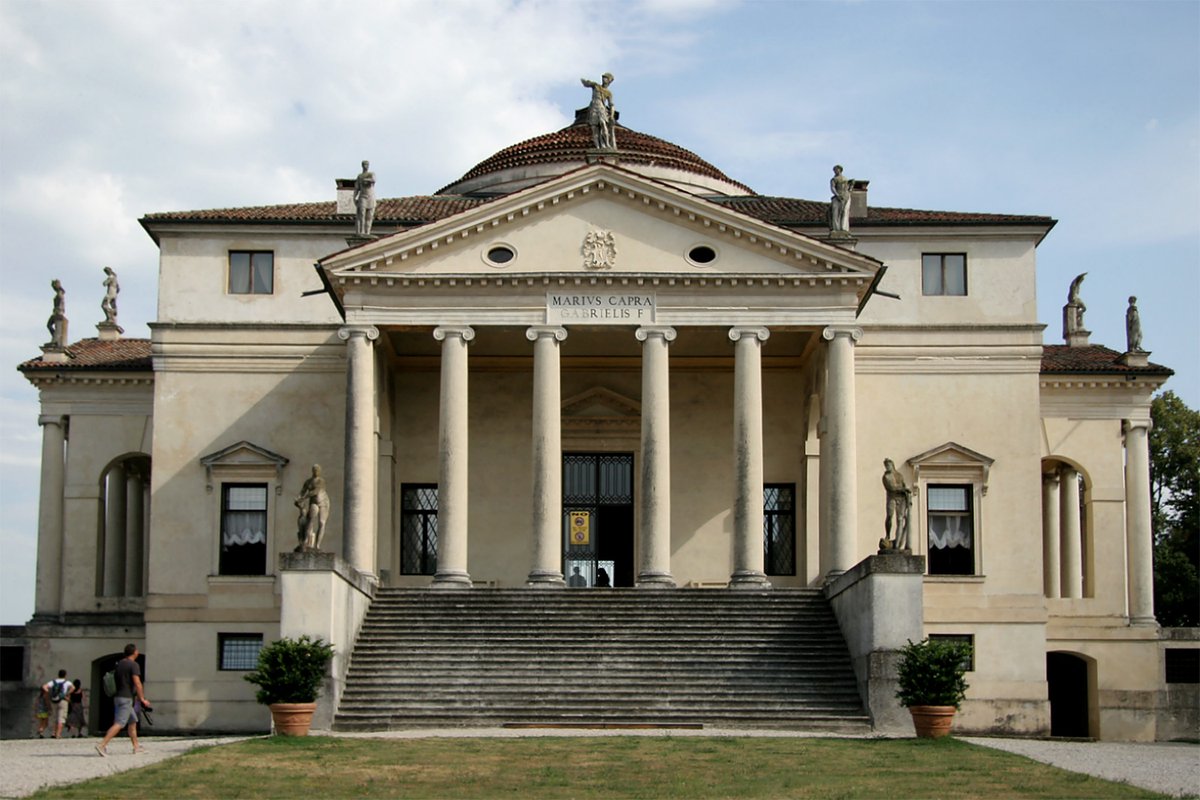 If there’s one villa that has made the world of architecture fall in love, it’s La Rotonda. Designed by Andrea Palladio in 1566 for canon Paolo Almerico, it stands on a hill just outside Vicenza, with a view embracing the hills and the sanctuary of Monte Berico. Its name, “Rotonda,” comes from the circular central hall covered by a hemispherical dome, a brilliant idea reminiscent of the Pantheon that makes the building unique. As soon as you arrive, you are struck by the four identical facades, each with a hexastyle pronaos and a staircase: it almost looks like a pagan temple. Inside, the frescoes by Alessandro Maganza and Louis Dorigny, with gigantic Olympian deities, make you feel in another world. And it’s not over: the stuccoes, the statues by Lorenzo Rubini, and the interventions by Scamozzi (who completed the work after Palladio’s death) enrich every corner. The villa still belongs to the Valmarana family, who opened it to the public in 1980. Visiting it is an experience that goes beyond mere architecture: the park, recently restored with a sensory garden and a grove, invites you to stroll among citrus trees and pathways. Book ahead, as hours are limited: from April to October only Fridays, Saturdays, and Sundays, and the ticket for interiors and exteriors costs €15 (but there’s also a guided tour called “I Segreti della Rotonda” for €20 that includes the monumental kitchens). In short, if you’re passing through Vicenza, don’t miss it.
Villa Capra 'La Rotonda': the Palladian masterpiece
- Go to the page: Villa Capra La Rotonda: Palladio's Masterpiece in Vicenza
- Via della Rotonda, Vicenza (VI)
- https://www.villalarotonda.it/
- Open in Google Maps
- View on Google Images
If there’s one villa that has made the world of architecture fall in love, it’s La Rotonda. Designed by Andrea Palladio in 1566 for canon Paolo Almerico, it stands on a hill just outside Vicenza, with a view embracing the hills and the sanctuary of Monte Berico. Its name, “Rotonda,” comes from the circular central hall covered by a hemispherical dome, a brilliant idea reminiscent of the Pantheon that makes the building unique. As soon as you arrive, you are struck by the four identical facades, each with a hexastyle pronaos and a staircase: it almost looks like a pagan temple. Inside, the frescoes by Alessandro Maganza and Louis Dorigny, with gigantic Olympian deities, make you feel in another world. And it’s not over: the stuccoes, the statues by Lorenzo Rubini, and the interventions by Scamozzi (who completed the work after Palladio’s death) enrich every corner. The villa still belongs to the Valmarana family, who opened it to the public in 1980. Visiting it is an experience that goes beyond mere architecture: the park, recently restored with a sensory garden and a grove, invites you to stroll among citrus trees and pathways. Book ahead, as hours are limited: from April to October only Fridays, Saturdays, and Sundays, and the ticket for interiors and exteriors costs €15 (but there’s also a guided tour called “I Segreti della Rotonda” for €20 that includes the monumental kitchens). In short, if you’re passing through Vicenza, don’t miss it.Basilica Palladiana: Vicenza's Symbol Where History Meets Beauty
- Go to the page: Palladian Basilica: Serliana loggias, 52-meter hall and UNESCO terrace
- Contra' del Monte, Vicenza (VI)
- http://www.basilicapalladiana.vi.it
- Open in Google Maps
- View on Google Images
 If there's one building that captures the soul of Vicenza, it's the Basilica Palladiana. Don't let the name fool you: it's not a church, but the medieval Palazzo della Ragione, clad by Andrea Palladio's genius in the 16th century. Its most famous feature is the Serlian loggias, a play of arches and columns that Palladio adapted to the pre-existing irregularity, creating a perfect rhythm. Walking under those porticoes makes you feel like you're inside a work of art.
Inside, the Council Hall is enormous: 52 meters by 22, with a wooden truss roof restored after the 1945 bombings. Today it hosts top-tier temporary exhibitions, like the recent "Italy Germany" (until May 2, 2027). But the real showstopper is the panoramic terrace (open from April 2025): a 360° view over rooftops, domes, and the Sanctuary of Monte Berico.
A detail that struck me? The copper roof in aquamarine green, reminiscent of an overturned ship. And do you know why it's called Basilica? Palladio named it in homage to ancient Roman courthouses. A UNESCO site since 1994, it's open Tuesday to Sunday (10 AM–6 PM, closed Monday), ticket €6 (free for residents). If you're in Vicenza, stop by: it's the beating heart of the city.
Teatro Olimpico: Palladio's Masterpiece in Vicenza
- Go to the page: Olympic Theatre: History and Visit of Palladio's Gem
- Stradella del Teatro Olimpico, Vicenza (VI)
- https://www.teatrolimpicovicenza.it/
- Open in Google Maps
- View on Google Images
- teatrolimpico@comune.vicenza.it
- +39 0444 222800
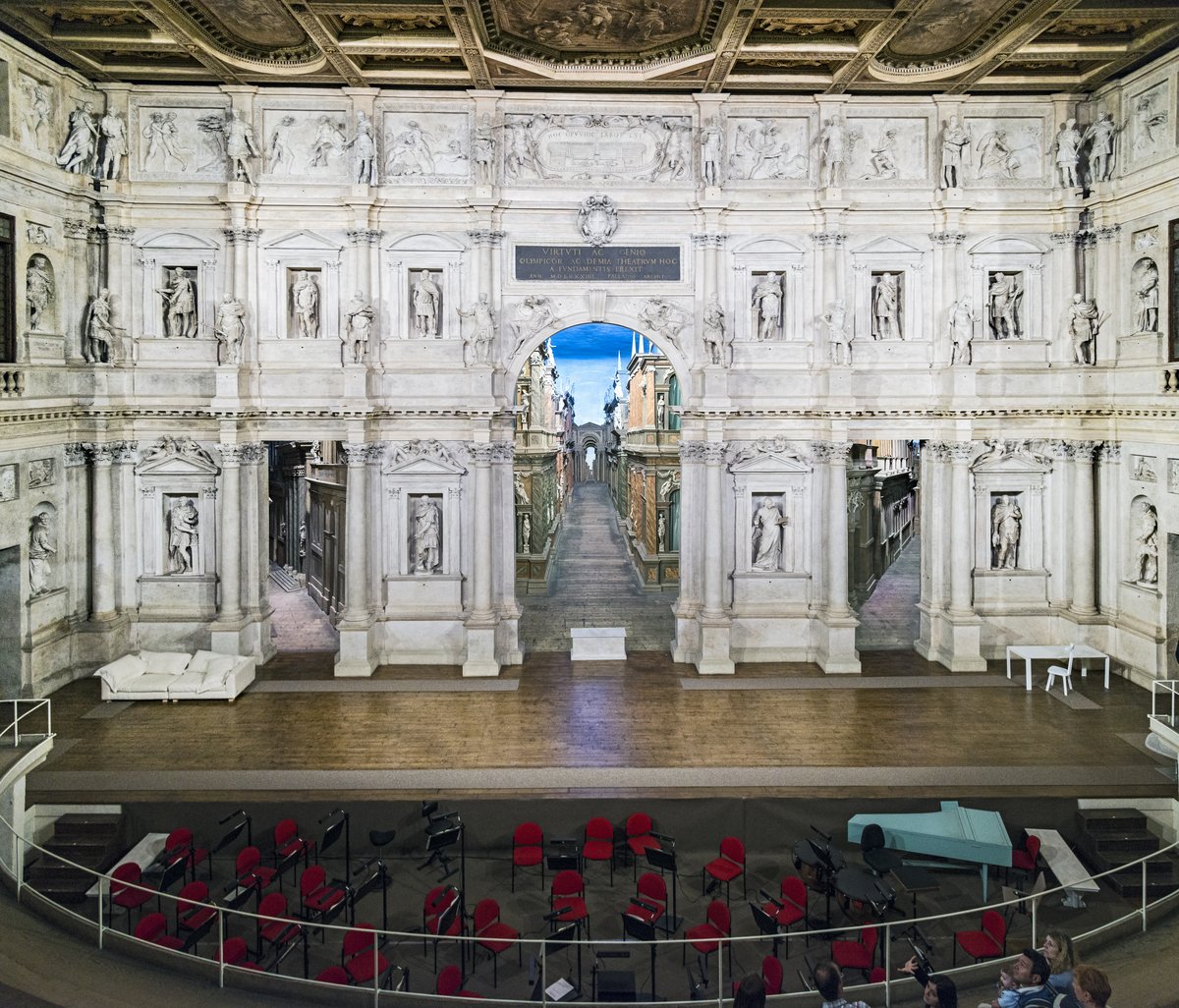 If there is one place that embodies the genius of Andrea Palladio, it is the Teatro Olimpico. It is not only the first permanent covered theater of the modern era but also the only one in the world to preserve its original Renaissance wooden sets. Stepping inside is like taking a leap back to 1585, when it was inaugurated with Sophocles' Oedipus Rex. The fixed scenery, designed by Vincenzo Scamozzi, depicts the seven streets of Thebes with a perspectival illusionism that seems to expand the space. The theater has been a UNESCO World Heritage Site since 1994 and a national monument since 2004. It seems incredible that it was built with humble materials like wood, stucco, and plaster, yet the effect is sumptuous. The elliptical cavea, the 95 statues, the two-tiered proscenium: every detail speaks of Palladio's passion for classical antiquity. Today, the theater has a limited capacity of 470 seats for conservation reasons (no heating or air conditioning to protect the structures). It is open Tuesday to Sunday (closed Monday): winter hours 9:00 AM–5:00 PM, summer hours 10:00 AM–6:00 PM. Tickets can be purchased on-site or online. If you happen to visit in spring or autumn, you might even catch a performance: the theater hosts the Classical Performances Cycle and festivals like Vicenza Jazz. A tip: do not lean on the balustrade, it is forbidden. And after your visit, take a stroll through the bookshop at Stradella dell'Olimpico 8, specialized in books on Palladio. In short, a gem not to be missed.
Teatro Olimpico: Palladio's Masterpiece in Vicenza
- Go to the page: Teatro Olimpico in Vicenza: World's First Covered Theater with Scamozzi's Fixed Stage
- Stradella del Teatro Olimpico, Vicenza (VI)
- https://www.teatrolimpicovicenza.it/
- Open in Google Maps
- View on Google Images
- teatrolimpico@comune.vicenza.it
- +39 0444 222800
If there is one place that embodies the genius of Andrea Palladio, it is the Teatro Olimpico. It is not only the first permanent covered theater of the modern era but also the only one in the world to preserve its original Renaissance wooden sets. Stepping inside is like taking a leap back to 1585, when it was inaugurated with Sophocles' Oedipus Rex. The fixed scenery, designed by Vincenzo Scamozzi, depicts the seven streets of Thebes with a perspectival illusionism that seems to expand the space. The theater has been a UNESCO World Heritage Site since 1994 and a national monument since 2004. It seems incredible that it was built with humble materials like wood, stucco, and plaster, yet the effect is sumptuous. The elliptical cavea, the 95 statues, the two-tiered proscenium: every detail speaks of Palladio's passion for classical antiquity. Today, the theater has a limited capacity of 470 seats for conservation reasons (no heating or air conditioning to protect the structures). It is open Tuesday to Sunday (closed Monday): winter hours 9:00 AM–5:00 PM, summer hours 10:00 AM–6:00 PM. Tickets can be purchased on-site or online. If you happen to visit in spring or autumn, you might even catch a performance: the theater hosts the Classical Performances Cycle and festivals like Vicenza Jazz. A tip: do not lean on the balustrade, it is forbidden. And after your visit, take a stroll through the bookshop at Stradella dell'Olimpico 8, specialized in books on Palladio. In short, a gem not to be missed.Piazza degli Scacchi: The Medieval Heart of Marostica
- Piazza degli Scacchi, Marostica (VI)
- Open in Google Maps
- View on Google Images
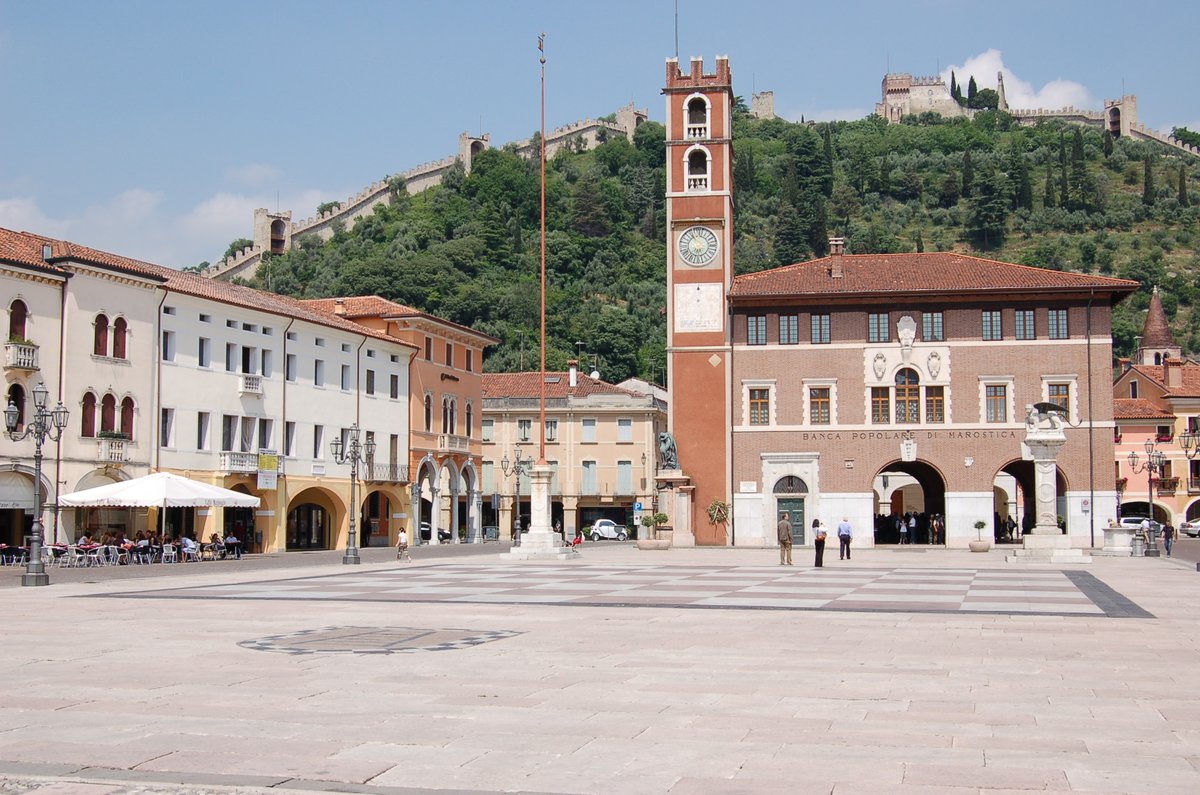 If you come to Marostica, the first thing that strikes you is Piazza degli Scacchi, one of the most scenic squares in the Veneto region. The name is no coincidence: the pavement is a real chessboard of 256 square meters, made with red and white marble from the Asiago Plateau, framed by dark trachyte. But the real magic happens every two years, on the second weekend of September of even years, when the square becomes the stage for the famous Living Chess Game. Over 600 figures in medieval costumes animate a challenge rooted in a legend from 1454: the lord Taddeo Parisio, to avoid a duel between two suitors of his daughter Lionora, decided that marriage would be decided by chess. The winner would marry Lionora, the loser her sister Oldrada. A happy ending for everyone, in short.
The square is rectangular and surrounded by monuments: on one side the Lower Castle with its imposing tower (built in 1312 by Cangrande della Scala), on the other the Upper Castle with four turrets, and the Palazzo del Doglione. Two sides are arcaded, perfect for a walk in the shade. On one side there is also Bottega Campana 1863, a cocktail bar in a historic furniture shop, ideal for an aperitivo with a view of the chessboard. Here, in 1954, Francesco Campana and Mirco Vucetich launched the idea of the reenactment.
Even if you are not here during the event, it's worth sitting at the tables under the arcades and imagining knights and ladies moving on the chessboard. All framed by the medieval walls that connect the two castles, almost 2 kilometers long. If you have time, climb to the Upper Castle (500 meters uphill) for a spectacular view of the square and the rooftops of Marostica. In short, a place that combines history, tradition, and a touch of legend – and works perfectly as a stop for a gelato or a drink.
Asiago Astrophysical Observatory
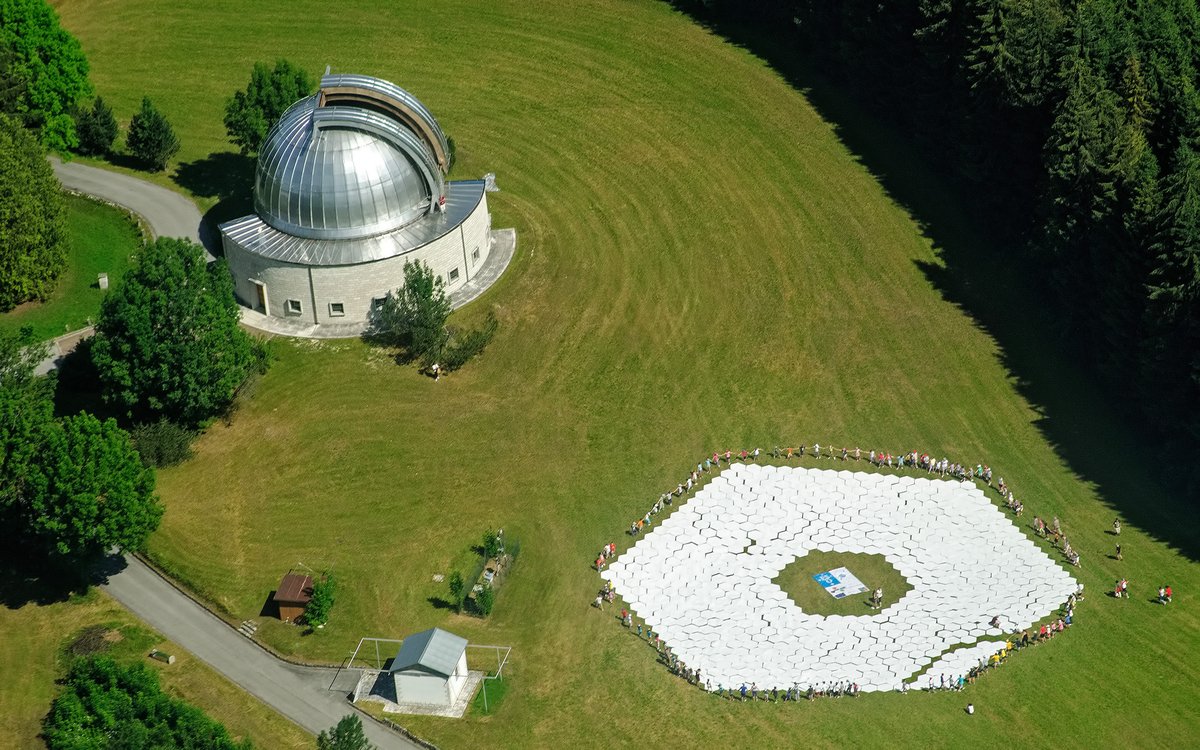 If you think the Asiago Plateau is just meadows, mountain huts, and Great War trenches, get ready to look up. Because here, at 1045 meters above sea level, stands the Asiago Astrophysical Observatory, a gem of Italian astronomical research. Founded in 1942 for the third centenary of Galileo Galilei's death, it was commissioned by the University of Padua precisely for the clarity of the skies in these parts. The project by architect Daniele Calabi gives the building an essential charm, surrounded by a thick fir forest.
The absolute protagonist is the Galileo telescope, with a mirror 122 cm in diameter: at the time of its inauguration, it was the largest in Europe, and today it is still perfectly functional. It is accompanied by other instruments, including the 23 cm refractor and a Celestron C11 for solar observations. But the observatory is not just pure research: it also does a lot of outreach. The Multimedia Room, created from the old dome of the Schmidt telescope, allows remote connection to the telescopes at Cima Ekar (4 km from here) and observation of the sky even in bad weather.
Don't miss the MUSA – Museum of Astronomical Instruments, which preserves the historical instruments used from the 1940s to the 1970s, and outside, in the meadow, the educational sundials. For families, there is a pedestrian path connecting the observatory to the Military Memorial, with scaled reproductions of the solar system elements. The evening public visits are a unique experience: the dark sky of the plateau offers a spectacular view of the Moon, planets, and stars, guided by astronomers from the University of Padua. In short, a place where the history of science is tangible, and your gaze is lost among the stars.
Leiten War Memorial: A Dive into Memory
- Via Leiten, Asiago (VI)
- Open in Google Maps
- View on Google Images
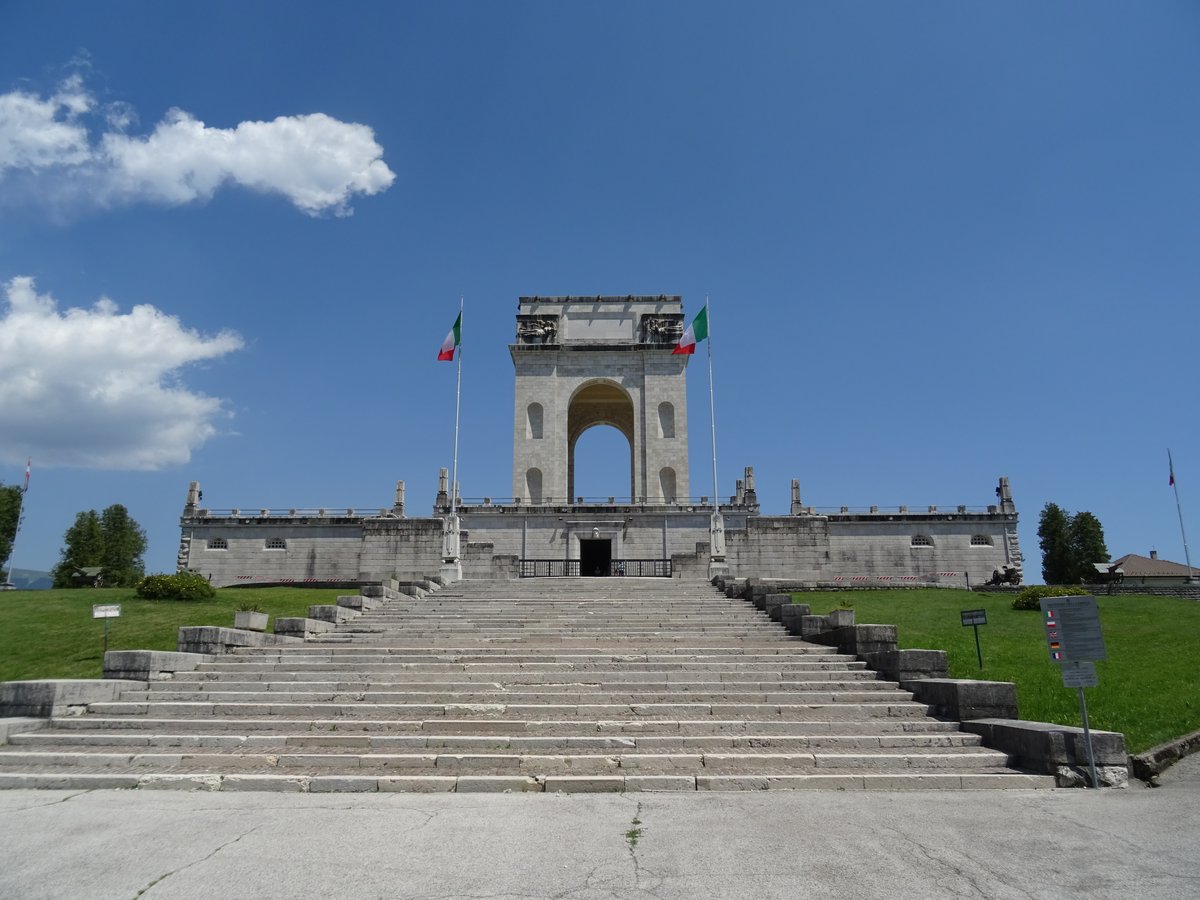 If there is a place that can make you feel small yet full of respect, it is the Leiten War Memorial, just a short walk from the center of Asiago. Perched at 1,058 meters above sea level on the hill of the same name, this imposing ossuary holds the remains of over 54,000 soldiers, Italian and Austro-Hungarian, who fell on the Altopiano dei Sette Comuni during World War I. Designed by Venetian architect Orfeo Rossato, it was completed in October 1936 and inaugurated two years later in the presence of King Vittorio Emanuele III. The structure has a square plan (80 meters per side) with an underground crypt where the burial niches run in symmetrical galleries. Above, the imposing quadrifront triumphal arch, 47 meters high, dominates the entire plateau. Climb the stairs, 35 meters wide on each side, and reach the panoramic terrace: from here your gaze sweeps over the peaks that made history – Pasubio, Zebio, Verena – and you understand why this is considered a symbol of the province of Vicenza. After two years of closure for restoration, the memorial reopened to the public on May 28, 2025. Inside the crypt, besides the alphabetically arranged niches, you will find a small octagonal chapel with the remains of twelve recipients of the Gold Medal. Don't miss the adjacent museum, which preserves a touching artifact: a letter from a young soldier written on the eve of the Battle of Ortigara. The memorial is accessible from Viale degli Eroi (free entry) and is open Tuesday to Saturday 9:00–12:00 and 14:00–17:00, Sunday and holidays 9:00–13:00. A place that leaves its mark, if only for the silence that surrounds you.
Schio Castle
- Via Petitti di Roreto, Schio (VI)
- Open in Google Maps
- View on Google Images
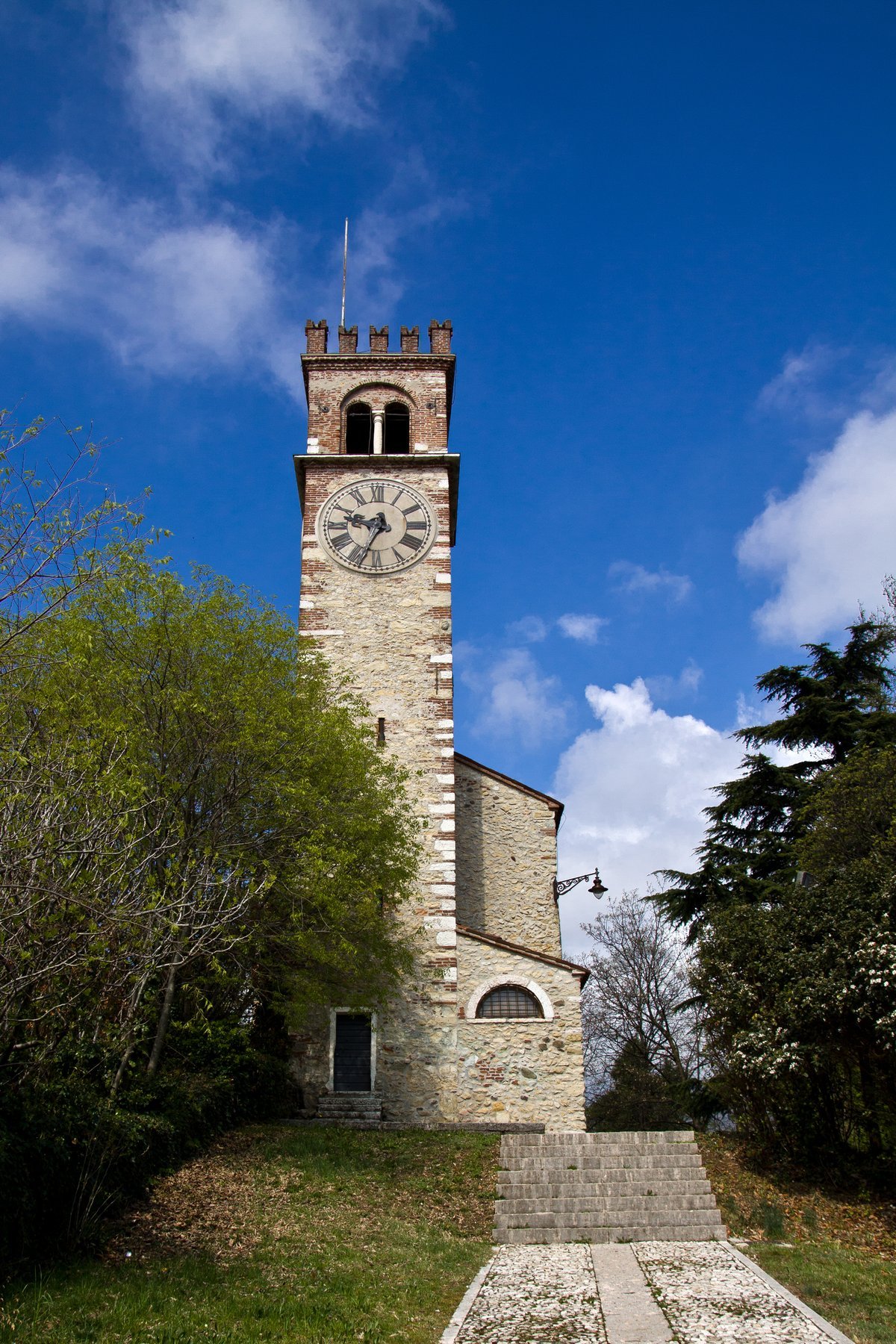 If you're passing through Schio, don't miss a walk up the hill overlooking the center: Schio Castle. Today, to be honest, only a few ruins remain of the actual castle, but the place has a charm all its own. Walk up the avenue of horse chestnuts to the little church of San Rocco, and you'll reach the top. Here you'll find the crenellated tower with its clock (installed in 1900), which has become the city's civic tower, and next to it the church of Santa Maria della Neve, deconsecrated, once part of the fortress. Don't expect an imposing castle: of the original structure, dismantled by Venice in 1412 and then definitively in 1514, only the bases of towers and walls remain. But history is palpable: it is said that its origins date back to the Iron Age, with settlements by the Euganei or Veneti. Then it belonged to the Maltraversi, the Scaligeri, the Visconti… in short, a succession of powerful families. A tip: take a look at the paintings by Francesco Verla from 1512, preserved in the church of San Francesco and in the Canossian convent; they show what the castle looked like before it was razed to the ground. At the foot of the hill, there is also a 1940s air raid shelter, now used for aging wines and cheeses – a curiosity not to be missed. The esplanade, set up as a public park, is perfect for a break with views of the Prealps. And if you love stories, look for the immersive exhibition “The Castle That Isn't There” at Lanificio Conte (open until October 2024), which with VR headsets lets you relive the fortress as you've never seen it. In short, a place that, despite its few remains, still speaks.
A Soldier's Life in the Great War: An Intimate Museum in Recoaro Terme
- Via Roma 17b, Recoaro Terme (VI)
- Open in Google Maps
- View on Google Images
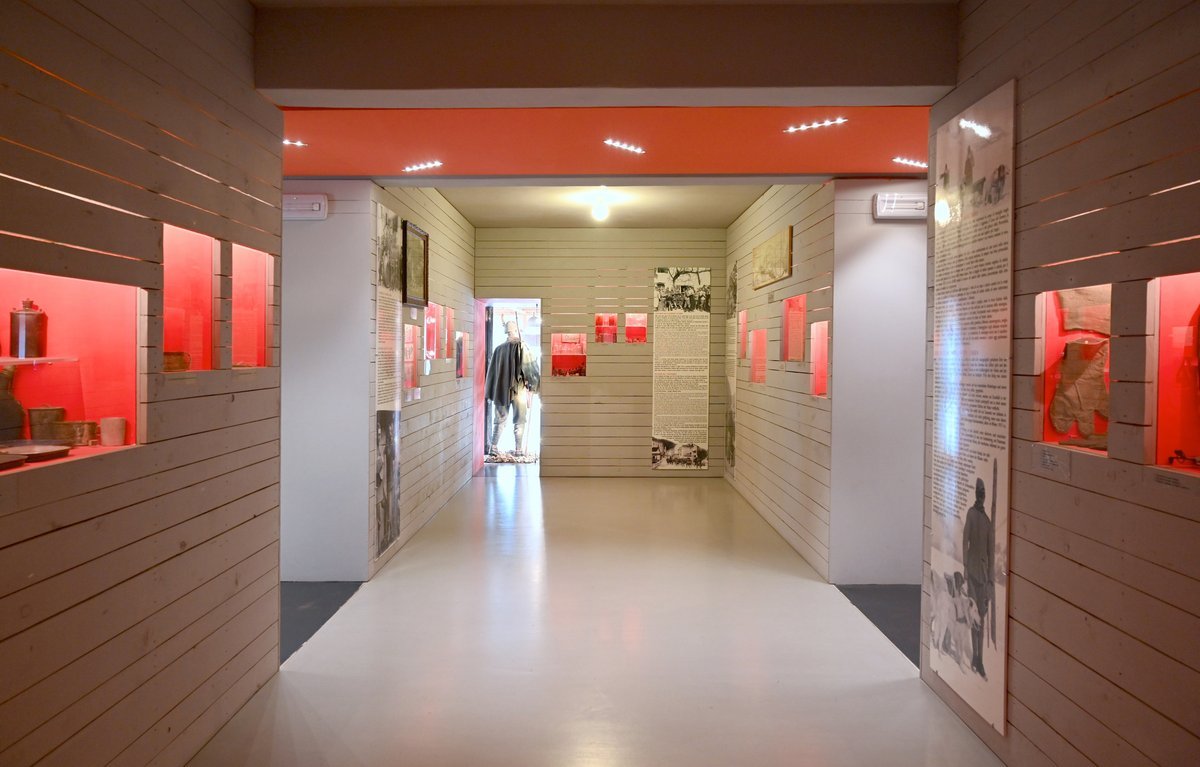 In Recoaro Terme, at Via Roma 17, there is a museum that sets aside cannons and medals and focuses on mess tins, boots, and tobacco boxes. It is the Historical Museum 'A Soldier's Life in the Great War,' opened in 1999 and the result of over thirty years of research by Antonio Storti on the battlefields of Adamello and Pasubio. Here, among about 1,200 artifacts, you breathe an anti-heroic dimension: the war seen through the objects of the men in the trenches. Clothing, feeding equipment, personal hygiene tools, work tools, and even games for rare moments of rest. The exhibition route starts with a model showing the movements of the front, then immerses you in daily life. Admission is free, but the museum is currently being rearranged: it is advisable to call 0445 76888 or write to biblioteca@comune.recoaroterme.vi.it to book. It is part of the Ecomuseum of the Vicentine Prealps, so it is the ideal starting point for excursions on the Great War trails at Campogrosso, Gazza, and Civillina. An unexpected place, far from war myths, almost domestic.
Pasubio Ossuary: A Beacon of Memory on Colle Bellavista
- Sentiero dell'Emmele, Valli del Pasubio (VI)
- Open in Google Maps
- View on Google Images
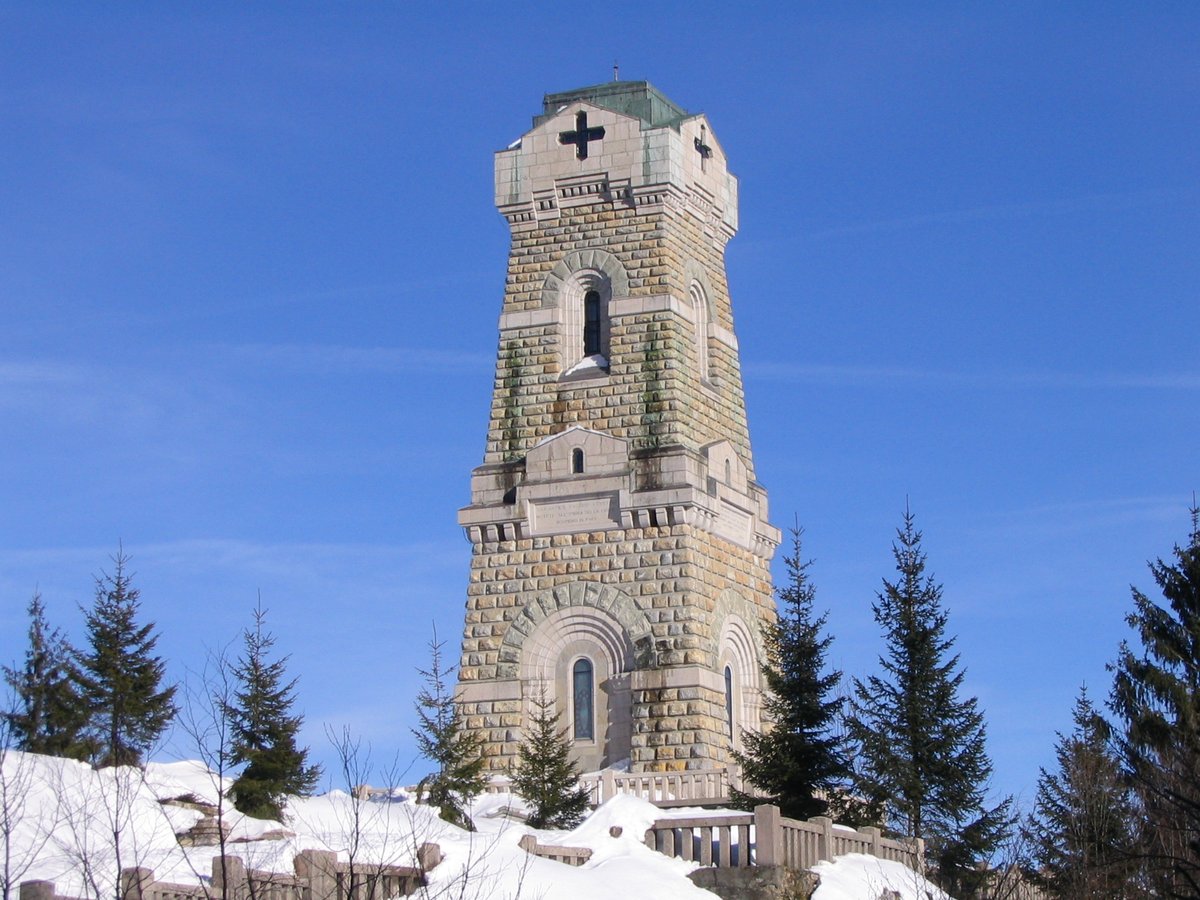 If there is a place that embodies the soul of the Great War on Pasubio, it is the Pasubio Ossuary. Perched on Colle Bellavista at an altitude of 1,217 meters, this monument is much more than a shrine: it is a true beacon of memory, visible from the entire Vicenza plain even at night thanks to the lantern on its summit. Designed by architect Ferruccio Chemello (who lost his son in the war) and decorated by Tito Chini, it was inaugurated in 1926 in the presence of King Victor Emmanuel III. Standing 35 meters tall, the structure consists of two parts: the actual ossuary in the base, with two concentric galleries housing the remains of 5,146 Italian soldiers and 40 Austrians, and the sacellum, a Greek-cross chapel with frescoes and stained glass. In the central crypt, since 1953, rests Marshal of Italy Guglielmo Pecori Giraldi, commander of the First Army. Climbing to the sacellum — passing through the Hall of Waiting and the Hall of Apotheosis — you reach a panoramic terrace that on clear days spans from Monte Grappa to the Venice lagoon. Entrance to the ossuary is free; the Museum of the First Army costs €2.50. The monument is wheelchair accessible and open from Tuesday to Sunday (closed Monday), with hours varying by season. A visit here is not just a dive into history: it is an emotion that catches you in the throat, amid the silence of the mountains and the weight of thousands of lives.
Oliero Caves: A Dive into the Karst Heart of Veneto
- Via Oliero di Sotto, San Nazario (VI)
- Open in Google Maps
- View on Google Images
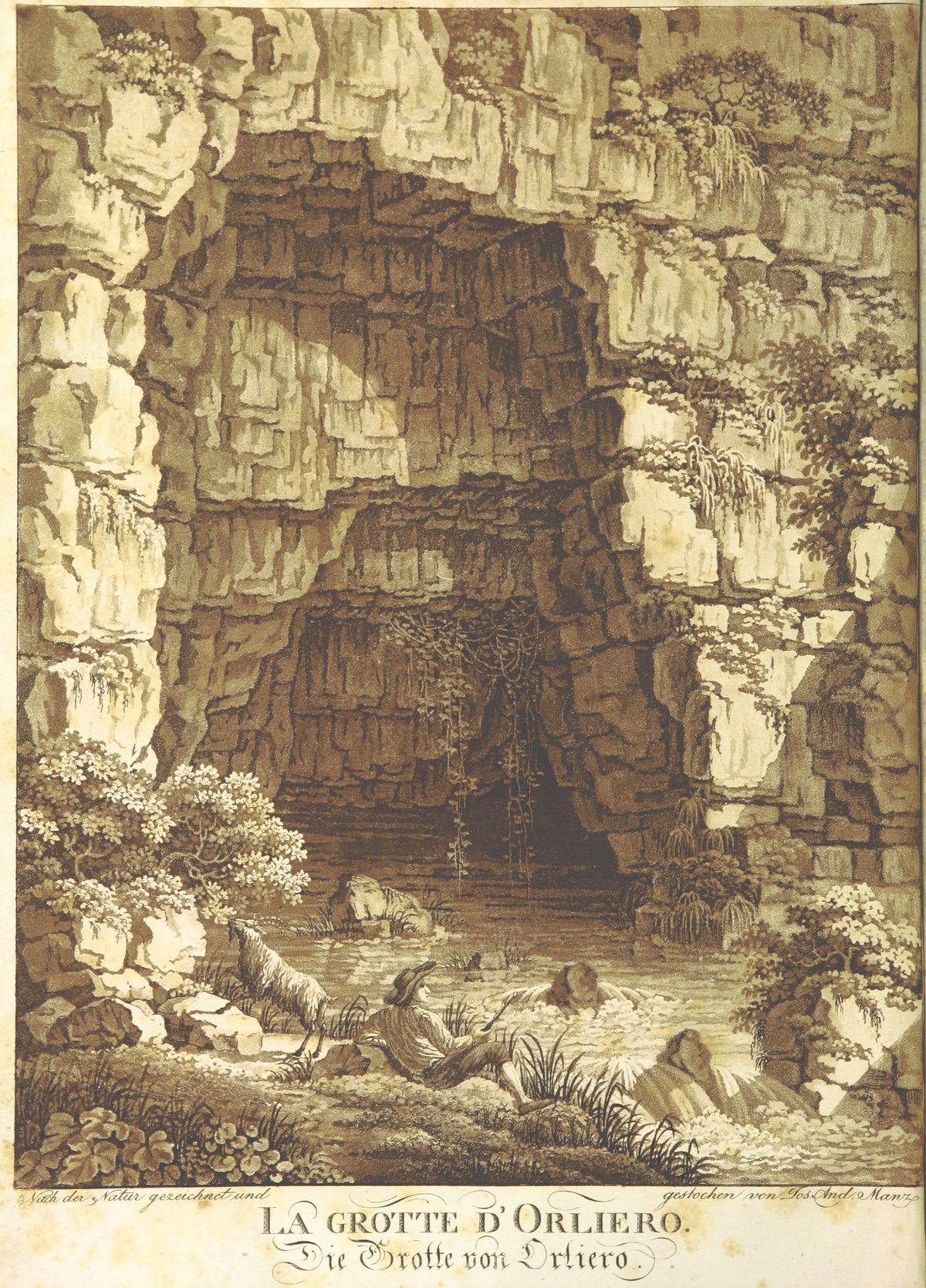 The Oliero Caves, located in the municipality of Valbrenta (VI), are no ordinary cavities: they are the largest Vauclusian springs in Europe, a true spectacle of nature. Discovered in 1882 by botanist Alberto Parolini, these caves lie at the foot of the Altopiano dei Sette Comuni. The complex includes four caves: Covol dei Veci and Covol dei Siori, from which the Oliero River emerges, and two upper caves now dry. The most evocative visit is to Grotta Parolini, accessible only by boat: a small hand-pulled wooden vessel takes you across a lake of crystal-clear waters, surrounded by millennia-old stalactites. You disembark at a dock and reach the Sala della Colata, where a 14-meter cascade of alabaster stalactites leaves you in awe. The tour lasts about half an hour, and the constant 12°C temperature calls for a windbreaker. Beyond the caves, the park also houses the Museum of Speleology and Karst and the Paper Museum, located in an 18th-century former paper mill. The area is a Site of Community Importance (SCI) and part of the Natura 2000 network, with unique fauna such as the Proteus anguinus. The park is open from April to September, with varying hours, but a spring visit is recommended to enjoy the coolness and fewer crowds.
Villa Pisani in Lonigo: A Palladian Masterpiece
- Go to the page: Villa Pisani in Lonigo: Fasolo's Frescoes and Palladian Italian Gardens
- Via Risaie, Lonigo (VI)
- Open in Google Maps
- View on Google Images
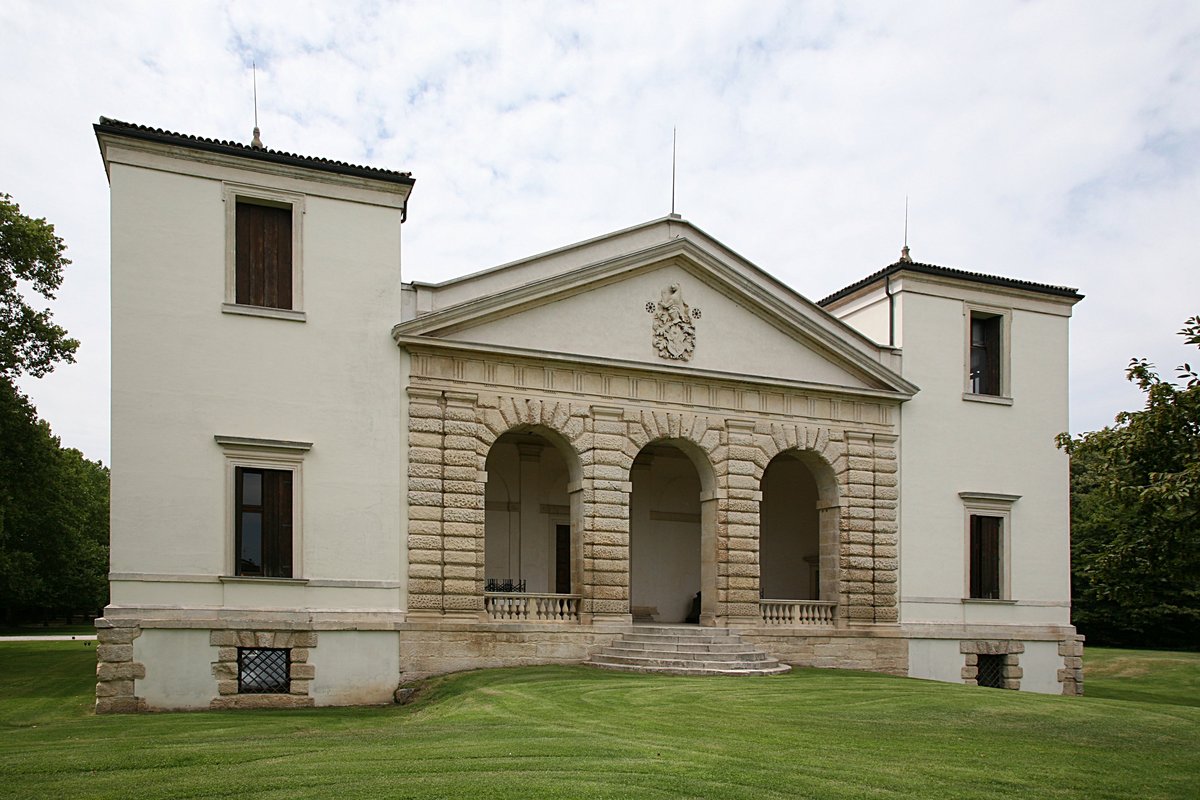 If you think you know all the Palladian villas, think again. Villa Pisani at Bagnolo di Lonigo is a gem that often goes unnoticed, but deserves far more attention. Designed by Andrea Palladio in 1542 for the brothers Vittore, Marco, and Daniele Pisani, it was his first commission from a major Venetian family. The villa stands along the Guà stream, surrounded by a historic park. The main façade, with three Doric rusticated arches and a triangular pediment, is a perfect example of Renaissance architecture. The two lower side towers, shorter than the original design, add a unique touch. Inside, the central T-shaped hall is frescoed by Francesco Torbido with scenes from Ovid's Metamorphoses. Today, the villa serves as a cultural hub, housing a contemporary art collection curated by owner Manuela Bedeschi and hosting annual exhibitions. The Barchessa, a typical 19th-century agricultural annex, has been transformed into a boutique hotel, while the Osteria del Guà offers a modern twist on local cuisine. Declared a UNESCO World Heritage Site in 1996, it can be visited only by appointment. I was struck by the elegant simplicity of the façade, reflected in the green of the park. A tip: plan your visit in advance and enjoy lunch at the Osteria. An experience that blends art, history, and flavors.
Villa Pisani in Lonigo: A Palladian Masterpiece
- Go to the page: Villa Pisani Lonigo: A Palladian Masterpiece and Art
- Via Risaie, Lonigo (VI)
- Open in Google Maps
- View on Google Images
If you think you know all the Palladian villas, think again. Villa Pisani at Bagnolo di Lonigo is a gem that often goes unnoticed, but deserves far more attention. Designed by Andrea Palladio in 1542 for the brothers Vittore, Marco, and Daniele Pisani, it was his first commission from a major Venetian family. The villa stands along the Guà stream, surrounded by a historic park. The main façade, with three Doric rusticated arches and a triangular pediment, is a perfect example of Renaissance architecture. The two lower side towers, shorter than the original design, add a unique touch. Inside, the central T-shaped hall is frescoed by Francesco Torbido with scenes from Ovid's Metamorphoses. Today, the villa serves as a cultural hub, housing a contemporary art collection curated by owner Manuela Bedeschi and hosting annual exhibitions. The Barchessa, a typical 19th-century agricultural annex, has been transformed into a boutique hotel, while the Osteria del Guà offers a modern twist on local cuisine. Declared a UNESCO World Heritage Site in 1996, it can be visited only by appointment. I was struck by the elegant simplicity of the façade, reflected in the green of the park. A tip: plan your visit in advance and enjoy lunch at the Osteria. An experience that blends art, history, and flavors.Villa Saraceno: Palladio's Hidden Gem
- Via Finale, Finale (VI)
- Open in Google Maps
- View on Google Images
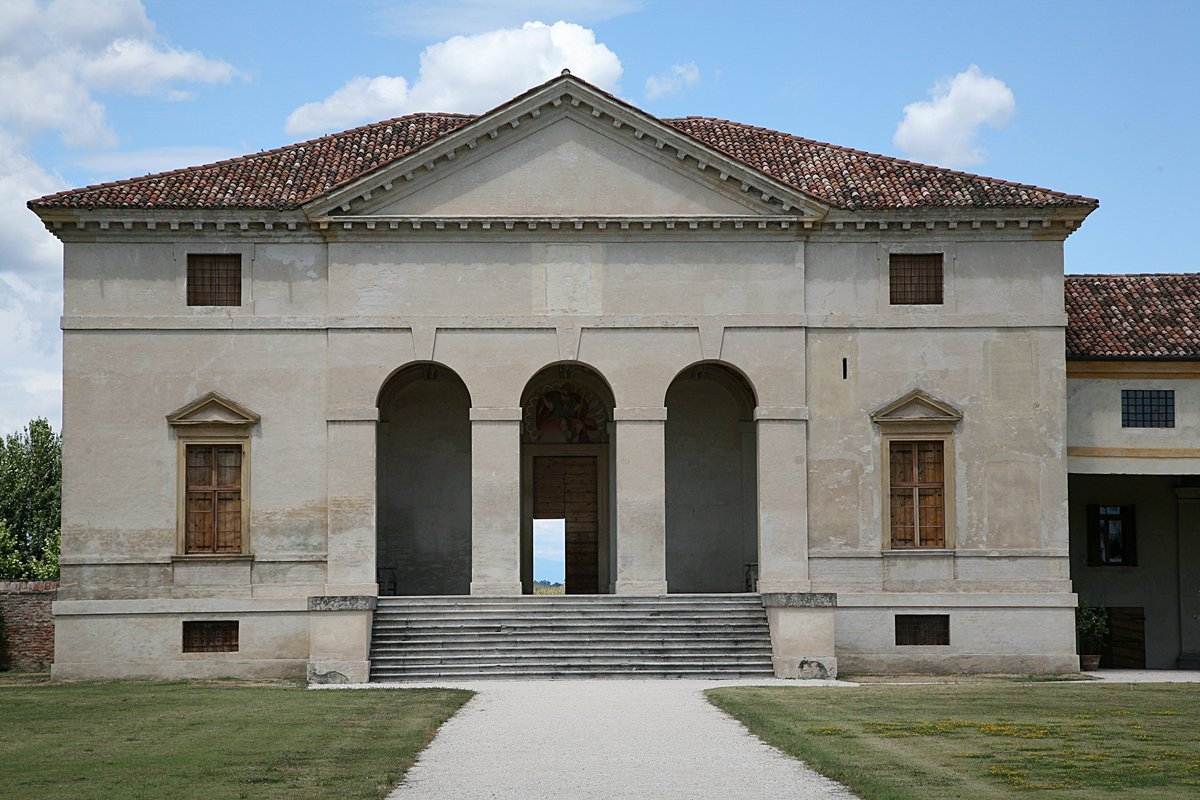 If you think of Palladian villas, you imagine grand buildings with columns and statues. But Villa Saraceno is a different story. Located in Finale di Agugliaro, deep in the Vicenza countryside, a young Palladio—around 1548—created one of his purest, most intimate designs. The client? Biagio Saraceno, a Vicentino politician, who asked him to renovate an existing farmhouse. The result is a simple, almost ascetic volume in brick and plaster, without frills. The three-arched loggia and pediment recall Roman temples, yet the whole is sober, almost bare. The T-shaped hall is the heart, overlooking the orchard on one side and the courtyard on the other. Inside, sixteenth-century frescoes attributed to Domenico Brusasorzi survive only in part: an allegorical Wealth in the loggia, a frieze in a side room. For decades the villa lay abandoned until 1989, when the Landmark Trust, a British foundation, bought it and lovingly restored it (work finished in 1994). Today it can be visited, but only on set days: from April to October on Wednesday afternoons, or by appointment for groups. It is one of the least lavish villas, but perhaps for that reason the most authentic: you can almost feel the rural life of the 16th century. If you’re in the area, don’t miss it. Take time to observe the bare façade and the lateral barchessa, added in the 19th century. Oh, the address is Via Finale 8 – and if you’re an architecture enthusiast, here you’ll understand why Palladio is considered a genius.
Forte Verena: The Master of the Highlands
- Alle Pareti, Roana (VI)
- Open in Google Maps
- View on Google Images
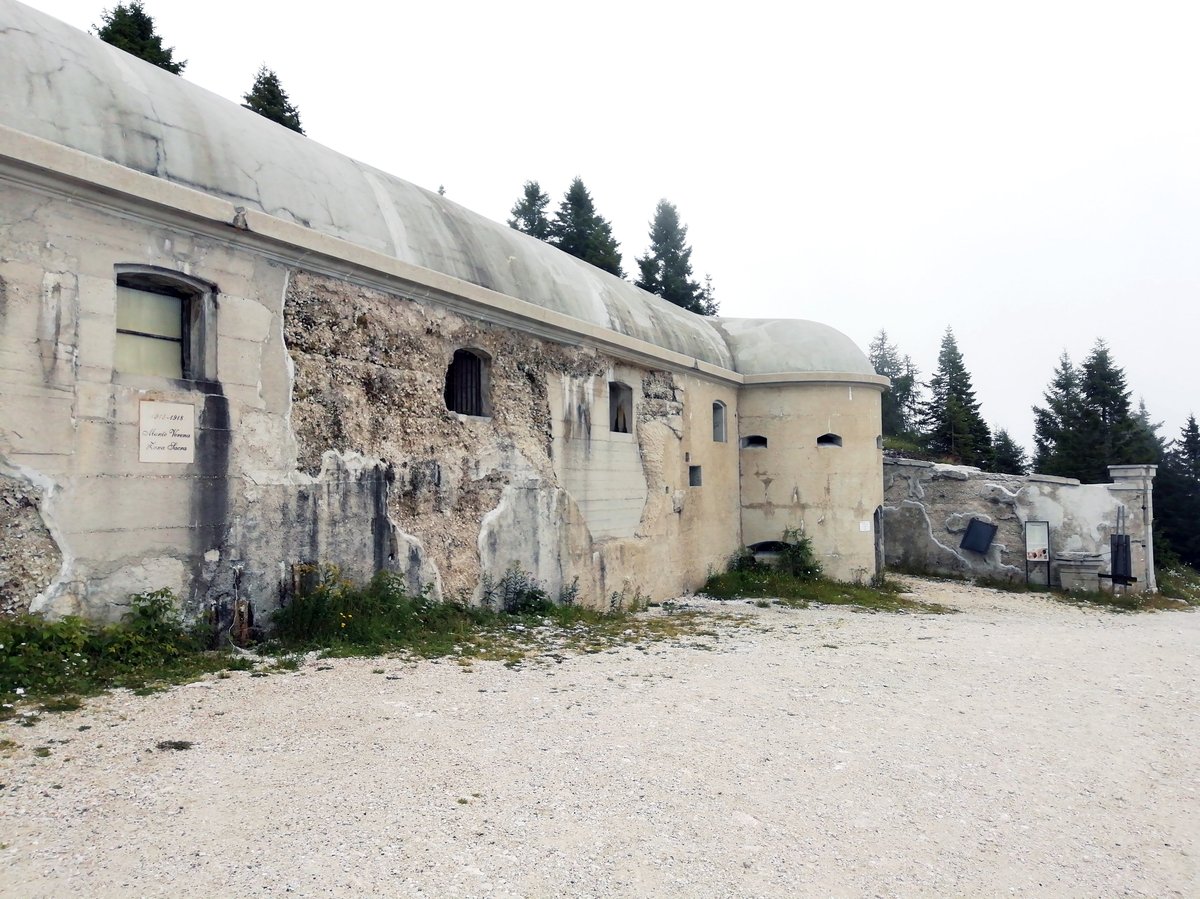 If there is one place that encapsulates the history of the Great War in Veneto, it is Forte Verena. Perched on Monte Verena at 2,015 meters, it dominates the Asiago Plateau with a 360-degree panorama. The Austro-Hungarians called it 'the Master of the Plateau,' and not without reason: from here, on May 24, 1915, the first Italian cannon shot of World War I was fired. Built between 1912 and 1914, the fort was armed with four 149 mm cannons in armored cupolas, but haste and poor-quality cement sealed its fate. On June 12, 1915, a 305 mm Austrian shell penetrated the casemate, killing 44 artillerymen, including the commander. Today, the fort is free to visit and offers a unique experience: walking among the ruins, observing the damage from the shell, and imagining the soldiers' lives. The classic hike starts from Casara di Campovecchio (1,523 m) and follows the CAI 820 trail, a comfortable mule track winding through red firs. In about 4 hours (round trip, 11 km with 500 m elevation gain) you reach the top, where you'll also find the Rifugio Verena for a typical lunch. The route is suitable for hikers of moderate experience and is accessible all year round: in winter, with crampons or snowshoes, the fort is even more evocative. Once at the summit, the view stretches from the Pale di San Martino to the Lagorai, all the way to Carega. A tip: stay for sunset, when the sun tints the Dolomites red.
Cappeller Wildlife Park: Animals, Botany, and Prehistory
- Via Kimle, Cartigliano (VI)
- Open in Google Maps
- View on Google Images
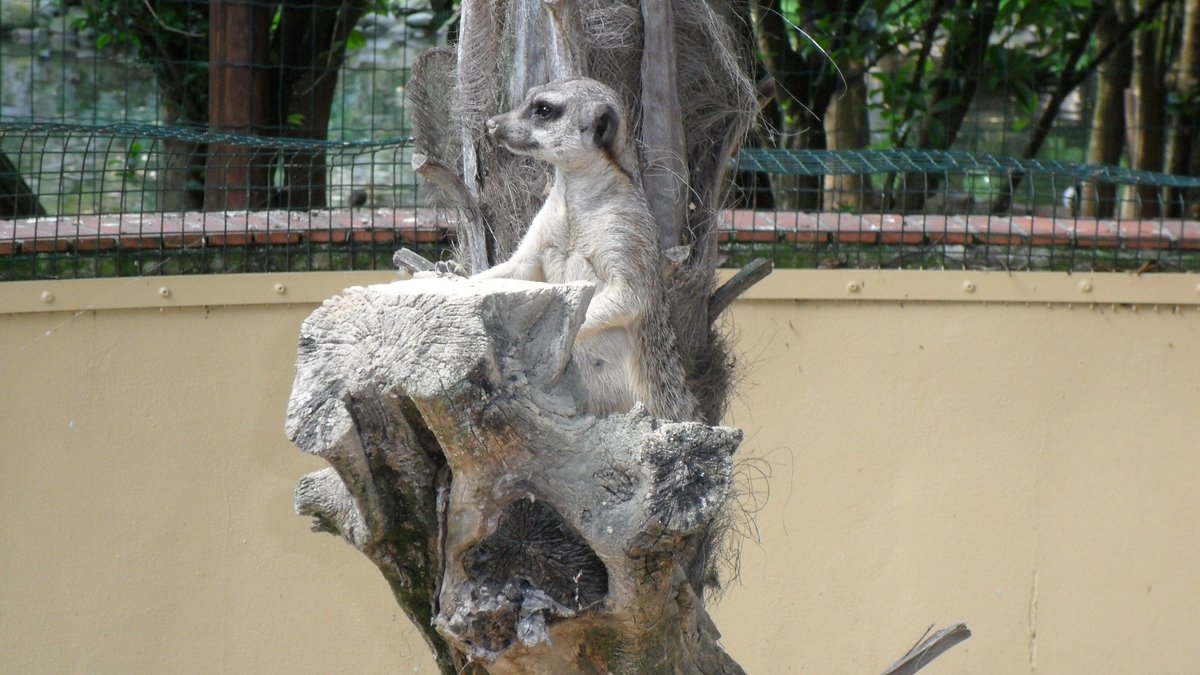 If you're in the Vicenza area and looking for a day trip that combines nature, education, and fun, the Cappeller Wildlife Park in Cartigliano is a must-see. Open to the public since March 1998, it spans 40,000 square meters and is not just a zoo: it's a true botanical garden with over 500 plant species (tropical ferns, exotic palms, conifers) framing the animals. The park is home to hundreds of specimens from around the world, from monkeys and kangaroos to pygmy hippos and lemurs, all in habitats designed for their well-being. Don't expect a flashy park, but an intimate place that invites observation and respect. A highlight is the Cappeller Museum, inaugurated in 2009 for Darwin's bicentennial: over 2,400 square meters, it displays over 4,000 taxidermied specimens and reconstructions that tell the story of human and animal evolution. Outside, dinosaur statues delight the little ones. Services are well thought out: accessible paths, shaded picnic areas, two cafés, a playground, and informative staff. It's recommended to follow the route counterclockwise so you don't miss any inhabitants. Hours: March to November, daily 9am-7pm (Sundays until 8:30pm); closed in December. Tickets: adults €15, children €9.50 (ages 2-10), museum extra €4. No dogs allowed. An experience that blends leisure and awareness, perfect for families and nature enthusiasts.
Monte Lungo: The Roof of the Berici Hills, Where Nature Meets Panoramic Views
- Via Mantovan, San Giovanni in Monte (VI)
- Open in Google Maps
- View on Google Images
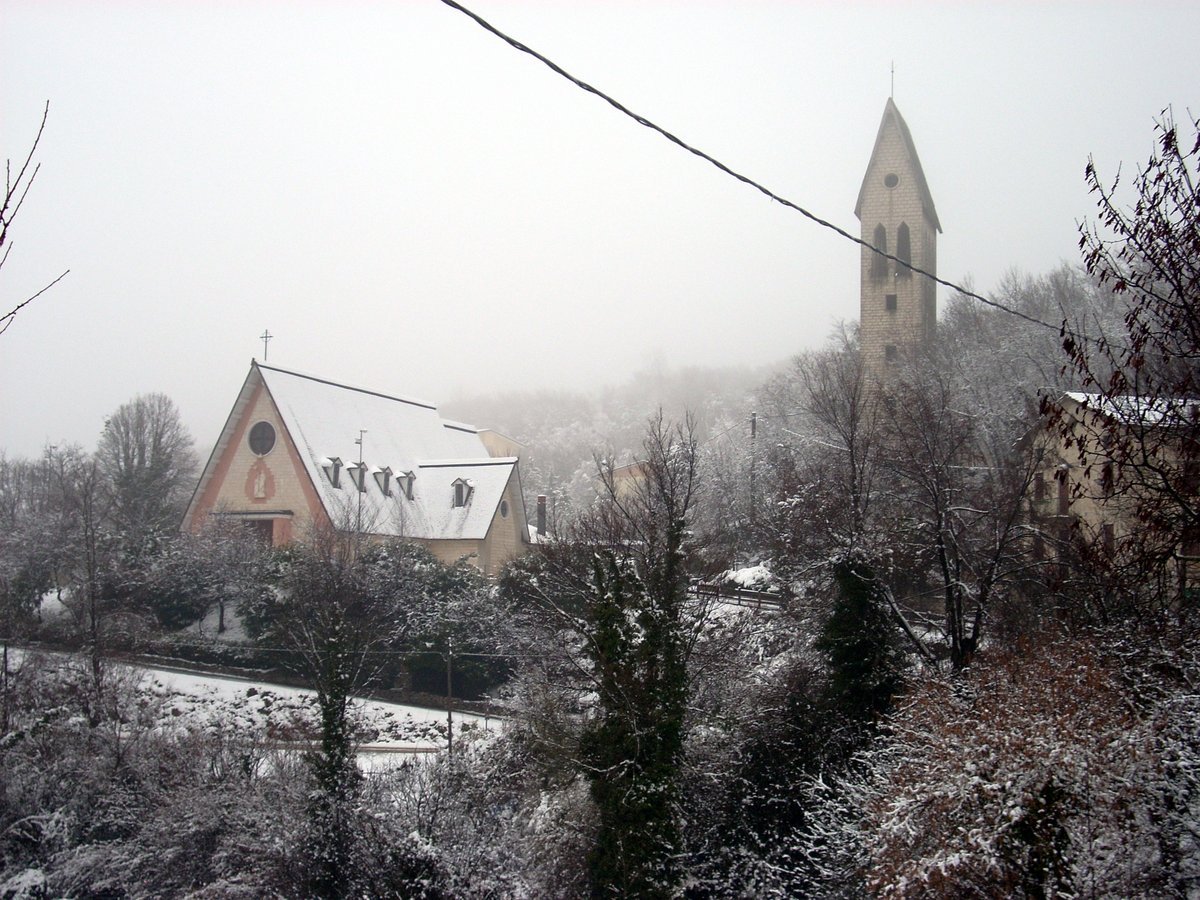 If you're looking for a place where time seems to move slower, Monte Lungo is just right. At 445 meters above sea level, it's the highest point of the Berici Hills, located in the quiet hamlet of San Giovanni in Monte, in the municipality of Barbarano Mossano. Once you arrive, you'll immediately understand why the climb is worth it: the summit is a perfect mix of woods, clearings, and ancient dry stone walls, with remnants of rural farmhouses that tell stories of bygone days. And then there are the “covoli”, those strange rock formations shaped by erosion: the Berici hills have over 580 of them, but here they feel like silent guardians. The beauty of Monte Lungo is that you don't need to be an experienced hiker to enjoy it. The trails are simple, and from those along the southern slopes – especially from Monte Cengia – the view is breathtaking: on a clear day, you can see the eastern Berici hills, the entire lower Vicenza area, and in the distance, the profiles of the Euganean Hills. It's the classic spot where you sit on a rock, quiet and still, and take in the spectacle. There's no crowd, no chaos. Just the wind in the trees and a silence that fills you. In short, if you're passing through these parts, Monte Lungo is a stop that won't disappoint.