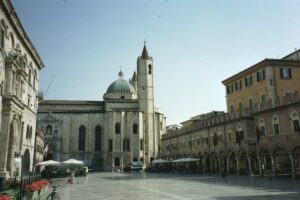
Ascoli Piceno is a travertine jewel nestled among the Marche mountains, and a walking tour is the most authentic way to explore it. In this day we will lead you through the historic center, an open-air museum where Roman walls, ancient bridges, and Renaissance palaces blend harmoniously. We’ll start from Piazza Arringo, the oldest square in the city, to visit the Civic Art Gallery and the Archaeological Museum, keepers of artistic treasures and historical artifacts. We’ll continue along Corso Mazzini to Piazza del Popolo, Ascoli’s living room, then reach the Forte Malatesta, an imposing fortress overlooking the city. A 7-stop route combining culture, architecture, and breathtaking views, perfect for those who love history and timeless beauty. We’ll cross the Roman Bridge, a testimony of ancient Rome, and every corner tells centuries of history. The route is easy and well-marked, ideal for those with limited time but wanting a complete experience. Comfortable shoes, camera, and off you go!
🗺️ Your trip at a glance
This 1-day itinerary takes you to the heart of Ascoli Piceno, from Piazza Arringo to Forte Malatesta, with visits to the Civic Art Gallery and Archaeological Museum. A perfect blend of history, art, and architecture.
- Ideal for curious travelers who love exploring cities on foot, immersing themselves in history.
- Highlights: travertine, Roman walls, ancient bridges, prestigious museums, and panoramic views.
- For whom: cultural explorers and city-breakers seeking an authentic 1-day experience.
Itinerary stops
Stop no. 1
Piazza Arringo: the oldest living room of Ascoli
 Our journey to Ascoli Piceno begins here, in what is considered the oldest and most solemn square of the city. Piazza Arringo, probably the ancient Roman forum, takes its name from the medieval popular assemblies held there, called ‘arringhi’. Today it is an explosion of travertine combining the majestic Cathedral of Sant’Emidio, the Romanesque Baptistery, the Palazzo dell’Arengo, and the Archaeological Museum. In the center, two elegant elliptical fountains from 1884, adorned with bronze sea horses, add a scenic touch. As you walk, imagine Saint Francis of Assisi who preached here in 1215, or the great elm tree symbol of justice that once stood in the center. The travertine paving, recently restored, invites you to pause and admire the Baroque and Renaissance facades. It is the perfect starting point to immerse yourself in Ascoli’s history.
- Go to the page: Piazza Arringo Ascoli Piceno: Cathedral, Art Gallery and Golden Travertine Pavement
- Ascoli Piceno (AP)
- Open in Google Maps
- View on Google Images

You should go if…
Stop no. 2
Palazzo dell’Arengo
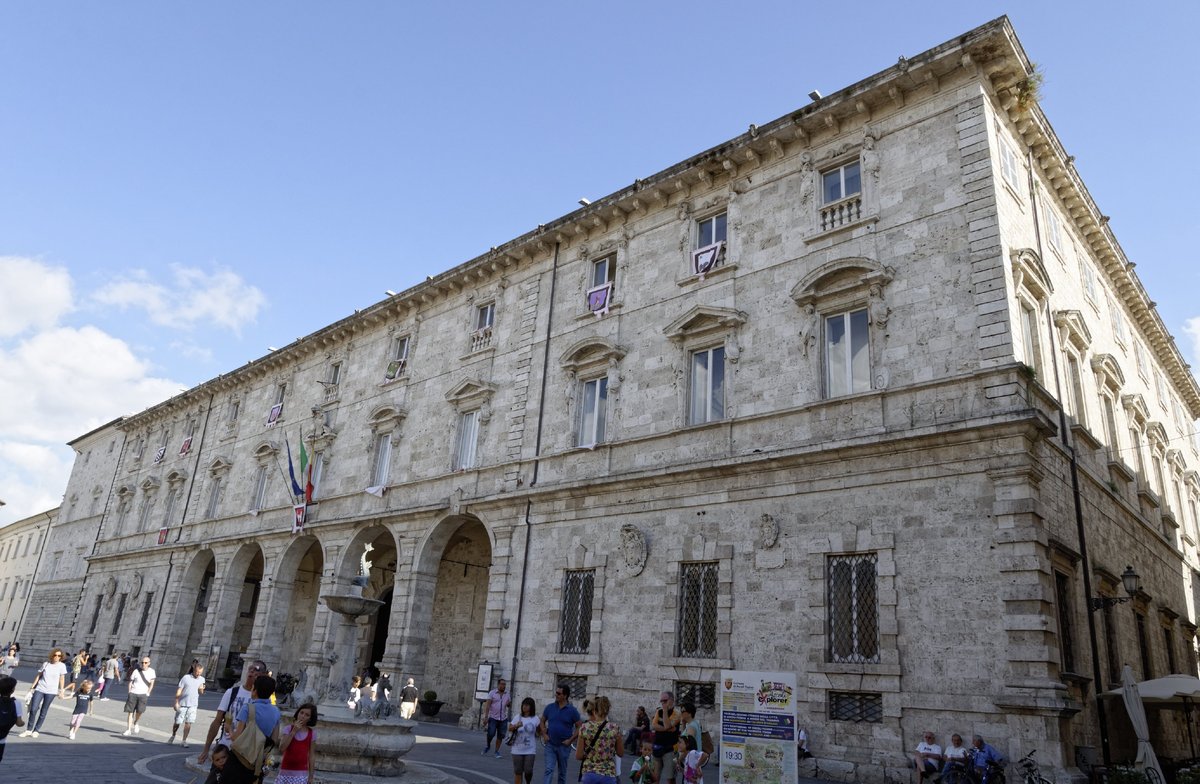 Right after Piazza Arringo, the Palazzo dell’Arengo dominates the scene with its travertine facade, the result of the union of the Palazzo Maggiore and Palazzo Minore, unified in the 17th century by architect Cavagna. The work was completed by the Giosafatti family in the 18th century. Under the five-arched portico, the large rusticated portal leads to a hall that was a 13th-century three-aisled room, once used as a market and tribunal. Today it houses the municipal offices and the Pinacoteca Civica, with masterpieces by Van Dyck and Tintoretto. Don’t miss the inner courtyard, with busts of illustrious Ascolani and Roman and medieval artifacts. On the ground floor, the Sala dei Mercatori displays two Lombard tombs. In short, a palace that tells the story of Ascoli from every angle.
- Go to the page: Arengo Palace Ascoli Piceno: Medieval Architecture and 13th-Century Loggia
- Piazza Arringo, Ascoli Piceno (AP)
- Open in Google Maps
- View on Google Images
You should go if…
Stop no. 3
Pinacoteca Civica: a treasure of art and history
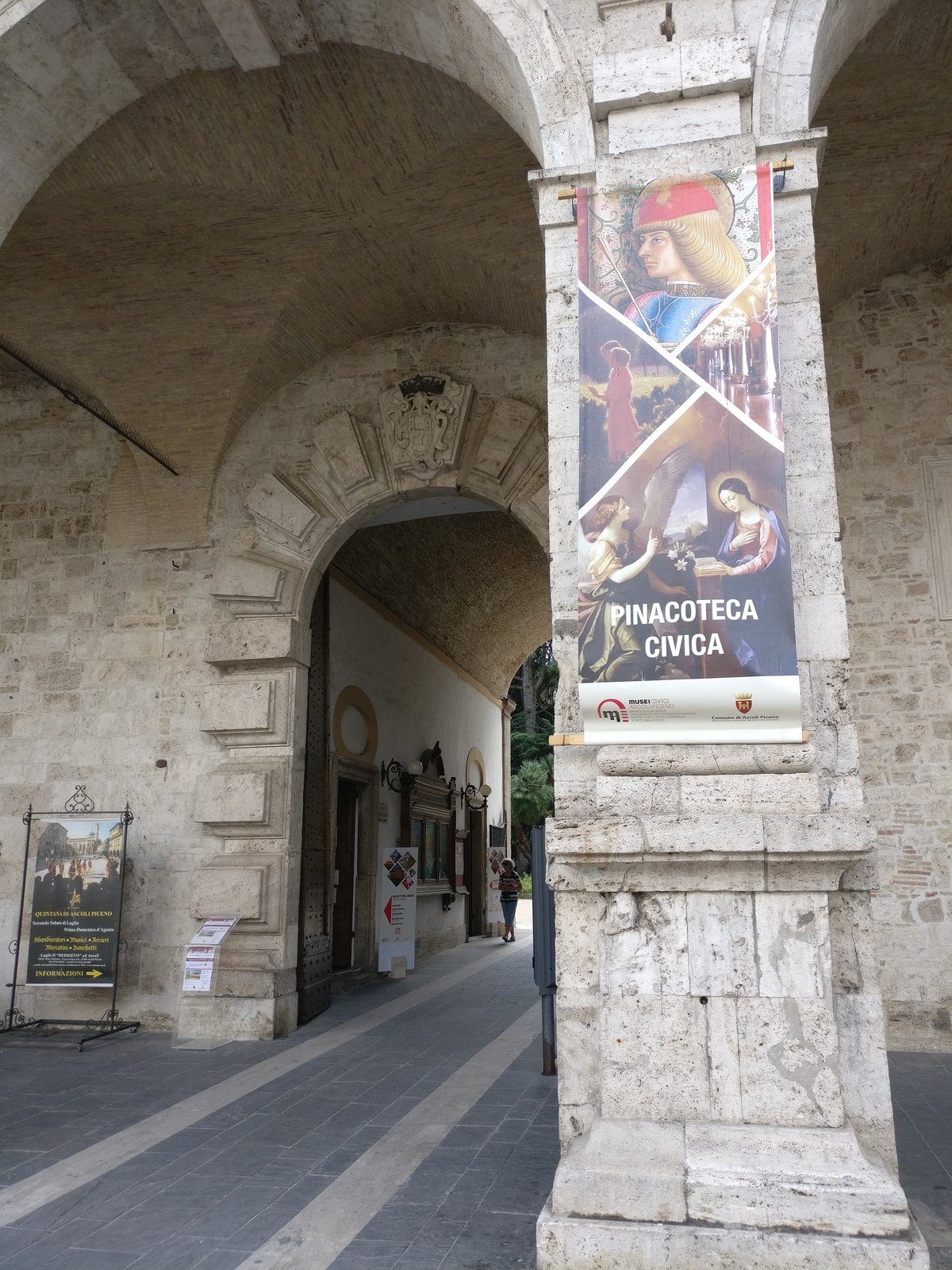 Climbing the grand staircase of the Palazzo dell’Arengo, you reach the Pinacoteca Civica, one of the most important museums in the Marche region. Founded in 1861, it houses over 800 works from the 13th to the 20th century, in an arrangement that resembles a noble palace: 18th-century furniture, Murano glass chandeliers, and Venetian mirrors donated by the Sgariglia family create a unique atmosphere. Among the highlights are the triptychs by Carlo Crivelli (from Valle Castellana), the precious Piviale di Niccolò IV (English craftsmanship from the 13th century), the San Francesco by Titian, and the Annunciation by Guido Reni. Don’t miss the Sala della Vittoria with the polyptych by Cola dell’Amatrice and the Passeggiata amorosa by Pellizza da Volpedo. The 15 rooms are spread across the first and second floors, offering a full immersion in Marche and Italian art. The museum is accessible with audio guides and tactile tours: in short, a gem to explore at leisure.
- Go to the page: Civic Art Gallery of Ascoli Piceno: Masterpieces from the Middle Ages to the 20th Century
- Piazza Arringo, Ascoli Piceno (AP)
- Open in Google Maps
- View on Google Images
You should go if…
Stop no. 3
Pinacoteca Civica: a treasure of art and history
Climbing the grand staircase of the Palazzo dell’Arengo, you reach the Pinacoteca Civica, one of the most important museums in the Marche region. Founded in 1861, it houses over 800 works from the 13th to the 20th century, in an arrangement that resembles a noble palace: 18th-century furniture, Murano glass chandeliers, and Venetian mirrors donated by the Sgariglia family create a unique atmosphere. Among the highlights are the triptychs by Carlo Crivelli (from Valle Castellana), the precious Piviale di Niccolò IV (English craftsmanship from the 13th century), the San Francesco by Titian, and the Annunciation by Guido Reni. Don’t miss the Sala della Vittoria with the polyptych by Cola dell’Amatrice and the Passeggiata amorosa by Pellizza da Volpedo. The 15 rooms are spread across the first and second floors, offering a full immersion in Marche and Italian art. The museum is accessible with audio guides and tactile tours: in short, a gem to explore at leisure.- Go to the page: Ascoli Piceno Civic Art Gallery: Crivelli’s Polyptych and Marche Art in Palazzo dell’Arengo
- Piazza Arringo, Ascoli Piceno (AP)
- Open in Google Maps
- View on Google Images
You should go if…
Stop no. 4
Roman Theatre: A Semicircle of History
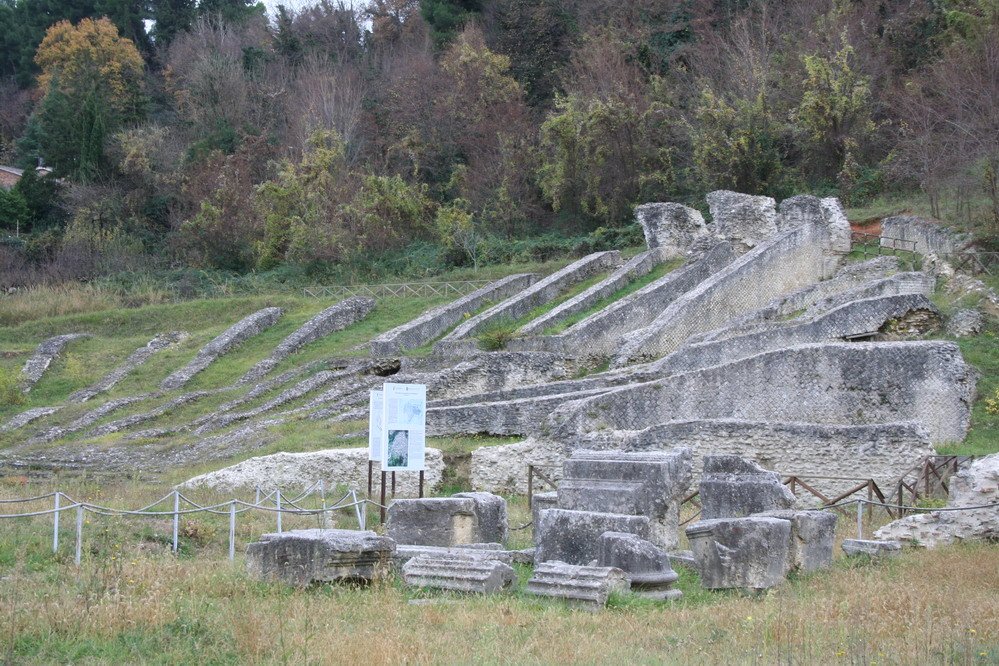 From the Pinacoteca, you descend towards Via Francesco Ricci, and suddenly the semicircular cavea of the Roman Theatre appears. Dating back to the 1st century BC, it was the stage for crucial events such as the killing of the Roman legates that sparked the Social War. With a diameter of 95 meters, the structure takes advantage of the slope of the Colle dell’Annunziata. Today, the radial walls in opus reticulatum and a semicircular exedra remain. After a long abandonment and Lombard looting, it was rediscovered in the 1930s and reopened in 2010. In summer, it hosts performances: sitting on the travertine steps (even if partially reconstructed) as the sun sets is a fascinating experience. Entry is by reservation, but it’s worth it for those who love archaeology and Roman history.
- Go to the page: Roman Theater Ascoli Piceno: 1st Century BC Cavea in the Historic Center
- Via Francesco Ricci, Ascoli Piceno (AP)
- Open in Google Maps
- View on Google Images
You should go if…
Stop no. 5
Forte Malatesta: From Prison to Museum
 After the Roman Theatre, crossing the Ponte di Cecco you reach Forte Malatesta, a fortress that tells centuries of history. Built on the remains of Roman baths, it was rebuilt by Galeotto Malatesta in 1349 and later transformed by Antonio da Sangallo the Younger in 1543 for Pope Paul III. Its irregular star shape is a Renaissance masterpiece. Until 1978 it served as a prison, but today, after a decade-long restoration, it houses the Museum of the Early Middle Ages. Inside, the Lombard grave goods from Castel Trosino – jewelry, weapons, a complete lady and knight – are displayed with multimedia supports. Until October 2025, there is also the exhibition “Seeing is Believing. Cecco’s Shadow” by Antonio Marras, which plays with light and memory in the dodecagonal church of Santa Maria del Lago. Entrance costs €6 (reduced €4), open Tuesday-Sunday. A place that stratifies eras: you breathe power, pain, and today, culture.
- Go to the page: Forte Malatesta: Medieval Fortress with Breathtaking Views over Ascoli Piceno
- Ponte di Cecco, Ascoli Piceno (AP)
- Open in Google Maps
- View on Google Images
You should go if…
Stop no. 6
Porta Gemina: The Roman Gateway to the City
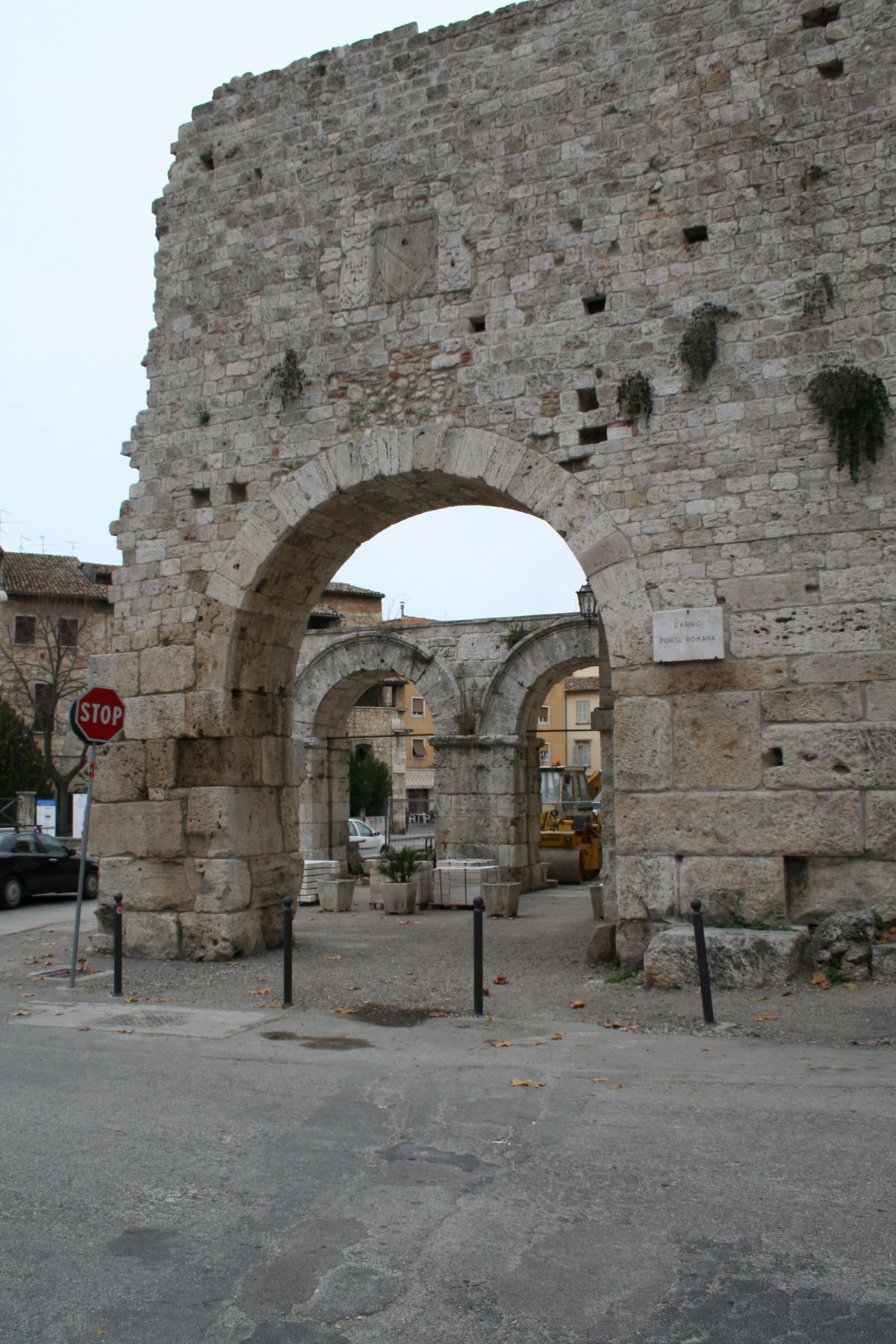 After Forte Malatesta, following the traces of the ancient walls, you arrive at Piazza Cecco d’Ascoli, where Porta Gemina stands—the eastern entrance to the historic center. Built in the 1st century BC, it’s a gem of Roman architecture with two symmetrical arches in local travertine, each 5.70 meters high and nearly 3 meters wide. Beneath the arches, you can still see the grooves of the portcullis, a sign that access to the Via Salaria was once controlled here—the salt road connecting Rome to the Adriatic. What struck me is the layering: in the Middle Ages, a second row of arches and a 13th-century circular-based merlon tower were added, still clearly visible. For a time, one of the two passages was blocked by a small church, then reopened in the 19th century. Walking among these squared, uncemented blocks gives the feeling of touching history with your own hands. The gate is always accessible, and from here you can admire the city from a unique perspective.
- Piazza Cecco d’Ascoli, Ascoli Piceno (AP)
- Open in Google Maps
- View on Google Images
You should go if…
Stop no. 7
State Archaeological Museum of Ascoli Piceno
 After leaving Porta Gemina, just cross Piazza Arringo to reach the State Archaeological Museum, housed since 1981 in the historic Palazzo Panichi. The 16th-century facade hides a courtyard with travertine arches and a frescoed hall: stepping inside is already a dive into the past. The itinerary unfolds over three floors, from prehistory to the Romans, but the heart is the Piceni section on the first floor. Here you can admire the famous female lozenge-shaped belts from the Salino necropolis, the engraved parure from Monteprandone, and the stele of Castignano, a rare testimony of South Picene writing. Don’t miss on the ground floor the sling bullets with inscriptions from the Social War and the splendid mosaic with a double-faced herma. The museum is open from Tuesday to Sunday (8:30 AM – 7:30 PM), closed on Mondays; full ticket €4. An essential place to understand the roots of Ascoli.
- Go to the page: Archaeological Museum of Ascoli Piceno: Piceni and Roman Treasures
- Piazza Arringo 28, Ascoli Piceno (AP)
- http://musei.beniculturali.it/musei?mid=204&nome=museo-archeologico-statale-di-ascoli-piceno
- Open in Google Maps
- View on Google Images
You should go if…
Stop no. 7
State Archaeological Museum of Ascoli Piceno
After leaving Porta Gemina, just cross Piazza Arringo to reach the State Archaeological Museum, housed since 1981 in the historic Palazzo Panichi. The 16th-century facade hides a courtyard with travertine arches and a frescoed hall: stepping inside is already a dive into the past. The itinerary unfolds over three floors, from prehistory to the Romans, but the heart is the Piceni section on the first floor. Here you can admire the famous female lozenge-shaped belts from the Salino necropolis, the engraved parure from Monteprandone, and the stele of Castignano, a rare testimony of South Picene writing. Don’t miss on the ground floor the sling bullets with inscriptions from the Social War and the splendid mosaic with a double-faced herma. The museum is open from Tuesday to Sunday (8:30 AM – 7:30 PM), closed on Mondays; full ticket €4. An essential place to understand the roots of Ascoli.You should go if…