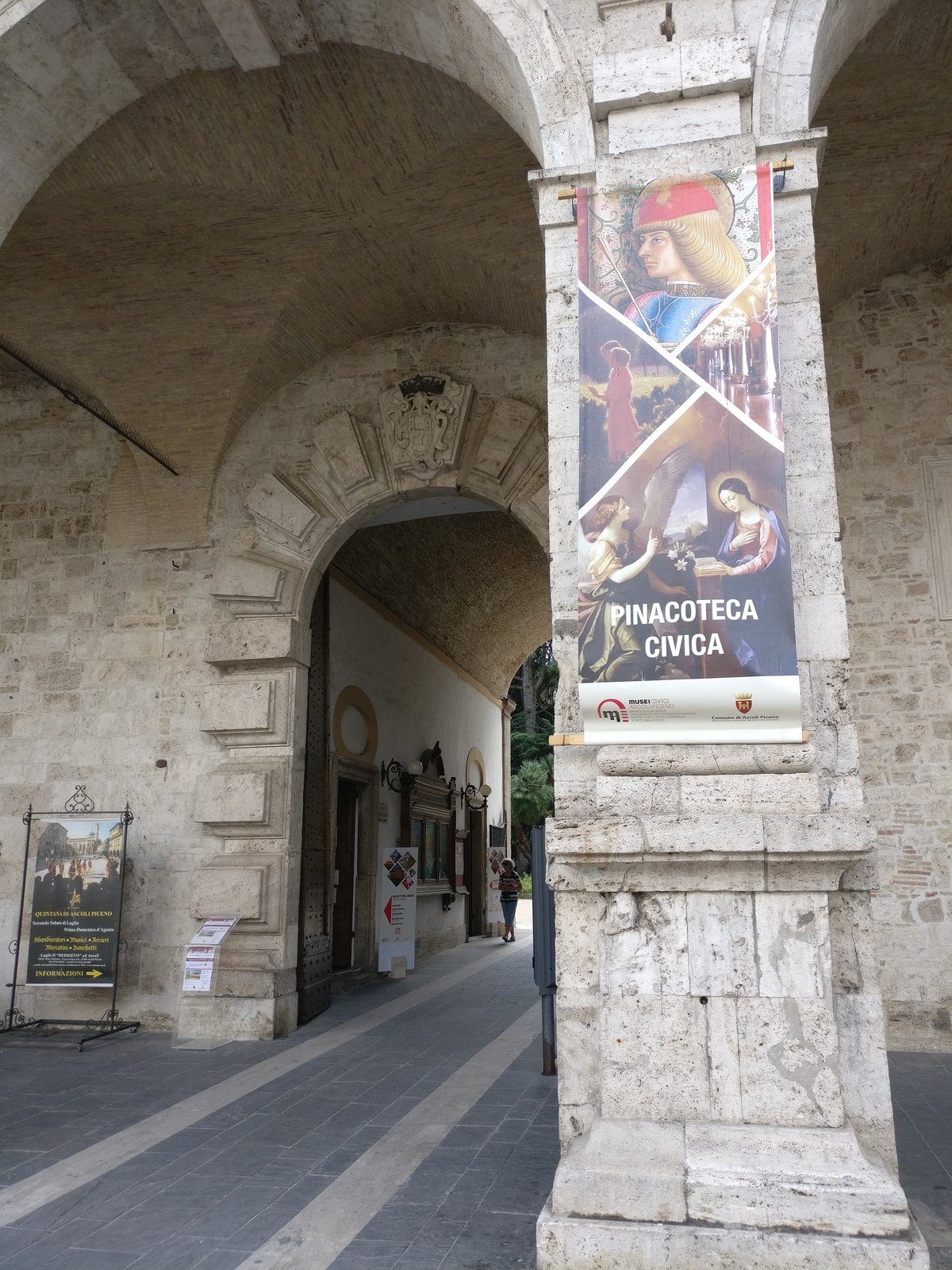
The Civic Art Gallery of Ascoli Piceno, one of the most important in the Marche region, is housed in the majestic Palazzo dell’Arengo in Piazza Arringo. Founded in 1861, it preserves over 800 works including paintings, sculptures, and period furnishings that tell centuries of art. Here’s what not to miss:
– The Piviale di Niccolò IV, a 13th-century masterpiece of English embroidery
– The polyptychs by Carlo Crivelli and Pellizza da Volpedo’s ‘Amorous Walk’
– The rooms furnished with Sgariglia furniture and Murano glass chandeliers
– The drawing collection with sheets by Guercino and Pietro da Cortona
Introduction
Stepping into the Civic Art Gallery of Ascoli Piceno is like crossing the threshold of a noble palace: period furniture, Venetian mirrors, and Murano glass chandeliers frame works spanning from the Middle Ages to the 20th century. The highlight? The Piviale of Nicholas IV, a rare English embroidery from the 13th century. But every room holds surprises, from Carlo Crivelli’s triptychs to Pellizza da Volpedo’s ‘Amorous Walk.’ A museum that is not just a collection of paintings, but an immersive experience among art and precious furnishings.
Introduction
Stepping into the Civic Art Gallery of Ascoli Piceno is like crossing the threshold of a noble palace: period furniture, Venetian mirrors, and Murano glass chandeliers frame works spanning from the Middle Ages to the 20th century. The highlight? The Piviale of Nicholas IV, a rare English embroidery from the 13th century. But every room holds surprises, from Carlo Crivelli’s triptychs to Pellizza da Volpedo’s ‘Amorous Walk.’ A museum that is not just a collection of paintings, but an immersive experience among art and precious furnishings.
Historical Notes
The Art Gallery opened on
August 4, 1861, just months after Italy’s unification, initiated by the Ascoli artists
Giorgio Paci and
Giulio Gabrielli. The original collection came from churches and convents suppressed after the Valerio decree, supplemented by private bequests: the legacy of Antonio Ceci (1924), furniture from the Sgariglia family, and Ernesto Verrucci’s collection. Today it features over 800 works in 15 rooms, furnished from Baroque to Empire style. A story of donations and civic passion.
- 1861: Foundation of the Art Gallery
- 1924: Arrival of the Ceci collection
- 1907: Recovery of the Niccolò IV Pluvial
- 2007: Ascoli maiolica moved to the Museum of Ceramic Art
Historical Notes
The Art Gallery opened on
August 4, 1861, just months after Italy’s unification, initiated by the Ascoli artists
Giorgio Paci and
Giulio Gabrielli. The original collection came from churches and convents suppressed after the Valerio decree, supplemented by private bequests: the legacy of Antonio Ceci (1924), furniture from the Sgariglia family, and Ernesto Verrucci’s collection. Today it features over 800 works in 15 rooms, furnished from Baroque to Empire style. A story of donations and civic passion.
- 1861: Foundation of the Art Gallery
- 1924: Arrival of the Ceci collection
- 1907: Recovery of the Niccolò IV Pluvial
- 2007: Ascoli maiolica moved to the Museum of Ceramic Art
The Cope of Nicholas IV: A Medieval Jewel
In the Cope Room lies perhaps the most precious treasure: a 13th-century English cope (opus anglicanum) donated by Pope Nicholas IV – born in Ascoli – to the Cathedral in 1288. Measuring 159×340 cm, made of samite fabric with gold brocade, it depicts evangelists, popes, and a Crucifixion. Stolen in 1902, it reappeared in London and was returned thanks to John Pierpont Morgan. It is a unique piece in Italy, to be admired slowly. It is not just embroidery: it is a piece of history woven in golden threads.
The Cope of Nicholas IV: A Medieval Jewel
In the Cope Room lies perhaps the most precious treasure: a 13th-century English cope (opus anglicanum) donated by Pope Nicholas IV – born in Ascoli – to the Cathedral in 1288. Measuring 159×340 cm, made of samite fabric with gold brocade, it depicts evangelists, popes, and a Crucifixion. Stolen in 1902, it reappeared in London and was returned thanks to John Pierpont Morgan. It is a unique piece in Italy, to be admired slowly. It is not just embroidery: it is a piece of history woven in golden threads.
From Crivelli to Pellizza: Unmissable Masterpieces
The art gallery is a succession of famous names. In the Hall of Titian, the Venetian master’s ‘St. Francis Receiving the Stigmata’ (c. 1570) stands out, along with the Annunciation by Pietro Alemanno featuring the map of Ascoli. Nearby are the two triptychs by Carlo Crivelli (from Valle Castellana), with their Gothic gilding. Further on, the Annunciation by Guido Reni (1629) and ‘The Passing of St. Joseph’ by Luca Giordano. And for those who love the 19th century, Amorous Walk by Pellizza da Volpedo (1901) is a dive into Divisionism.
From Crivelli to Pellizza: Unmissable Masterpieces
The art gallery is a succession of famous names. In the Hall of Titian, the Venetian master’s ‘St. Francis Receiving the Stigmata’ (c. 1570) stands out, along with the Annunciation by Pietro Alemanno featuring the map of Ascoli. Nearby are the two triptychs by Carlo Crivelli (from Valle Castellana), with their Gothic gilding. Further on, the Annunciation by Guido Reni (1629) and ‘The Passing of St. Joseph’ by Luca Giordano. And for those who love the 19th century, Amorous Walk by Pellizza da Volpedo (1901) is a dive into Divisionism.
Why Visit
Three good reasons: 1) The Chasuble of Nicholas IV – a masterpiece of medieval embroidery you won’t find anywhere else in Italy. 2) The polyptychs of Carlo Crivelli – with their late Gothic elegance, they are among the best of the Venetian master. 3) The palace atmosphere – the furniture and furnishings donated by the Sgariglia family make the visit more intimate, as if you were a guest in a historic residence. Plus, audio guides and tactile paths make the museum accessible to all.
Why Visit
Three good reasons: 1) The Chasuble of Nicholas IV – a masterpiece of medieval embroidery you won’t find anywhere else in Italy. 2) The polyptychs of Carlo Crivelli – with their late Gothic elegance, they are among the best of the Venetian master. 3) The palace atmosphere – the furniture and furnishings donated by the Sgariglia family make the visit more intimate, as if you were a guest in a historic residence. Plus, audio guides and tactile paths make the museum accessible to all.
When to Go
The best time? A weekday morning in spring or autumn. The light filters gently through the windows of the Palazzo dell’Arengo, and the reflections on the gilded furnishings create a nearly magical atmosphere. Avoid weekends if you can: the gallery is very popular and can get crowded. In winter, on the other hand, the rooms are more intimate, and the warmth of the Murano chandeliers makes everything cozier. In short, choose a day calmly, without rushing.
When to Go
The best time? A weekday morning in spring or autumn. The light filters gently through the windows of the Palazzo dell’Arengo, and the reflections on the gilded furnishings create a nearly magical atmosphere. Avoid weekends if you can: the gallery is very popular and can get crowded. In winter, on the other hand, the rooms are more intimate, and the warmth of the Murano chandeliers makes everything cozier. In short, choose a day calmly, without rushing.
Nearby
Once you step outside, you are in Piazza Arringo: from here you can walk to Piazza del Popolo, Ascoli’s living room, with its Renaissance loggia and Caffè Meletti. A stone’s throw away, the Cathedral of Sant’Emidio (with its Romanesque crypt and baptistery) and the Museum of Ceramic Art, which houses splendid Ascoli majolica. If you have time, drop by the Osvaldo Licini Contemporary Art Gallery: a dive into the 20th century.
Nearby
Once you step outside, you are in Piazza Arringo: from here you can walk to Piazza del Popolo, Ascoli’s living room, with its Renaissance loggia and Caffè Meletti. A stone’s throw away, the Cathedral of Sant’Emidio (with its Romanesque crypt and baptistery) and the Museum of Ceramic Art, which houses splendid Ascoli majolica. If you have time, drop by the Osvaldo Licini Contemporary Art Gallery: a dive into the 20th century.