Durini Castle: History, Gardens and Events in Brianza

The Durini Castle in Alzate Brianza, in the province of Como, is an architectural complex with roots dating back to 860, built around a late-Roman tower. Today it is open to visitors and hosts cultural events such as the LacMus Festival, as well as wedding receptions. The 300-hectare estate offers an Italian-style hanging garden unique in Lombardy and panoramic views of the Alps.

– 5th-century late-Roman tower and 13th-14th-century frescoes
– Italian-style hanging garden unique in Lombardy
– 360° views of Monte Rosa, the Grigne and Resegone
– LacMus Festival and exclusive receptions


Events nearby


Copertina itinerario Durini Castle: History, Gardens and Events in Brianza
Durini Castle in Alzate Brianza: a Roman tower, a hanging garden unique in Lombardy, 13th-century frescoes and the LacMus Festival. Guided tours and receptions on a 300-hectare estate.

Good to know


Durini Castle: An Introduction

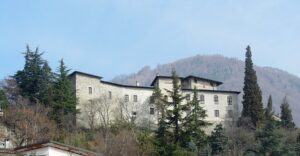
Durini Castle is no ordinary picture-postcard manor. It rises in Fabbrica Durini, a hamlet of Alzate Brianza in the province of Como, settled on a hill from which the eye sweeps from the Brianza countryside to Monte Rosa, the Grigne, and, on clear days, as far as Milan. The first thing that strikes you is the late-Roman tower around which the whole complex grew, with two 5th-century towers still visible. Then comes the rest: the Baroque façade, the horseshoe staircase, the Italian-style hanging garden, the only one in Lombardy, and the 300-hectare estate. This is not a static museum: guided tours, weddings, events and the LacMus Festival are held here. The atmosphere is stately yet lived-in, with the slightly secluded charm of family residences still owned by the Durinis, Counts of Monza.

Historical background

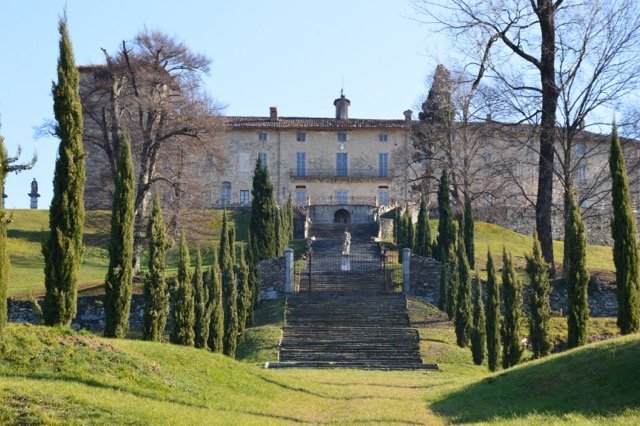
The origins are ancient: the first documented reference dates back to 860, when Tadone, a native of Fabbrica Durini, became Archbishop of Milan. The castle served as a lookout and defensive point thanks to its commanding view. In 1383 it became a fief of the Dal Verme family, later passing to the Durini, Counts of Monza, who still own it today. Its current appearance is Baroque in layout, but in 1750 Gian Giacomo III Durini created the perspective axis with the pincer-shaped staircase, the stables, and the symmetrical service wings. In 1815 the architect Carlo Amati added the façade of the inner courtyard; the Chapel of Sant’Anna and the dining room are also attributed to him. Between the 17th and 19th centuries the complex was transformed, with frescoes from the 13th–14th centuries, decorated single-lancet windows, and painted wooden ceilings.

  • 860: first documented reference, Tadone Archbishop of Milan
  • 1383: fief of the Dal Verme family
  • 1750: pincer-shaped staircase by Gian Giacomo III Durini
  • 1815: façade by Carlo Amati
  • 20th century: Church of Sant’Andrea donated to the Curia of Milan

Gardens and architecture: the hanging garden, the towers, the staircase

The beauty of Castello Durini is that you don’t just visit it indoors. Outside there are two 5th-century towers, the late-Roman tower and an Italian-style hanging garden, unique in Lombardy, supported by stone walls probably dating from the same period as the towers. At the same elevation as the castle, the Baroque garden opens up, with the Terrace of the Caesars, fountains and tree-lined avenues. Lower down is the axis commissioned in 1750 by Gian Giacomo III Durini: a pincer-shaped staircase descending toward the plain, with symmetrical stables and service buildings. There were once French-style gardens, now vanished. The centuries-old park and the 300-hectare estate do the rest, amid countryside, mature trees and the estate’s farming hamlet. Don’t expect a perfect, polished formal garden: rather, there is the charm of a layered historic landscape, where architecture and agriculture have coexisted for centuries.

Interior halls, frescoes and LacMus Festival

Inside the castle there are eight halls of great character. The Maria Theresa Hall is the main hall, with frescoes and period furnishings; then there are the Hall of Mirrors with stuccoes, the Napoleonic Hall, the ballroom, the Trophy Hall with hunting memorabilia, the library and the small dining room. Among the works, the Durini table stands out, a sculpture by Giuseppe Rusnati from the mid-17th century. The walls preserve 13th- and 14th-century frescoes, decorated single-light windows and painted wooden ceilings. The castle is also an event venue: seating for up to 150 people, in-house catering with vegetarian, vegan and gluten-free menus, only one event per day until 2:00 a.m. But the most magical moment is the LacMus Festival, a classical music series that has brought concerts here such as the one on 14 July 2025 with Vyacheslav Gryaznov and G-Phil Virtual Orchestra.

Why visit it

First reason: the Italian-style hanging garden is described as unique in Lombardy, and it’s not a brochure gimmick. Second: the historical layers are visible to the naked eye, from the late-Roman tower to the 14th-century frescoes, from the 18th-century staircase to Carlo Amati’s neoclassical additions. Third: it is a residence that is still alive, not just a photo stop. It hosts guided tours, wedding receptions, corporate events, and concerts for the LacMus Festival; for weddings it has an average rating of 4.8 out of 5 from 34 reviews, with 96% of couples recommending it. The 300-hectare estate and views of Monte Rosa, Grigne, and Resegone add the wow factor. In short, if you’re in Brianza and looking for a place with history, landscape, and a bit of contemporary life, this is hard to beat.

When to Go

The best time is a clear day: only then does the 360-degree view make the climb worthwhile, with Monte Rosa, the Grigne, the Resegone and, on exceptional occasions, the outline of Milan. Late afternoon is even better, when the slanting light brings out the stone of the towers and the tree-lined avenues. If you’re looking for the most special atmosphere, keep an eye on the calendar of the LacMus Festival: evening concerts turn the halls and gardens into an unusual stage. In general, avoid the central hours of overly muggy summer days and choose softer light. This is not a place to visit in a rush: better to pause, take in the view and then enter the halls. Before setting off, always check opening times and events, because the castle is also a venue for private events and visits may vary.

In the Surroundings

Castello Durini is located in Brianza, between Milan and Lake Como, so it can easily be combined with a longer day out. From here, you can continue towards Como and Lake Como, perhaps with a lakeside stroll and a trip up to Brunate to enjoy the view from above. Another idea is to stay in Brianza and explore the area’s hillside villages, among historic villas and agricultural landscapes. If you are interested in local heritage, the complex was included in the FAI’s I Luoghi del Cuore (Places of the Heart) campaign from 2003 to 2024, a sign that the farming village around the castle is a source of identity for the community. You don’t need to go far: simply wandering between Alzate Brianza and Fabbrica Durini shows why this part of Lombardy is less showy but more authentic.

Itineraries nearby


💡 Did You Know…?

Over the centuries, Durini Castle has welcomed notable figures such as the poet Giuseppe Parini, the composer Gioachino Rossini, the writer Giovanni Verga and members of the royal House of Savoy. A curious detail: inside is the ‘Durini Table’, a sculpture by Giuseppe Rusnati from the mid-1600s. The village around the castle has been included in FAI’s Places of the Heart, a sign of the community’s affection for this place.