
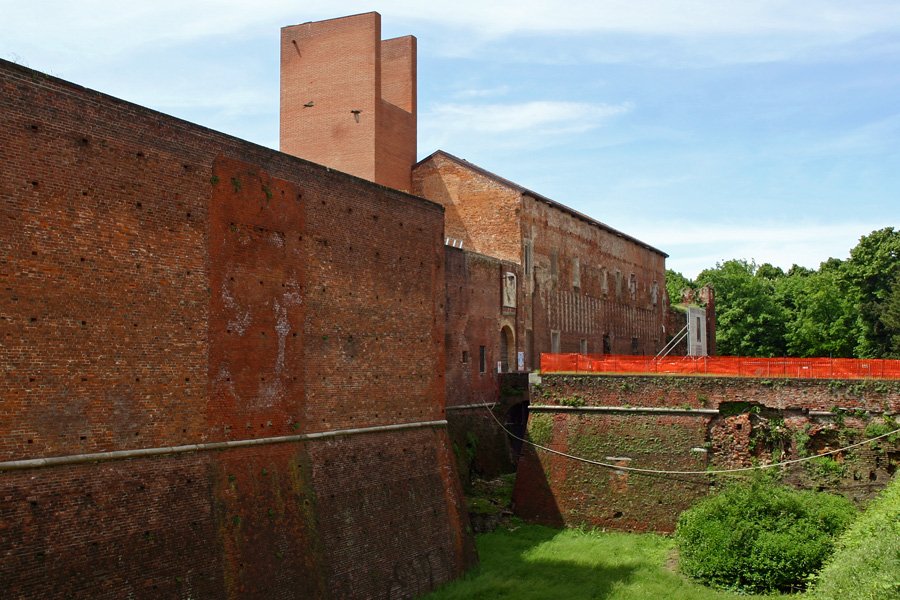
The Visconti-Sforza Castle of Novara dominates the historic center with its corner towers and moat. Built in 1358 by Galeazzo II Visconti, it exemplifies medieval military architecture transformed into a noble residence, now hosting temporary exhibitions and cultural events.
- Crenellated towers and red brick facade in Lombard Gothic style
- Renaissance courtyards with arches and carved coats of arms
- Historical graffiti left by Spanish soldiers on interior walls
- Views over Novara’s rooftops and the Alps from the terraces
Events nearby
Medieval fortress from 1358 with original red bricks, historical graffiti, and Alpine views. Hosts temporary exhibitions and offers free access to courtyards in the heart of Novara.
- https://www.ilcastellodinovara.it/
- Largo Donatori di Sangue, Novara (NO)
- +39 0321 1855421
- Open in Google Maps
- View on Google Images Castello Visconteo – Sforzesco di Novara a Novara
Good to know
Introduction
As soon as you enter Novara’s historic center, the Visconti-Sforza Castle strikes you with its grandeur. It’s not just a monument—it’s a visual experience that dominates Piazza Martiri della Libertà with its crenellated towers and brick walls. Built in 1358 at the behest of Galeazzo II Visconti, this castle is a symbol of the power that shaped Piedmont’s history. Today it houses municipal offices, but its Renaissance courtyards and frescoed halls are open to the public. Walking through its walls makes you feel part of a past that still breathes, among medieval architecture and details that tell centuries of dominations.
Historical Overview
The castle was established in 1358 as a military fortress by the Visconti family of Milan, to control the Piedmont territories. It passed to the Sforza family in 1450 under Francesco Sforza, who strengthened its defenses. In the 16th century, with the arrival of the Spanish, it became a barracks and lost some of its former splendor. 20th-century restorations recovered original elements, such as the corner towers and stone portals. Today, in addition to housing the Town Hall, it hosts temporary exhibitions in its interior spaces. Its history is a tapestry of power and transformation, visible in the traces left by each era.
- 1358: Foundation by order of Galeazzo II Visconti
- 1450: Transfer to the Sforza family under Francesco Sforza
- 16th century: Use as a Spanish barracks
- 20th century: Restoration and conversion to municipal headquarters
Architecture and Hidden Details
The castle’s exterior showcases a red brick facade typical of Lombard Gothic style, with Ghibelline battlements symbolizing Visconti power. Inside, the main courtyard impresses with Renaissance elegance, featuring stone columns supporting arched arcades and carved coats of arms. Not everyone notices the historical graffiti left by Spanish soldiers on interior walls, silent testimonies to daily life in the 16th century. The ground floor halls, occasionally opened for events, preserve vaulted ceilings and traces of frescoes deserving careful attention. It’s a place where every corner tells a story, without need for complicated explanations.
Scenic Routes and Hidden Corners
The tour begins in the main courtyard, where you can admire the balance between Gothic and Renaissance styles. Climbing the side staircases leads to terraces with views over the city and the Alps on clear days. A less frequented spot is the rear garden, with shaded benches perfect for a break. If you join a guided tour, you might access the weapons hall, where medieval artifacts recovered during restorations are displayed. The castle isn’t huge, but its intricate layout invites leisurely exploration, revealing niches and passageways that evoke the atmosphere of bygone eras.
Why Visit It
Three practical reasons make the castle a must-see stop: first, the free accessibility of the courtyards, perfect for a break during a city center stroll; second, the central location just steps from the Basilica of San Gaudenzio, allowing you to combine culture and relaxation; third, the temporary exhibitions on historical or artistic themes, often included at no extra cost. It’s a place that combines utility and beauty, ideal for those seeking an authentic experience without rigid schedules.
When to Go
The best time to visit the castle is in the early afternoon, when the sunlight illuminates the brick facades, creating evocative shadow plays. Avoid the busy morning hours if you prefer tranquility. In autumn, the warm hues of the bricks harmonize with the surrounding foliage, offering more intimate atmospheres. There’s no need to wait for specific seasons: it’s accessible year-round, but a clear sky enhances its majesty.
In the Surroundings
Just a few minutes’ walk away, the Basilica of San Gaudenzio with its Antonellian bell tower offers a fascinating architectural contrast. For an enogastronomic experience, the restaurant “Il Cavallino” on Via Canobio serves typical Novara dishes like paniscia, connecting you with local traditions. Both places enrich your visit with authentic culture and flavors.
Itineraries nearby


💡 Did You Know…?
A local legend tells that in the northeastern basement lies a secret passage that connected the castle to the Cathedral, used by the dukes to move around unseen. During restoration work, traces of this corridor emerged, now walled up but still visible in some places. The courtyard also preserves graffiti left by Spanish soldiers during the seventeenth-century occupation, including heraldic symbols and dates carved into the stone.