Parma Cathedral, with its facade of pink Verona marble, is a journey through centuries of Emilian art. Inside, the dome frescoed by Correggio and the Romanesque crypt with carved columns offer a unique experience.
- Correggio’s Dome: Fresco of the Assumption of the Virgin that anticipates the Baroque with trompe-l’oeil technique.
- Antelami’s Baptistery: Important example of transition between Romanesque and Gothic with sculptures of the months and zodiac signs.
- Romanesque Architecture: Pink marble facade, massive columns, and crypt with carved capitals.
- Artworks: Deposition by Benedetto Antelami on the main altar and light filtering through stained glass windows.
The Cathedral of Santa Maria Assunta in Parma houses the dome frescoed by Correggio with the Assumption of the Virgin and the Baptistery by Benedetto Antelami, examples of Romanesque and Gothic art in the historic center. Free admission.
- Borgo Pipa, Parma (PR)
- Open in Google Maps
- View on Google Images Cattedrale di Santa Maria Assunta a Parma
Good to know
Introduction
As soon as you step into the Parma Cathedral, you immediately understand why it’s a jewel of Emilia-Romagna. The light filtering through the stained glass windows blends with the frescoes, creating an atmosphere that envelops you. It’s not just a church—it’s a journey through art and spirituality. Correggio left his masterpiece here in the dome, with the Assumption of the Virgin appearing to soar above you. The massive, solid Romanesque architecture makes you feel small in the face of centuries of history. Walking through the naves is like flipping through an art book, where every chapter tells the story of Parma and its soul. If you love places that unite beauty and devotion, this is the right spot.
Historical Overview
Parma Cathedral boasts a history dating back to the 11th century, when it was constructed on the ruins of an early Christian basilica. It was consecrated in 1106 by Pope Paschal II, but a severe earthquake in 1117 caused significant damage, leading to a reconstruction that defined its Romanesque appearance. In the 16th century, Antonio da Correggio transformed the interior with his dome frescoes, a masterpiece that influenced Baroque art. Over the centuries, it has withstood wars and restorations, becoming a symbol of the city.
- 1059: Construction begins
- 1106: Official consecration
- 1520-1530: Correggio paints the dome
- 19th century: Restorations to preserve the structure
Correggio’s Dome
Looking up at Correggio’s dome is a breathtaking experience. The fresco depicts the Assumption of the Virgin, with figures that seem to defy gravity, suspended in a whirlwind of light and color. Correggio used trompe-l’oeil to create the illusion of infinite space, an innovation that anticipated the Baroque period. The details are extraordinary: the dancing angels, the clouds opening toward the sky. It is considered one of the masterpieces of the Italian Renaissance, and you’ll understand why artists like Parmigianino were influenced by it. I recommend sitting for a moment to admire it calmly, perhaps when the afternoon light illuminates the golden tones.
Sculptures and Architectural Details
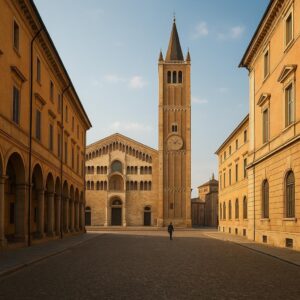
Every corner of the Cathedral hides treasures. Outside, the Romanesque facade with its rose window and bas-reliefs tells biblical stories, while the bell tower, standing 63 meters tall, dominates Parma’s skyline. Inside, don’t miss the Baptistery of Benedetto Antelami, separate yet part of the complex, with its sculptures depicting the months of the year and zodiac signs. The columns of the naves are massive, typical of the Romanesque style, supporting capitals decorated with vegetal motifs and symbolic figures. The marble pulpit is also an example of medieval art, used for centuries during celebrations. These elements make the Cathedral an open-air museum where architecture and sculpture merge.
Why Visit It
Visit the Cathedral for three concrete reasons. First, the Correggio frescoes are unique in Italy and showcase an art form that inspired generations. Second, the Romanesque architecture is well-preserved and allows you to literally touch the medieval history of Emilia-Romagna. Third, it’s located in the historic center of Parma, so you can easily combine it with other sites like the Baptistery or Piazza Garibaldi, making your day rich without long commutes. Plus, admission is free, ideal for travelers who want to explore deeply without spending.
When to Go
The best time to visit the Duomo is in the early afternoon, when natural light streams through the windows and illuminates Correggio’s frescoes, enhancing the colors and details. Avoid peak group tour hours to enjoy the tranquility. In terms of season, spring or autumn are ideal because the weather is mild and crowds are smaller, allowing you to admire the art in peace.
In the Surroundings
After the Cathedral, explore the Baptistery of Parma, just a few steps away, with its sculptures by Antelami that complete the medieval experience. Then, head to the National Gallery to see works by local artists like Parmigianino, connected to the history of Correggio. Both places enrich your visit with art and culture, without straying far from the city center.
💡 Did You Know…?
In the crypt, look for the Madonna of the Drought, a fourteenth-century fresco to which the people of Parma have been devoted for centuries. According to legend, during a severe drought, prayers before this image brought rain that saved the crops. Even today, during periods of scarce rainfall, some faithful make pilgrimages to it.