
Agrigento is much more than the Valley of the Temples, but in one day you can embrace its essence. This itinerary takes you from the Greek temples to the medieval heart of the city, with all the tips to best organize your day. It starts from the Valley of the Temples, where the Temple of Concordia is the most imposing, but don’t forget the Temples of Olympian Zeus and the Dioscuri. Then a stop at the Garden of Kolymbetra, a peaceful corner among olive trees. The Regional Archaeological Museum provides valuable context for the artifacts. In the afternoon, the historic center welcomes you with the Church of Santa Maria dei Greci, built on a 5th-century BC temple, and Porta Di Ponte, the ancient entrance to the city. A detailed map guides you smoothly. A complete experience for history and archaeology lovers, perfect even for those with limited time.
🗺️ Your trip at a glance
This itinerary gives you an intense day of history and archaeology. With a detailed map, you won’t miss any important stops.
- Ideal for: curious travelers and families wanting a mix of archaeology and medieval history.
- Highlights: UNESCO Valley of the Temples, Garden of Kolymbetra, authentic historic center.
- Why it’s different: includes customized map and practical tips to save time.
Itinerary stops
Stop no. 1
Temple of Olympian Zeus: The Unfinished Giant
 Your first stop in Agrigento hits you right in the heart: the Temple of Olympian Zeus. Get ready to be awestruck by what were once the foundations of the largest temple in the Greek West, measuring 113 meters in length and 56 meters in width. Built after the victory at Himera over the Carthaginians, it was never finished – wars and earthquakes did the rest. What remains today is a heap of enormous stones, among which stand out the Telamons, statues nearly 8 meters tall that once supported the architrave. One of them, a cast, has been repositioned at the center of the cella, but the original can be seen at the Archaeological Museum. Among the ruins you’ll also notice the monumental altar and a small sacellum. All surrounded by the Valley of the Temples Park, with ancient olive trees framing the scene. It’s the perfect place to feel the full power of ancient Akragas.
- Go to the page: Temple of Olympian Zeus: The Unfinished Colossus of the Valley of the Temples
- Via Passeggiata Archeologica, Agrigento (AG)
- Open in Google Maps
- View on Google Images

You should go if…
Stop no. 1
Temple of Olympian Zeus: The Unfinished Giant
Your first stop in Agrigento hits you right in the heart: the Temple of Olympian Zeus. Get ready to be awestruck by what were once the foundations of the largest temple in the Greek West, measuring 113 meters in length and 56 meters in width. Built after the victory at Himera over the Carthaginians, it was never finished – wars and earthquakes did the rest. What remains today is a heap of enormous stones, among which stand out the Telamons, statues nearly 8 meters tall that once supported the architrave. One of them, a cast, has been repositioned at the center of the cella, but the original can be seen at the Archaeological Museum. Among the ruins you’ll also notice the monumental altar and a small sacellum. All surrounded by the Valley of the Temples Park, with ancient olive trees framing the scene. It’s the perfect place to feel the full power of ancient Akragas.- Go to the page: Temple of Olympian Zeus: Monumental Ruins with Giant Telamones in Valley of the Temples
- Via Passeggiata Archeologica, Agrigento (AG)
- Open in Google Maps
- View on Google Images
You should go if…
Stop no. 2
Temple of the Dioscuri
 Just beyond the Temple of Jupiter, you’ll come across the Temple of the Dioscuri, with its four iconic columns rising among olive trees and Mediterranean scrub. In reality, it’s a 19th-century reconstruction made from pieces of different eras, but it has become the quintessential symbol of the Valley of the Temples. Originally a 5th-century BC Doric temple dedicated to Castor and Pollux, protectors of travelers and horsemen, only four of the original 34 columns remain, re-erected between 1836 and 1856. The atmosphere here is magical: sunlight filters through the steps and ancient stone blends with the surrounding nature. It’s the perfect spot for a photo break before continuing to the Garden of Kolymbetra. Don’t miss the rosette detail on the corner and the view opening towards the sea.
- Via Angelo Bonfiglio, Agrigento (AG)
- Open in Google Maps
- View on Google Images
You should go if…
Stop no. 3
Kolymbetra Garden: A Hidden Oasis Among the Temples
 After the Temple of the Dioscuri, descend into the small valley and find yourself in an almost surreal silence. The Kolymbetra Garden is a five-hectare corner of paradise, hidden among the rocks and managed by FAI since 1999. Originally it was a large water basin built by the tyrant Theron in the 5th century BC to supply Akragas, later transformed into an orchard and, over the centuries, into a lush citrus grove. Walking among centuries-old orange, lemon, almond, and carob trees, you breathe an atmosphere suspended in time: water still flows through Greek channels, citrus flowers perfume the air year-round, and the Mediterranean scrub sets the scene. It’s the perfect spot for a break from the temple crowds: bring a book, sit in the shade of a mulberry tree, and listen to the birds. Don’t miss the visit to the hypogeum (by reservation), where you can see ancient aqueducts with stalactites and fossil shells. Entry fee is €4 (in addition to the Valley ticket), and remember it’s closed on Sundays and in January.
You should go if…
Stop no. 3
Kolymbetra Garden: A Hidden Oasis Among the Temples
After the Temple of the Dioscuri, descend into the small valley and find yourself in an almost surreal silence. The Kolymbetra Garden is a five-hectare corner of paradise, hidden among the rocks and managed by FAI since 1999. Originally it was a large water basin built by the tyrant Theron in the 5th century BC to supply Akragas, later transformed into an orchard and, over the centuries, into a lush citrus grove. Walking among centuries-old orange, lemon, almond, and carob trees, you breathe an atmosphere suspended in time: water still flows through Greek channels, citrus flowers perfume the air year-round, and the Mediterranean scrub sets the scene. It’s the perfect spot for a break from the temple crowds: bring a book, sit in the shade of a mulberry tree, and listen to the birds. Don’t miss the visit to the hypogeum (by reservation), where you can see ancient aqueducts with stalactites and fossil shells. Entry fee is €4 (in addition to the Valley ticket), and remember it’s closed on Sundays and in January.You should go if…
Stop no. 4
Pietro Griffo Regional Archaeological Museum
 After the tranquility of the Kolymbetra Garden, we climb up to San Nicola Hill, where the Pietro Griffo Regional Archaeological Museum awaits. Housed in a former 14th-century convent and a modern building designed by Franco Minissi, it’s the perfect place to make sense of the wonders you’ve just seen. Here there are over 5,000 artifacts spanning from prehistory to Roman times: Attic vases, sculptures, and especially the highlights: the Telamon (that colossal 7.5-meter statue from the Temple of Zeus) and the Ephebe of Agrigento, a 5th-century BC marble of disarming beauty. The rooms are arranged in chronological and topographical order, with bilingual panels to help you understand everything. To save money, the combined ticket with the Valley of the Temples costs €13.50 (full price) and grants access to the museum as well. Opening hours: daily 9:00 AM – 7:30 PM (last entry at 7:00 PM).
- Go to the page: Pietro Griffo Archaeological Museum: Journey into Ancient Akragas
- Via Passeggiata Archeologica, Agrigento (AG)
- Open in Google Maps
- View on Google Images
You should go if…
Stop no. 4
Pietro Griffo Regional Archaeological Museum
After the tranquility of the Kolymbetra Garden, we climb up to San Nicola Hill, where the Pietro Griffo Regional Archaeological Museum awaits. Housed in a former 14th-century convent and a modern building designed by Franco Minissi, it’s the perfect place to make sense of the wonders you’ve just seen. Here there are over 5,000 artifacts spanning from prehistory to Roman times: Attic vases, sculptures, and especially the highlights: the Telamon (that colossal 7.5-meter statue from the Temple of Zeus) and the Ephebe of Agrigento, a 5th-century BC marble of disarming beauty. The rooms are arranged in chronological and topographical order, with bilingual panels to help you understand everything. To save money, the combined ticket with the Valley of the Temples costs €13.50 (full price) and grants access to the museum as well. Opening hours: daily 9:00 AM – 7:30 PM (last entry at 7:00 PM).- Go to the page: Museo Griffo Agrigento: Giant Telamon and 5,000 Artifacts from the Valley of the Temples
- Via Passeggiata Archeologica, Agrigento (AG)
- Open in Google Maps
- View on Google Images
You should go if…
Stop no. 5
Santa Maria dei Greci: A Greek Temple Beneath a Church
 We continue toward the heart of the historic center, on the hill that was once the acropolis of Akragas. Here stands the Church of Santa Maria dei Greci, a medieval gem built between the 12th and 13th centuries directly on the remains of an ancient Doric temple from the 5th century BC, perhaps dedicated to Athena. The name ‘dei Greci’ recalls the Greek Orthodox community that used it as a cathedral. The façade is simple, but the Chiaramontan Gothic portal is a real eye-catcher. Upon entering, you’ll be amazed: beneath your feet, protected by glass panels, you can see the foundations of the Greek temple, with truncated columns and steps. The interior has three naves, with a painted wooden ceiling from the 14th century and medieval frescoes of the Madonna del Latte. Don’t miss the marble sarcophagus from 1570 and the 17th-century crypt used for the drying of confreres. Free entry, open daily 10:00 AM–7:00 PM.
- Via Santa Maria dei Greci, Agrigento (AG)
- Open in Google Maps
- View on Google Images
You should go if…
Stop no. 6
Porta Di Ponte
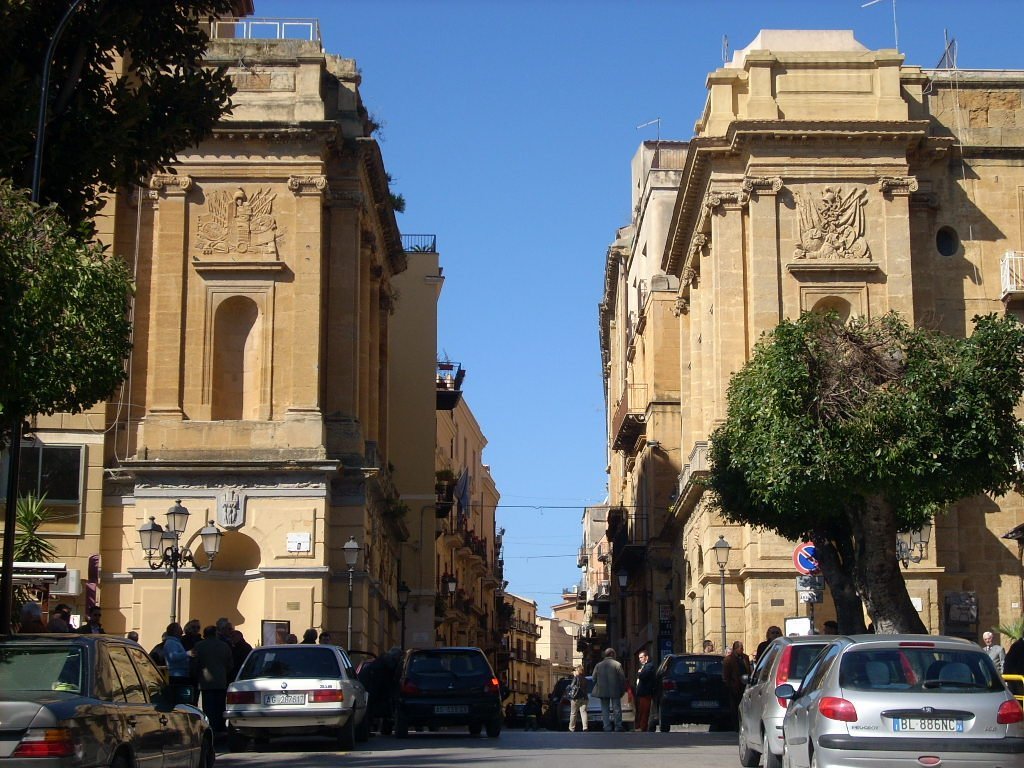 The last stop on our itinerary is Porta Di Ponte, the square that serves as the city’s true living room. Here, where the ancient gate once stood giving access to the bridge, life now flows slowly and authentically. Café tables spill into the square, children play, and noble palaces provide the backdrop. It’s a place to stop, perhaps with an ice cream, and watch the locals come and go. Don’t miss the chance to sit on a bench and breathe in the Sicilian atmosphere: Porta Di Ponte is the perfect meeting point for those who want to experience the city from within, away from the more beaten tourist routes.
- Via Atenea, Agrigento (AG)
- Open in Google Maps
- View on Google Images
You should go if…


