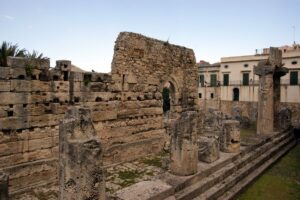
In the heart of the Valley of the Temples stand the ruins of the Temple of Olympian Zeus, the largest Doric temple in the West. Although never completed, its colossal dimensions (113×56 meters) and the 7.6-meter-tall telamones bear witness to the ambition of ancient Akragas. A must-visit for archaeology enthusiasts.
– Record-breaking dimensions: 113.20 m long, 56 m wide, estimated column height up to 19 m.
– Giant telamones: statues almost 8 meters tall that supported the structure, with originals on display at the museum.
– Monumental altar: remains of the 54.5×17.5 m altar, among the largest in antiquity.
– Practical information: open daily 8:30-19, entrance €10, combined ticket valley+museum €13.50.
The Stone Giant That Never Fully Rose
Walking among the ruins of the Temple of Olympian Zeus is a spine-tingling experience. This was no ordinary temple: it was one of the largest ever designed by the Greeks, with a base measuring 113 by 56 meters. Today only ruins remain, but a single fallen capital or a reclining telamon is enough to grasp the scale. The columns were nearly 18 meters high, and their flutes were so wide that a man could fit inside. This is a place that speaks of ambition and fragility: begun to celebrate a victory, it was never completed. Every stone here has a story, even if it remains silent.
The Stone Giant That Never Fully Rose
Walking among the ruins of the Temple of Olympian Zeus is a spine-tingling experience. This was no ordinary temple: it was one of the largest ever designed by the Greeks, with a base measuring 113 by 56 meters. Today only ruins remain, but a single fallen capital or a reclining telamon is enough to grasp the scale. The columns were nearly 18 meters high, and their flutes were so wide that a man could fit inside. This is a place that speaks of ambition and fragility: begun to celebrate a victory, it was never completed. Every stone here has a story, even if it remains silent.
Historical Notes
Construction began around 480 BC, right after Agrigento’s victory over the Carthaginians at Himera. The people of Agrigento wanted to thank Zeus with a colossal temple, using Carthaginian prisoners as labor. But the project was never completed: wars, earthquakes, and the looting of the city halted the work. Already in ancient times, the temple lay in ruins, and in the 18th century its blocks were used to build the pier at Porto Empedocle. Today, only an imposing skeleton remains, but its story is written in the fragments.
Historical Notes
Construction began around 480 BC, right after Agrigento’s victory over the Carthaginians at Himera. The people of Agrigento wanted to thank Zeus with a colossal temple, using Carthaginian prisoners as labor. But the project was never completed: wars, earthquakes, and the looting of the city halted the work. Already in ancient times, the temple lay in ruins, and in the 18th century its blocks were used to build the pier at Porto Empedocle. Today, only an imposing skeleton remains, but its story is written in the fragments.
Historical Timeline
- 480 BC: Victory at Himera and start of temple construction ordered by tyrant Theron.
- 5th century BC: The temple remains unfinished due to the Carthaginian conquest.
- December 9, 1401: According to historian Fazello, the last remaining structures collapse.
- 18th century: The stones are reused for the port of Porto Empedocle.
- Today: The ruins are visible in the Valley of the Temples, with a reconstructed telamon at the Archaeological Museum.
Historical Timeline
- 480 BC: Victory at Himera and start of temple construction ordered by tyrant Theron.
- 5th century BC: The temple remains unfinished due to the Carthaginian conquest.
- December 9, 1401: According to historian Fazello, the last remaining structures collapse.
- 18th century: The stones are reused for the port of Porto Empedocle.
- Today: The ruins are visible in the Valley of the Temples, with a reconstructed telamon at the Archaeological Museum.
The Telamons: Giants That Held Up the Temple
One of the most striking features are the Telamons, giant statues almost 8 meters tall that served as human columns. They were set into the wall between the half-columns, with their arms bent above their heads as if supporting the entablature. Symbol of the defeated Carthaginians, these figures were carved from stone blocks. Today only scattered fragments remain among the ruins, but a reconstructed Telamon is on display at the Archaeological Museum of Agrigento. Imagining them standing, aligned along the perimeter, gives an idea of the temple’s dramatic power.
The Telamons: Giants That Held Up the Temple
One of the most striking features are the Telamons, giant statues almost 8 meters tall that served as human columns. They were set into the wall between the half-columns, with their arms bent above their heads as if supporting the entablature. Symbol of the defeated Carthaginians, these figures were carved from stone blocks. Today only scattered fragments remain among the ruins, but a reconstructed Telamon is on display at the Archaeological Museum of Agrigento. Imagining them standing, aligned along the perimeter, gives an idea of the temple’s dramatic power.
An Unfinished Masterpiece Amid Destruction and Reuse
The temple was not just large: it was also architecturally unique. It was a pseudo-peripteral design, meaning it had semi-columns attached to a continuous wall instead of free-standing columns. The project planned for 7 semi-columns on the short sides and 14 on the long ones. However, construction stopped and the structure never received a roof. Over the centuries, earthquakes and fires damaged it, and eventually its blocks were looted to build the harbor. Today you can see the foundations, the monumental altar stretching 54 meters long, and a few capitals. It is a monument to unfulfilled glory, and perhaps that is exactly why it is fascinating.
An Unfinished Masterpiece Amid Destruction and Reuse
The temple was not just large: it was also architecturally unique. It was a pseudo-peripteral design, meaning it had semi-columns attached to a continuous wall instead of free-standing columns. The project planned for 7 semi-columns on the short sides and 14 on the long ones. However, construction stopped and the structure never received a roof. Over the centuries, earthquakes and fires damaged it, and eventually its blocks were looted to build the harbor. Today you can see the foundations, the monumental altar stretching 54 meters long, and a few capitals. It is a monument to unfulfilled glory, and perhaps that is exactly why it is fascinating.
Why Visit
It’s worth it for three reasons. First: the incredible scale – it’s hard to believe such an immense structure was designed in ancient times. Second: the architectural uniqueness – no other Greek temple has telamones and continuous walls. Third: the romantic ruin atmosphere – the scattered stones and nature reclaiming the space create an emotion that an intact temple cannot give. Bring a book or just sit and observe: the place speaks for itself.
Why Visit
It’s worth it for three reasons. First: the incredible scale – it’s hard to believe such an immense structure was designed in ancient times. Second: the architectural uniqueness – no other Greek temple has telamones and continuous walls. Third: the romantic ruin atmosphere – the scattered stones and nature reclaiming the space create an emotion that an intact temple cannot give. Bring a book or just sit and observe: the place speaks for itself.
When to Go
The best time? At sunset, when the low sun illuminates the golden stones and stretches the shadows of the fallen telamones. The warm light turns the ruins into an almost theatrical scene. In spring (April-May) the vegetation is green and almond blossoms frame the view. Summer is very hot, but evening openings allow you to enjoy the cool. Avoid Easter weekend only if you don’t like crowds.
When to Go
The best time? At sunset, when the low sun illuminates the golden stones and stretches the shadows of the fallen telamones. The warm light turns the ruins into an almost theatrical scene. In spring (April-May) the vegetation is green and almond blossoms frame the view. Summer is very hot, but evening openings allow you to enjoy the cool. Avoid Easter weekend only if you don’t like crowds.
Nearby
Don’t miss the San Nicola Archaeological Museum: it houses the original reconstructed telamon and a model of the temple. It’s just a short walk away, and the combined ticket (€13.50) also includes entry to the Valley of the Temples. Also in the valley, visit the nearby Temple of Concordia, one of the best-preserved Greek temples in the world. Two sites that together tell the entire story of Akragas, from triumph to collapse.
Nearby
Don’t miss the San Nicola Archaeological Museum: it houses the original reconstructed telamon and a model of the temple. It’s just a short walk away, and the combined ticket (€13.50) also includes entry to the Valley of the Temples. Also in the valley, visit the nearby Temple of Concordia, one of the best-preserved Greek temples in the world. Two sites that together tell the entire story of Akragas, from triumph to collapse.