
The Certosa di San Lorenzo in Padula is an imposing Carthusian monastery, a UNESCO World Heritage Site since 1998. Covering 51,500 m², it is one of the largest in Europe. Here’s what not to miss:
– The Grand Cloister, with 84 arches and 15,000 m², the largest in Italy.
– The 18th-century elliptical staircase by Gaetano Barba.
– The 16th-century inlaid wooden choir stalls.
– The Archaeological Museum of Western Lucania, featuring ancient artifacts.
Events nearby
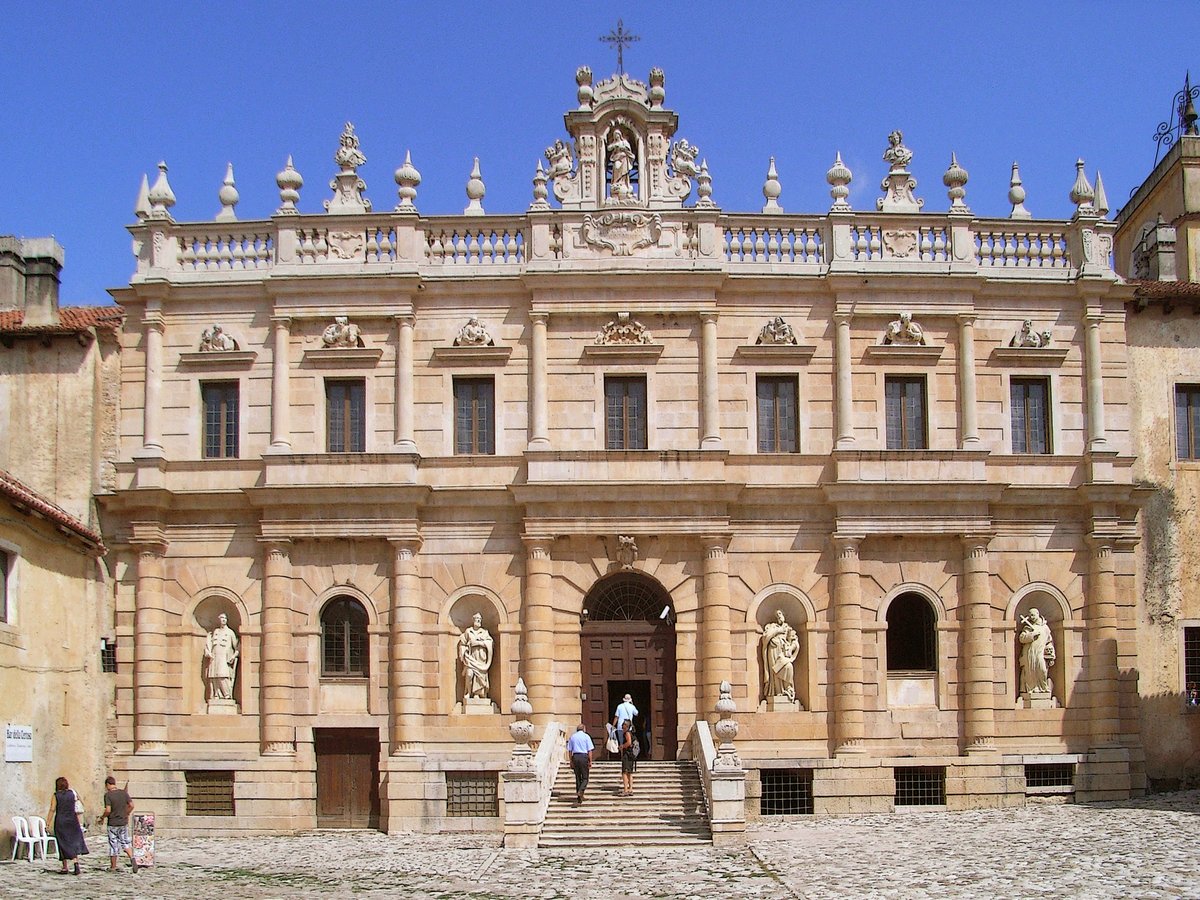
In Padula, Cilento, the Certosa di San Lorenzo is a Baroque masterpiece and UNESCO World Heritage Site. Admire Europe’s largest cloister, the elliptical staircase, and its artistic treasures.
- http://www.polomusealecampania.beniculturali.it/index.php/la-certosa-padula
- Viale Certosa 1, Salerno (SA)
- +39 0975 77745
- Open in Google Maps
- View on Google Images Certosa di San Lorenzo a Salerno
Good to know
Introduction
Stepping into the Certosa di San Lorenzo is like diving into another era. With its 51,500 square meters, it is the largest Baroque monument in Italy and one of the most impressive in Europe. From the entrance, silence envelops you: here for centuries the Carthusian monks lived in seclusion, between work and prayer. The enormous cloister leaves you breathless, with 84 arches that seem to go on forever. And then the gilded stuccoes, the frescoes, the majolica floors… it is a riot of art that takes you back in time. Since 1998 it has been a UNESCO World Heritage Site, but it is not one of those places you visit in a hurry: here you need calm, to breathe in history.
Historical Notes
The Charterhouse was founded on January 28, 1306 at the behest of Tommaso Sanseverino, Count of Marsico. Over the centuries it was expanded and transformed in Baroque style, starting from 1583. The last great work is the elliptical staircase (1763-1779). In 1807 the French suppressed the order, and many treasures were dispersed. After the unification of Italy, it became a national monument (1882) and during the two world wars it was used as a prisoner-of-war camp. Since 1957 it has housed the Archaeological Museum of Western Lucania, and in 1998 it was added to the UNESCO list. Today it is a restored jewel that attracts travelers from all over the world.
The Grand Cloister: A Sea of Arches
The grand cloister is the beating heart of the Certosa: with its 15,000 m² (104×150 meters), it is the largest in Italy and one of the largest in Europe. Two levels of porticoes on 84 pillars of Padula stone, with bas-reliefs depicting saints and angels. At the center, a fountain from 1640, surrounded by 26 monks’ cells (each with a small garden). On the east side, the monks’ cemetery with a balustrade carved with skulls (1729), work by Cosimo Fanzago. Getting lost here is inevitable: every corner is a discovery of light and shadow.
The Elliptical Staircase and the Library
On the west side, the elliptical double-ramp staircase (1763–1779) is a masterpiece of ingenuity: seven large windows illuminate the octagonal tower that encloses it. It was probably designed by Ferdinando Sanfelice and built by Gaetano Barba. At the top, you enter the library, which once held 20,000 volumes (today only 2,000 remain). The floor is made of Vietri sul Mare ceramics, and the vault is frescoed with the Aurora and the Last Judgment (Olivieri, 1763). A fifteenth-century spiral staircase connects the floors: a leap between different eras, from Gothic to Baroque.
Why Visit It
Three reasons not to miss it: 1. Italy’s largest cloister: walking among its 84 arches is an almost mystical experience. 2. Artistic treasures: from the 16th-century inlaid wooden choir stalls to the gilded stuccoes, from the kitchen with its majolica hood to the Treasury Chapel. 3. Great value for money: with a ticket costing just a few euros (free for under 18s) you also get to visit the Archaeological Museum and contemporary art installations in the cells. In short, it’s one of those places that gives you so much for the time you invest.
When to Go
The best time? Early morning, right when it opens at 9:00 AM. The low light filters through the cloister arches and illuminates the church’s stuccoes, creating a unique atmosphere. If you prefer fewer crowds, choose autumn or spring: the weather is mild and visitors are few. Avoid Tuesdays, as it is closed. And remember that the last admission is at 7:00 PM, so allow at least a couple of hours to explore at your leisure.
Nearby
The Certosa is located in the heart of the Cilento National Park, so you are spoiled for choice. Don’t miss the Greek temples of Paestum (about 40 minutes away), also a UNESCO World Heritage site. Or the archaeological site of Velia, with the remains of the Magna Graecia city. If you love charming villages, pop into Padula itself, with its medieval historic center and the Church of San Nicola alle Donne. For a perfect day, combine culture and nature.
Itineraries nearby

💡 Did You Know…?
According to tradition, in 1535 Charles V and his army stopped at the Certosa. To feed them, the monks prepared an omelette with a thousand eggs. Today, the Certosa also serves as a film set: it appeared in Francesco Rosi’s film ‘C’era una volta’ (Once Upon a Time).