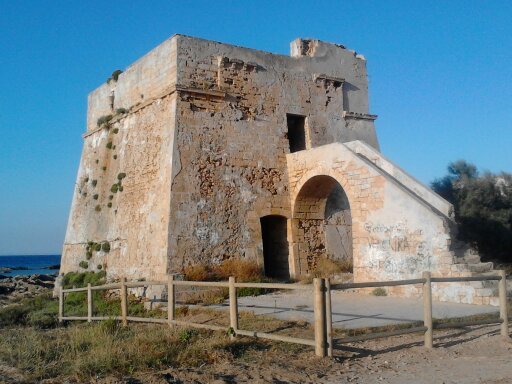
Punta Penne Tower in Brindisi: History and Panoramic Views of the Adriatic Sea

Punta Penne Tower is a 16th-century coastal tower located in Brindisi, perfect for a short excursion with breathtaking views. Built to spot pirates, it now offers a unique panorama of the Adriatic Sea and the Brindisi coastline.

Why visit:
Panoramic view of the Adriatic and Brindisi coast
Historical structure well-preserved from the 16th century
Easy access with a short walk from the parking area
Peaceful moments away from the crowds

Copertina itinerario Punta Penne Tower in Brindisi: History and Panoramic Views of the Adriatic Sea
Punta Penne Tower in Brindisi is a 16th-century coastal tower offering panoramic views of the Adriatic, accessible via a short walk and ideal for photography and peaceful moments.

Good to know


Introduction

Reaching the Torre di Punta Penne feels like discovering a well-kept secret. You won’t find it in the city center, but on a strip of land jutting into the Adriatic Sea, almost as if trying to touch the horizon. The view that greets you is pure magic: the cobalt blue sea on one side, the silhouette of Brindisi on the other, and the tower itself, solid and silent. It’s not a crowded monument—quite the opposite. Often, only a few people make the journey, which makes the moment even more special. The feeling is of being in a place outside of time, perfect for disconnecting and letting yourself be captivated by the sunlight playing on the water. An authentic corner of Puglia, far from the noise, where the only sound is the waves.

Historical Notes

This tower was not built to beautify the landscape, but to defend. It was constructed in 1568 at the behest of Spanish viceroy Pedro Afán de Ribera, as part of a surveillance system against Saracen pirate raids that plagued the coasts. Imagine: from its arrow slits, the sea was watched day and night. In the 18th century, it lost its military function and was converted into a lighthouse, guiding ships toward the port of Brindisi. Today, restored, it stands as a silent witness to centuries of history. I like to imagine the guards who from up there saw enemy sails approaching, or the sailors searching for its glow in the night. It’s a story made of stone and sea.

  • 1568: Construction for coastal defense.
  • 18th century: Conversion into a lighthouse.
  • Today: Restoration and enhancement as a historical and landscape site.

Photography and Light

If you’re passionate about photography, you’ll find plenty to capture here. The early afternoon light is simply perfect: it illuminates the stone facade of the tower with a golden warmth and creates sparkling reflections on the sea. The contrast between the solid mass of the structure and the vast blue expanse of the Adriatic offers powerful compositions. Try framing the details: the stones weathered by the salty wind, the external staircase, the entrance arch. And then the 360-degree panorama: on one side, the island of Sant’Andrea and the harbor; on the other, the open sea. I took dozens of photos, but none truly capture the emotion of being there. I recommend a wide-angle lens to capture the breadth and a telephoto lens to isolate architectural details against the horizon line.

The Atmosphere of Tranquility

What strikes you, beyond the beauty, is the absolute peace. There are no bars, souvenir shops, or queues. Just the sound of the wind and waves crashing against the rocks below. It’s the perfect spot for a restorative break: sit on one of the benches or directly on the grass, perhaps with a book or simply to gaze at the sea. I saw couples chatting quietly, photographers focused on their shots, and families with children exploring the surroundings without haste. In an era of mass tourism, finding such an authentic and less-traveled corner is a true gift. Personally, I return here when I need to clear my mind. The salty air and endless panorama have a therapeutic, almost meditative effect. A piece of advice? Disconnect your phone and savor the moment.

Why Visit It

Three concrete reasons not to miss it? First: it’s easily accessible with a short and pleasant walk, suitable for everyone. Second: it offers one of the most beautiful views of the Brindisi coast, with a breathtaking vista stretching from the port to the open sea. Third: it’s an authentic and non-commercial place, where you can breathe in history and nature without distractions. Perfect for a refreshing break, to take memorable photos, or simply to sit quietly by the sea. Plus, it’s free. No need to book anything, just arrive and enjoy.

When to go

The best time? Late afternoon, when the sun begins to set. The light becomes warm and low, painting the tower and the sea in shades of orange and pink. The atmosphere is magical, almost surreal. In summer, you can enjoy the sea breeze that mitigates the heat, while in spring and autumn the colors are particularly intense. I would avoid the midday hours on a hot summer day, unless you love strong sun. I’ve also been there on a windy winter day: it was deserted, but the stormy sea offered an unforgettable spectacle of nature’s power. In every season, it has its own charm.

In the Surroundings

A visit to the tower can be perfectly paired with a culinary experience. Just a few minutes’ drive away, in the center of Brindisi, you’ll find the Antica Enoteca di Brindisi, a historic venue where you can sample local wines like Negroamaro accompanied by platters of Apulian cured meats and cheeses. For those wishing to continue exploring the coast, a great idea is to make a stop at the Torre Guaceto Nature Reserve, a protected area with pristine beaches, dunes, and nature trails. It’s another side of the province, more wild and dedicated to nature. Two different yet complementary experiences that enrich the day.

💡 Did You Know…?

The tower was built in 1568 as part of the coastal defense system of the Kingdom of Naples against Ottoman pirate raids. During World War II, it served as a military observation post. Today, its walls over a meter thick tell centuries of history, while the wind whipping the summit recalls the lookouts scanning the horizon.