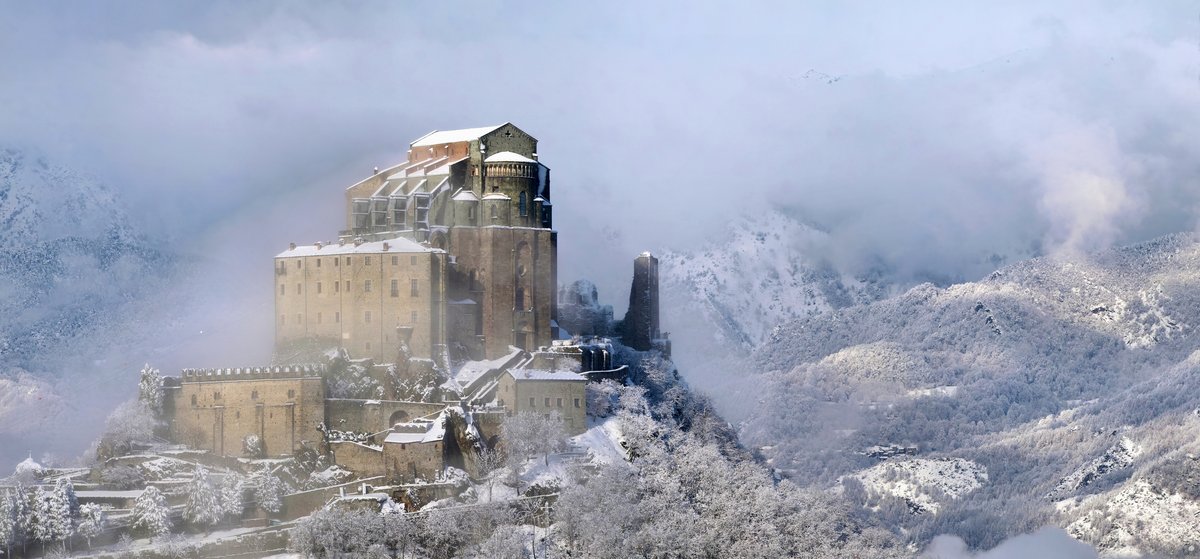
The Sacra di San Michele, symbol of Piedmont, stands at 962 meters on Monte Pirchiriano. Founded between 983 and 987, it is a Benedictine abbey that holds centuries of history and legends. The hiking excursion from Sant’Ambrogio di Torino is an immersive experience between nature and spirituality.
– Panoramic hike: mule track with Via Crucis, 1h30 ascent with views of the Susa Valley.
– Romanesque-Gothic architecture: Staircase of the Dead, Zodiac Portal, Bell’Alda Tower.
– Fascinating legends: the magical line of St. Michael and the miracle of construction.
– Museum and library: over 10,000 volumes and historical artifacts.
Introduction
Perched at 962 meters on Mount Pirchiriano, the Sacra di San Michele welcomes you with a breathtaking view of the Susa Valley. It is not just an abbey: it is an icon of Piedmont, a place where art, nature, and ancient legends come together. The hike from Sant’Ambrogio di Torino is an unmissable experience, through woods and ancient mule tracks, allowing you to touch centuries of history.
Introduction
Perched at 962 meters on Mount Pirchiriano, the Sacra di San Michele welcomes you with a breathtaking view of the Susa Valley. It is not just an abbey: it is an icon of Piedmont, a place where art, nature, and ancient legends come together. The hike from Sant’Ambrogio di Torino is an unmissable experience, through woods and ancient mule tracks, allowing you to touch centuries of history.
Historical Notes
Founded between 983 and 987 by Benedictine monks, the Sacra became a crossroads for pilgrims and culture in the 12th century. After a period of decline, in 1836 Carlo Alberto entrusted the abbey to the Rosminians, who still care for it today. Visited by Pope John Paul II in 1991, it was a source of inspiration for Umberto Eco’s ‘The Name of the Rose’.
Historical Notes
Founded between 983 and 987 by Benedictine monks, the Sacra became a crossroads for pilgrims and culture in the 12th century. After a period of decline, in 1836 Carlo Alberto entrusted the abbey to the Rosminians, who still care for it today. Visited by Pope John Paul II in 1991, it was a source of inspiration for Umberto Eco’s ‘The Name of the Rose’.
A Walk Between Nature and Spirituality
From Sant’Ambrogio, a paved mule track of 1.5 km and 572 m of elevation gain sets off. Along the ascent, the 15 stations of the Via Crucis accompany the walk up to the hamlet of San Pietro. The trail is accessible all year round, but in autumn the colors of the forest create a magical atmosphere. Once you arrive, the view from the top rewards every effort.
A Walk Between Nature and Spirituality
From Sant’Ambrogio, a paved mule track of 1.5 km and 572 m of elevation gain sets off. Along the ascent, the 15 stations of the Via Crucis accompany the walk up to the hamlet of San Pietro. The trail is accessible all year round, but in autumn the colors of the forest create a magical atmosphere. Once you arrive, the view from the top rewards every effort.
Mysteries and Curiosities of the Abbey
Among the hidden treasures are the Staircase of the Dead, once an ossuary, and the Zodiac Portal by Master Nicolao. The Tower of Bell’Alda tells the legend of a young woman who fell twice. It is said that the abbey is aligned with Mont Saint-Michel and Monte Sant’Angelo along a ‘magic line’, with an energy point to the left of the entrance.
Mysteries and Curiosities of the Abbey
Among the hidden treasures are the Staircase of the Dead, once an ossuary, and the Zodiac Portal by Master Nicolao. The Tower of Bell’Alda tells the legend of a young woman who fell twice. It is said that the abbey is aligned with Mont Saint-Michel and Monte Sant’Angelo along a ‘magic line’, with an energy point to the left of the entrance.
Why Visit It
1. It is the symbolic monument of Piedmont: a unique piece of history. 2. It inspired Umberto Eco for ‘The Name of the Rose’: a literary journey. 3. From the square you enjoy a spectacular view of the Susa Valley and the Alps, perfect for breathtaking photos.
Why Visit It
1. It is the symbolic monument of Piedmont: a unique piece of history. 2. It inspired Umberto Eco for ‘The Name of the Rose’: a literary journey. 3. From the square you enjoy a spectacular view of the Susa Valley and the Alps, perfect for breathtaking photos.
When to Go
The best time? Early in the morning, when the light hits the facade and the abbey is still quiet. In autumn, the warm colors of the woods make the climb even more evocative. Avoid January: the abbey is closed for maintenance until the end of the month.
When to Go
The best time? Early in the morning, when the light hits the facade and the abbey is still quiet. In autumn, the warm colors of the woods make the climb even more evocative. Avoid January: the abbey is closed for maintenance until the end of the month.
Around the Area
Just a stone’s throw away is the Avigliana Lakes Natural Park, with two swimmable lakes and walking trails. Drop by the village of Sant’Ambrogio di Torino, where you’ll find the Abbey Castle and the excellent San Michele Brewery for a craft beer break.
Around the Area
Just a stone’s throw away is the Avigliana Lakes Natural Park, with two swimmable lakes and walking trails. Drop by the village of Sant’Ambrogio di Torino, where you’ll find the Abbey Castle and the excellent San Michele Brewery for a craft beer break.