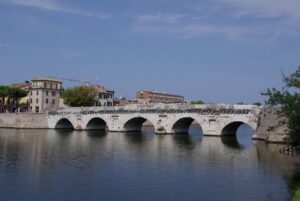
The Tiberius Bridge in Rimini is a 1st-century AD Roman bridge still in use today, linking the historic center with Borgo San Giuliano as it crosses the Marecchia River. Built with Istrian stone and five perfectly balanced arches without mortar, it offers a tangible historical experience—walking on the same stones as Roman legionaries and medieval pilgrims.
- Free and open access always, with no tickets or closing hours
- Walkable and bikeable with panoramic views of the river and city
- Visible historical details such as Roman inscriptions and medieval marks on the parapets
- An ideal starting point to explore the historic center and Borgo San Giuliano with its murals
Introduction
Walking on the Tiberius Bridge in Rimini is an experience that makes you feel the weight of history beneath your feet. It’s not just a bridge; it’s a piece of Roman life that still functions perfectly today, with its stones worn by time and the passage of thousands of people. You see it from afar, massive and solid, crossing the Marecchia River with ancient elegance. When you step onto it, you almost seem to hear the noise of carts and voices from two thousand years ago. It’s incredible to think that it’s still there, intact, while the city around it has completely changed. For me, it’s one of those places that makes you understand how advanced Roman engineering was, and how little we’ve invented since then. It’s not just a tourist attraction; it’s a living monument, still used by the people of Rimini every day to get to the city center or for a stroll along the river. If you visit Rimini, you can’t miss it: it’s the most authentic symbol of the city, far more than the crowded beaches.
Historical Notes
The Tiberius Bridge was begun under Augustus in 14 AD and completed under Tiberius in 21 AD, from whom it takes its name. It is not just a Roman bridge, but was part of the
Via Emilia, the road connecting Rimini to Piacenza, a vital artery for the Empire. It has survived wars, floods, and even the bombings of World War II, when retreating Germans attempted to blow it up without success—the mines did not explode, and the bridge remained standing. A stroke of luck for us today. Its construction is an engineering masterpiece: the foundations rest on wooden piles driven into the riverbed, and the arches are designed to withstand the current. In the Middle Ages, it was called the ‘Bridge of Augustus,’ but the name Tiberius has endured. Every stone tells a story, and walking across it makes you want to learn more.
- 14 AD: Construction begins under Augustus
- 21 AD: Completion under Tiberius
- Middle Ages: Used as a pilgrimage route
- 1944: Survives wartime destruction attempts
- Today: A national monument and part of the urban fabric
Walking on the Bridge
One of the most beautiful things about the Tiberius Bridge is that you can cross it on foot or by bicycle without paying a ticket—it’s free and open to everyone, day and night. I’ve passed by at different times: early in the morning, when the air is fresh and you can see fishermen along the river; in the afternoon, with the sun beating down on the warm stones; and in the evening, when the city lights come on and create a magical atmosphere. The bridge connects Rimini’s historic center, with its alleys and shops, to the Borgo San Giuliano area, a colorful neighborhood full of murals. Crossing it gives you a unique perspective on the city: on one side, you see medieval towers, and on the other, the sea in the distance. If you have a bike, it’s perfect for continuing along the Marecchia cycle path, which takes you inland. But even just stopping halfway across the bridge and watching the water flow beneath is a moment of peace, away from the summer chaos. Be careful, though: the stones can be slippery when it rains, so it’s better to wear comfortable shoes.
Details Not to Be Missed
As you walk across the bridge, look around: there are details that tell stories. The parapets, for example, still bear Roman inscriptions, though worn by time—if you look closely, you can read the names of emperors. Then there are the ‘holes’ in the stones, which some say were used to secure ancient railings, but I’ve heard they were for transport during construction. Who knows. On the side toward Borgo San Giuliano, you’ll notice a small shrine with a Madonna—a sign of popular devotion added over the centuries. And if you look at the arches, you’ll see they’re not all the same: the central one is wider, to better let water pass during floods. These details show how thoughtfully it was built to last. Another tip: take a photo from the riverbank to capture the bridge’s full majesty against the sky. At night, it’s lit with soft lights that highlight its forms—a spectacle worth seeing, even for just a few minutes.
Why Visit It
Visiting Tiberius Bridge gives you three good reasons, beyond its obvious beauty. First, it’s a living piece of history you can touch—it’s not locked away in a museum, you experience it by walking across it. Second, it offers a panoramic view of Rimini that blends ancient and modern: from here you see the historic center, the river, and in the distance the sea, all at a glance. Third, it’s the perfect starting point to explore the city: cross it and you’ll find yourself in Borgo San Giuliano, with its painted houses and typical taverns, or head back toward the Arch of Augustus and the shopping streets. For me, it’s also a way to understand Rimini beyond the beach—here you feel its most authentic soul, shaped by centuries of history. And it costs nothing, which never hurts.
When to Go
The best time to visit Tiberius Bridge? I’d say at sunset, when the sun dips behind the hills and paints the stones in shades of orange and pink. The atmosphere is romantic and quiet, far from the daytime crowds. In summer, avoid the hottest afternoon hours—the bridge offers no shade, and the stones become scorching. In spring and autumn, however, it’s pleasant at any time, with fresh air and the changing colors of nature. If you want to avoid tourists, try early in the morning, before the city wakes up: you’ll have the bridge almost to yourself and can enjoy the sound of the water and birdsong. In winter, when it rains, the glistening stones have their own charm, but be careful not to slip. In short, every season has its magical moment, but sunset remains my favorite choice—it’s when the bridge feels most ‘alive’.
In the Surroundings
After seeing the bridge, explore Borgo San Giuliano, the fishermen’s quarter on the other side of the river. It’s a maze of colorful alleys, with murals telling local stories and small taverns where you can eat traditional dishes like piadina. Not far away, there’s the City Museum on Via Tonini, which preserves Roman artifacts found right in the bridge area, including mosaics and everyday tools—perfect for delving deeper into history. If you enjoy walking, follow the path along the Marecchia River toward the sea, passing through parks and green areas. These places help you understand how the bridge isn’t isolated but part of an urban fabric rich with stories.