Arch of Augustus in Rimini: The Oldest Roman Arch in Northern Italy with 4 Openings

The Arch of Augustus in Rimini, built in 27 BC, is the oldest surviving Roman arch in Northern Italy. It is located in the heart of the city at the intersection of Corso d’Augusto and Via IV Novembre, surrounded by shops and eateries. Admission is free and always accessible, ideal even for those with limited time between beach days.

  • Four unique openings: a large central archway for carts and two side passages for pedestrians, a rarity among Roman arches in Northern Italy
  • Istrian stone: white limestone that shines in the sun and takes on warm hues at sunset
  • Strategic location: just a few minutes’ walk from the beach and other attractions like the Tiberius Bridge
  • Living history: a symbol of Rimini as a crucial crossroads two thousand years ago, now integrated into modern urban life


Events nearby


Copertina itinerario Arch of Augustus in Rimini: The Oldest Roman Arch in Northern Italy with 4 Openings
The Arch of Augustus in Rimini, built in 27 BC, is the oldest surviving Roman arch in Northern Italy. Located in the historic center, it features four unique openings and Istrian stone, making it perfect for a visit between beach and history.

Good to know


Introduction

You find yourself in the heart of Rimini, amid the chatter of tourists and the scent of the sea, and suddenly there it is: the Arch of Augustus. It’s not just an old monument; it’s a gateway through time that catapults you back two thousand years, even as modern beach life flows around you. You see it there, massive and solitary at the intersection of Corso d’Augusto and Via IV Novembre, and you wonder: how has this structure survived everything? Its Istrian stone, white and worn, tells stories that books sometimes forget. It’s a powerful sight, especially if you arrive from the beach: you go from absolute relaxation to a plunge into Roman history in just a few minutes. For me, this is the beauty of Rimini: you can alternate a swim in the sea with a history lesson without even moving too far. The arch isn’t as majestic as others, but it has an authenticity that grabs you. You can almost hear the rumble of carts that once passed beneath it, headed toward the forum. A detail I love? Its four openings, unique among surviving Roman arches in northern Italy. It’s not just an arch; it’s a declaration of power that still dominates the square today.

Historical Notes

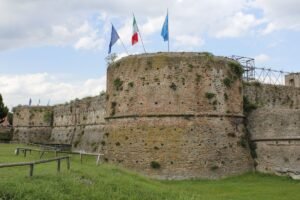
This arch was not built by chance. It was commissioned by the Roman Senate in 27 BC to honor Octavian Augustus, the first emperor, who had just restored the Via Flaminia, the vital artery connecting Rome to Rimini (then Ariminum). Imagine: Rimini was the gateway to the Po Valley, and the arch symbolically marked the end of the Via Flaminia and the beginning of the Via Emilia. For centuries, it functioned as a city gate until, in the Middle Ages, the walls were lowered, leaving it isolated yet proud. Fun fact: at its summit, there was a bronze statue of Augustus on a quadriga, lost over the centuries. During the Renaissance, it was even incorporated into the Malatesta walls, but its Roman structure remained recognizable. It has survived wars, earthquakes, and urban transformations, becoming the city’s symbol. Today, looking at it, you see layers of history superimposed: Roman power, medieval defenses, modern vibrancy.

  • 27 BC: Construction commissioned by the Roman Senate.
  • Medieval era: Loses its function as a gate after the walls are lowered.
  • Renaissance era: Incorporated into the Malatesta walls.
  • Today: A symbolic monument and landmark in the historic center.

The Architecture That Speaks

Approach and observe it closely. It’s not just a simple block of stone. The arch is made of Istrian stone, that white, durable limestone that glistens in the sun and takes on warm hues at sunset. What immediately catches the eye are the four openings: a large central archway for carts and two smaller side ones for pedestrians. An absolute rarity among Roman triumphal arches in northern Italy, which typically had only one. Above the central arch, look for the inscriptions: the original one celebrates Augustus as a restorer of roads, but there’s a later one, from the Fascist period, celebrating its restoration. It’s a bit unusual to see them together, but it gives an idea of how this monument has been claimed in different eras. The capitals of the side half-columns are Corinthian, elegant and well-preserved. I enjoy looking at the details of the reliefs, even if worn: they speak of a refined art that here, in the provinces, maintained very high standards. It’s not a closed museum; it’s a living work that interacts with the city: cars pass by it, people stop to take photos, and it remains there, unchanged.

An Urban Experience

Visiting the Arch of Augustus isn’t something you do in isolation. It’s an experience that blends with the life of Rimini. You can sit on a nearby bench, perhaps with an ice cream in hand from one of the historic gelaterias just steps away, and watch the comings and goings. In the evening, when the lights come on, the arch becomes even more evocative, casting long shadows across the square. There are often street artists or small impromptu events that give it a festive atmosphere. It’s also a perfect starting point for exploring the historic center: from here you can walk along Corso d’Augusto, the street it marks, and reach Piazza Tre Martiri (the ancient forum) and the Tiberius Bridge. For me, the best time is early afternoon, when the light hits the main façade and highlights every detail of the stone. Don’t expect a fenced-off, silent site: here, history coexists with the present in a noisy and authentic way. Sometimes I pass by and think about how many millions of people must have seen it over the centuries. It’s almost as if the arch is an immobile witness to the city.

Why Visit It

First: it’s the oldest surviving Roman arch in Northern Italy. This is no small detail: it puts you face to face with a piece of history that has been lost elsewhere. Second: its location is strategic. It’s just a few minutes’ walk from both the beach and other main attractions, like the Tiberius Bridge or the Malatesta Temple. You can easily fit it into a day combining beach and culture without any stress. Third: it’s free and always accessible. There are no tickets to buy or opening hours to worry about: you can see it whenever you want, even just in passing. For those traveling with children, it’s a simple and immediate way to let them touch Roman history, without having to spend hours in a museum. And let’s be honest, it always looks great in photos, especially with Rimini’s blue sky in the background.

When to Go

I recommend seeing it at sunset, especially in spring or early autumn. In summer, Rimini is very lively, but it can be crowded and hot; at sunset, however, the light is golden and warm, the crowd thins out a bit, and the atmosphere becomes more intimate. The white stone of the arch turns pink and orange, creating a beautiful contrast with the darkening sky. In winter, on clear days, it has its own melancholic and solemn charm, but watch out for the sea breeze which can be biting. Avoid the midday hours on a sultry summer day: you risk rushing through without enjoying it. My personal opinion? Seeing it after a rainstorm, when the air is clean and the stone is still damp, gives it a special shine. It’s at that moment that it seems most alive.

In the Surroundings

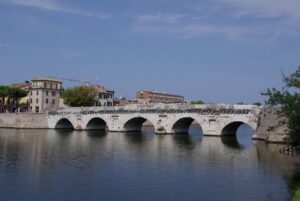
From the arch, take a five-minute stroll along Corso d’Augusto to reach the Tiberius Bridge, another perfectly preserved Roman gem spanning the Marecchia River. It’s impressive to think it’s still in use after two thousand years. If you’re passionate about history, nearby is the Surgeon’s Domus, an archaeological site with extraordinary mosaics that show daily life in Roman times. For a lighter experience, spend an hour browsing the stalls at Rimini’s covered market on Via Castelfidardo, where you can sample local products like piadina. These are all enriching additions to your visit, without requiring long trips.

Itineraries nearby


💡 Did You Know…?

Look carefully at the top of the arch: the upper part with the emperor’s statue is missing. It didn’t collapse, but was deliberately removed in the Middle Ages to make room for battlements when the arch became part of the city walls. Another interesting detail: the four clipei (round shields) depict Roman deities like Jupiter and Neptune, but the one facing Rome shows Apollo, a god particularly dear to Augustus. If you pass by in the evening, the lighting makes it even more suggestive, offering a memorable photo without flash.