Porta Borsari: Perfectly Preserved Roman Gate with Two White Stone Arches

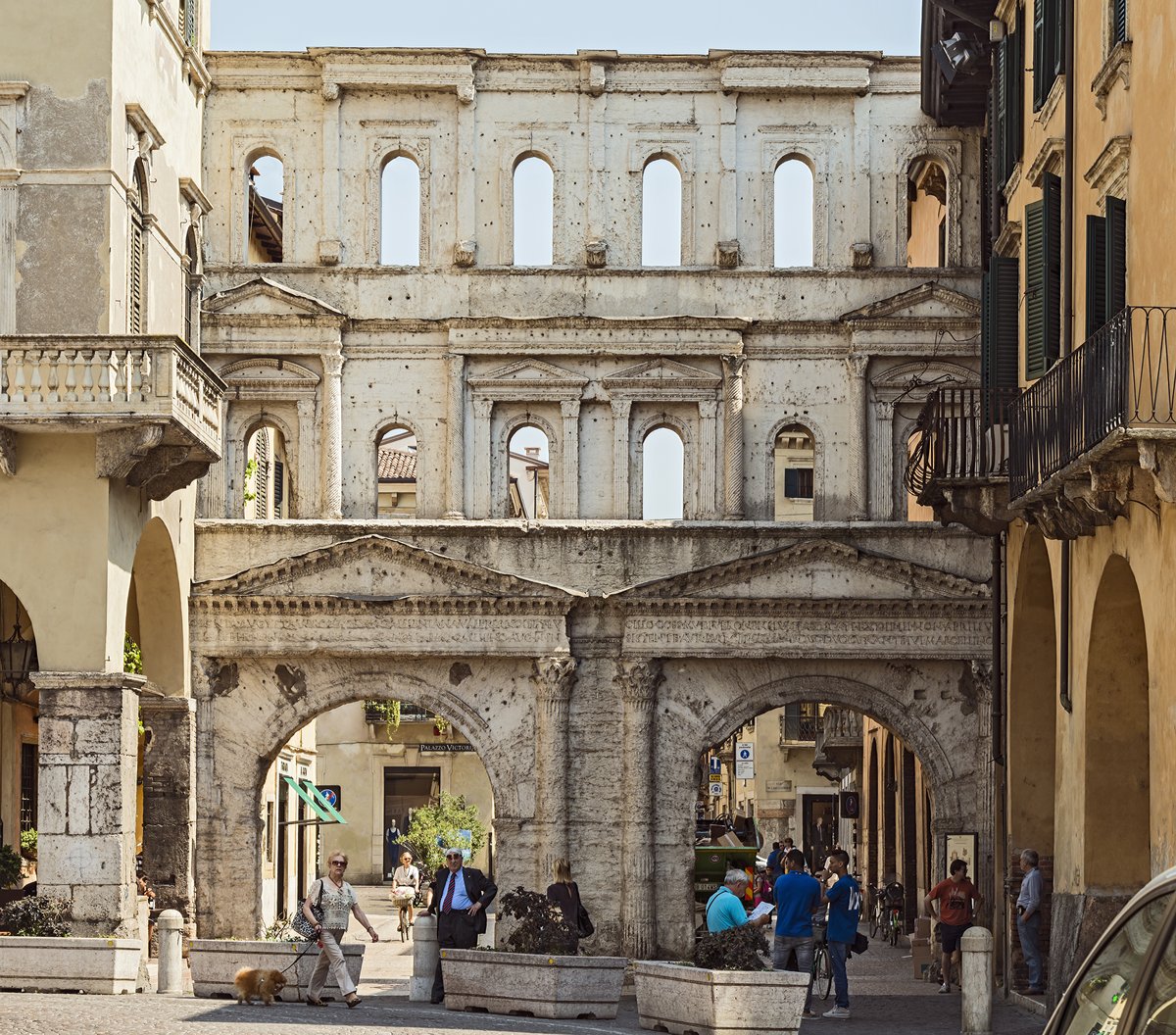
Porta Borsari is a perfectly preserved 1st-century AD Roman gate in Verona’s historic center, with free access and always open. Its local white stone facade and two monumental arches offer a unique glimpse into ancient Verona, perfect for photography and historical immersion.

  • Perfectly preserved 1st-century AD Roman gate with two monumental arches
  • Local white stone facade that changes tones with daylight
  • Free access available 24/7
  • Strategic location in the historic center, near Piazza delle Erbe and other attractions


Events nearby


Copertina itinerario Porta Borsari: Perfectly Preserved Roman Gate with Two White Stone Arches
Porta Borsari in Verona is a perfectly preserved 1st-century AD Roman gate, featuring a white stone facade and two monumental arches. Free access 24/7, ideal for photography and discovering Roman Verona in the historic center.

Good to know


Introduction

Walking along Corso Porta Borsari, in the heart of Verona, you come across an imposing Roman gate that seems to defy the centuries. Porta Borsari is not just a monument, but a true gateway to the past, with its facade made of local white stone that shines under the sun and its two perfectly preserved arches. This site, which once marked the southern entrance to the Roman city, now welcomes visitors with timeless elegance, offering a unique glimpse of the Roman Verona still alive among modern streets. Its location, right at the beginning of one of the main streets in the historic center, makes it impossible to ignore: it’s the first taste of the historical richness that awaits you just beyond the threshold.

Historical Background

Porta Borsari has a history that dates back to the 1st century AD, when it was built as part of the Roman walls of Verona. Originally named Porta Iovia due to its proximity to a temple dedicated to Jupiter, it acquired its current name in the Middle Ages, derived from ‘bursarii’ (tax collectors) who levied duties here. The structure we see today is largely from the 3rd century AD, when it was rebuilt in white stone after a previous fire. Over the centuries, it has withstood invasions, sieges, and urban transformations, becoming a symbol of continuity in the city.

  • 1st century AD: Original construction as Porta Iovia
  • 3rd century AD: Rebuilding in white stone after a fire
  • Middle Ages: Assumes the name Porta Borsari for tax collection
  • Today: Perfectly preserved monument and tourist landmark

The Architecture That Speaks

What strikes you about Porta Borsari is its extraordinary preservation. The facade, made from locally sourced white stone, features two monumental arches (fornices) perfectly intact, topped by two rows of blind windows that once housed statues. Looking closely, you can still see the marks of Roman carriageways on the bases, evidence of the passage of carts and travelers for centuries. The structure, about 13 meters high, showcases Roman construction mastery that has withstood time: the stone blocks are still perfectly aligned, without the need for invasive restoration. It is a rare example of a Roman city gate that retains its original function as an entrance, even though today it symbolically separates pedestrian traffic in the historic center from the modern city.

Photography and Light

Porta Borsari is a photographer’s paradise, both for professionals and amateurs. Its white stone facade takes on different shades depending on the time of day: in the morning, the grazing light highlights every detail of the arches and decorations; at sunset, it is tinged with warm golden hues that create spectacular plays of shadows. The advice is to shoot from different angles: frontally to capture the perfect symmetry, from the side to emphasize the depth of the arches, or by including the urban context with the surrounding Renaissance buildings. Even at night, with artificial lighting enhancing its volumes, it offers evocative shots. Don’t forget to photograph the details: the Latin inscriptions, the signs of time on the stone, and the contrast between ancient Roman architecture and the lively Veronese bustle of today.

Why Visit It

Visiting Porta Borsari is worthwhile for at least three concrete reasons. First, it is one of the best-preserved Roman monuments in Northern Italy, allowing you to experience Roman engineering firsthand without barriers or entrance tickets. Second, its strategic location makes it a perfect starting point for exploring Verona’s historic center: from here, you can reach Piazza delle Erbe, the Arena, and Juliet’s House on foot in just a few minutes. Third, it offers an immersive historical experience: it’s not a closed museum but a living monument that is part of the daily urban fabric, where you can walk exactly where the Romans walked two thousand years ago. Additionally, it is accessible 24/7, allowing visits even during the quietest hours.

When to Visit

The best time to appreciate Porta Borsari is early morning, when sunlight strikes the facade diagonally, highlighting every detail of the white stone and creating deep shadows that enhance its three-dimensionality. During this time slot, tourist flow is still minimal, allowing for a calm observation of the monument and crowd-free photography. Spring and summer evenings are also magical, when night lighting illuminates the area and the atmosphere becomes more intimate. Avoid instead the midday hours on the hottest summer days, when direct sunlight can flatten details and the heat makes lingering less pleasant.

In the Surroundings

Just beyond Porta Borsari, you find yourself immersed in the heart of Verona. A few steps away is Piazza delle Erbe, the ancient Roman forum transformed into a lively daily market, surrounded by medieval and Renaissance palaces. Also nearby, don’t miss the Roman Theater and the adjacent Archaeological Museum, which complete the journey through Roman Verona with artifacts and a panoramic view of the city from the hilltop. For a thematic experience, follow the traces of Shakespearean Verona toward Juliet’s House, reachable with a pleasant walk through cobblestone streets and hidden courtyards.

Itineraries nearby


💡 Did You Know…?

Porta Borsari gets its current name from the Middle Ages: ‘Borsari’ referred to the soldiers who collected the toll (the ‘purse’ of taxes) on incoming goods. In Roman times it was called Porta Iovia, perhaps due to a nearby temple of Jupiter. An ultra-realistic detail: if you look carefully at the stone near the arches, you can see marks from cart wheels that rubbed against it for centuries. It’s not an invented legend: the wear is visible and tangible, and that’s exactly what makes the place so authentic. Additionally, the gate was part of a city wall about 900 meters long: consider that only this gate and Porta Leoni have reached us so intact. In the evening, with the lighting, it takes on an even more suggestive atmosphere.