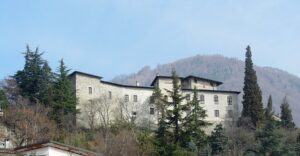
Discover Mantua in one day with this walking itinerary designed for those short on time but unwilling to miss Renaissance masterpieces. Start at Palazzo Ducale, the ancient residence of the Gonzaga family, and stroll through the historic center to Piazza delle Erbe, the city’s vibrant heart. Don’t miss the Basilica of Sant’Andrea with its Albertian facade. In the afternoon, head to Palazzo Te, Giulio Romano’s masterpiece, famous for the Hall of the Giants. The route includes a detailed map and practical tips on tickets and opening hours. Ideal for a cultural city break discovering one of Italy’s most fascinating art cities.
🗺️ Your trip at a glance
A stroll through the centuries: from the opulent Gonzaga palace to the imaginative Palazzo Te, this itinerary grants you an unforgettable day in Mantua. A route designed for those who want to savor the essence of Lombard Renaissance in just a few hours.
- Ideal for: City breakers and time-pressed travelers who want to see Mantua‘s main attractions in one day.
- Highlights: Walking itinerary covering Palazzo Ducale, Basilica of Sant’Andrea, and Palazzo Te with map and practical tips.
- What to expect: A blend of art, history, and Renaissance architecture in a compact route rich in masterpieces.
Itinerary stops
Stop no. 1
Palazzo Ducale
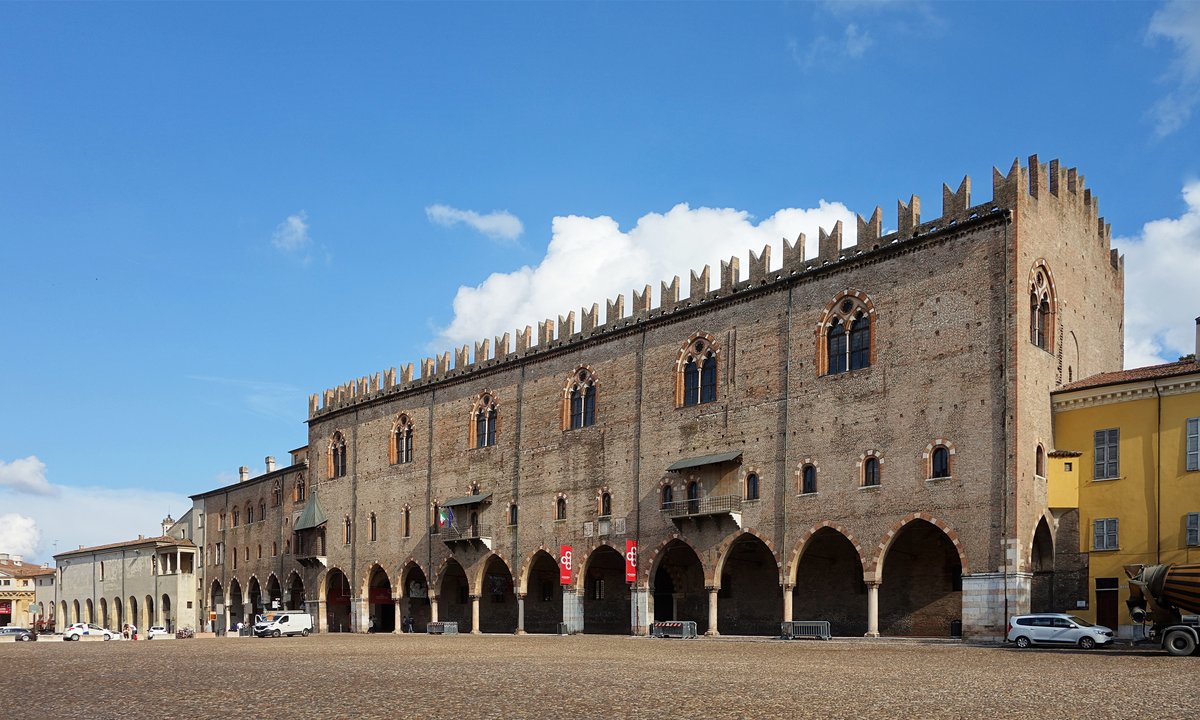 I start my day in Mantua right here, at Palazzo Ducale. What an impression—this giant of 35,000 square meters with over 500 rooms! It was the residence of the Gonzaga family for centuries, and every corner tells of their power. The oldest part, the Corte Vecchia, dates back to the 13th century, but the jewel is Mantegna’s Camera degli Sposi in the Castello di San Giorgio: that oculus on the ceiling is pure magic. Then there are the Raphael tapestries, Pisanello’s frescoes, and the Galleria della Mostra, 64 meters long. The palace is so vast it feels like a city within a city. Open from 8:15 AM to 7:15 PM (closed on Mondays), the full ticket costs €18. Book ahead to avoid the queue. I recommend spending at least two hours, but if you’re short on time, prioritize the Camera degli Sposi.
- Go to the page: Palazzo Ducale of Mantua: The Gonzaga Residence Between Art and Power
- Piazza Santa Barbara, Mantova (MN)
- Open in Google Maps
- View on Google Images

You should go if…
Stop no. 2
Piazza Broletto: the Medieval Heart Where Power Meets Poetry
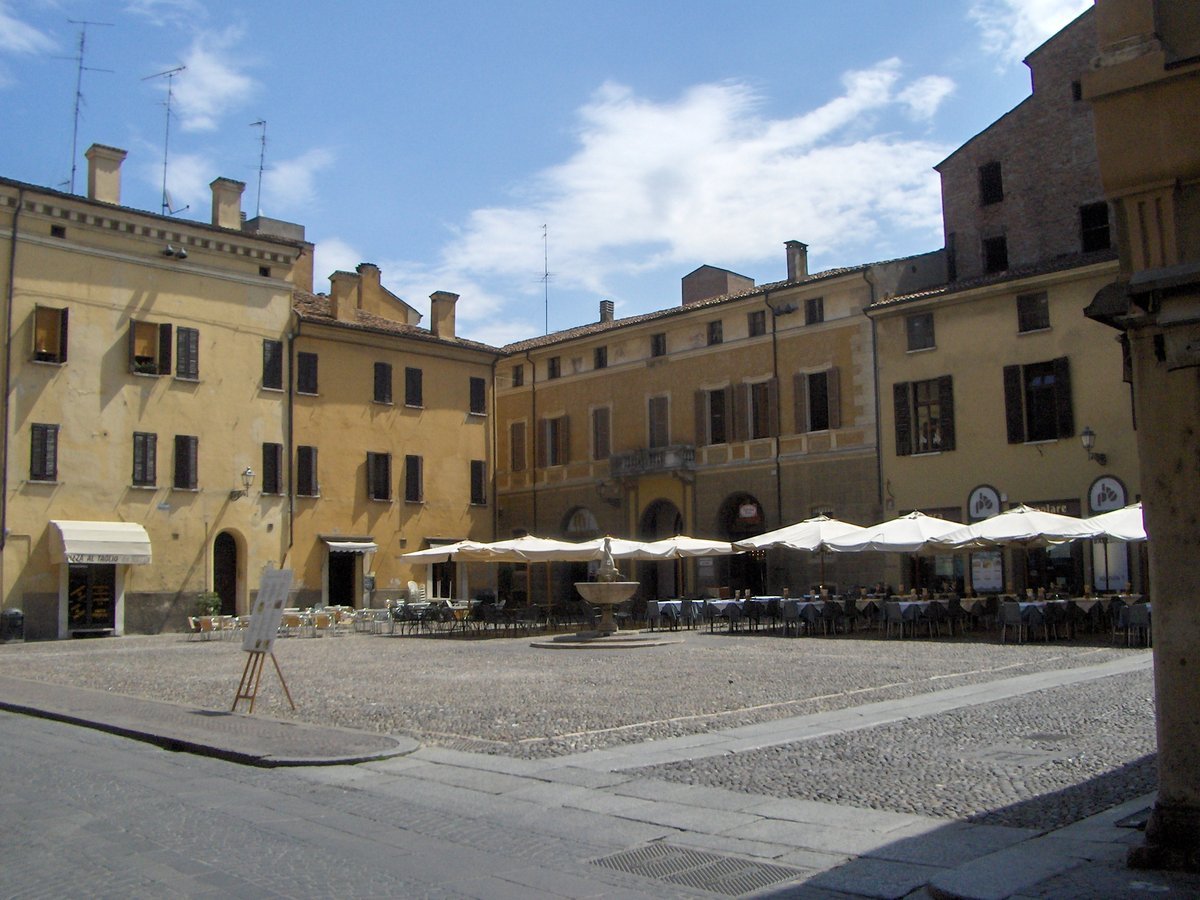 A few steps from Piazza Sordello, Piazza Broletto is a true medieval gem. Here, between the 12th and 13th centuries, the political heart of the city beat: the Palazzo del Podestà (1227) with its bell tower, the Arengario (early 14th century) used for speeches and even torture, and the Palazzo del Massaro, where communal revenues were recorded. On the palace façade, a niche houses the 13th-century statue of Virgil in his chair, called by the Mantovans “la vecia” (the old lady). At the center, the Fontana dei Delfini (Dolphin Fountain) marks the site of the first artesian well (1890). Today the restored palace has housed the Museo Virgilio (Virgil Museum) since 2024, while the west side is a succession of 15th-century arcades, with shops and the dome of Sant’Andrea in the background. Walking here is like taking a step back in time, among iron rings and 15th-century frescoes showing what Mantua was like then.
- Piazza Broletto, Mantova (MN)
- Open in Google Maps
- View on Google Images
You should go if…
Stop no. 3
Basilica of Sant’Andrea: Alberti’s Masterpiece
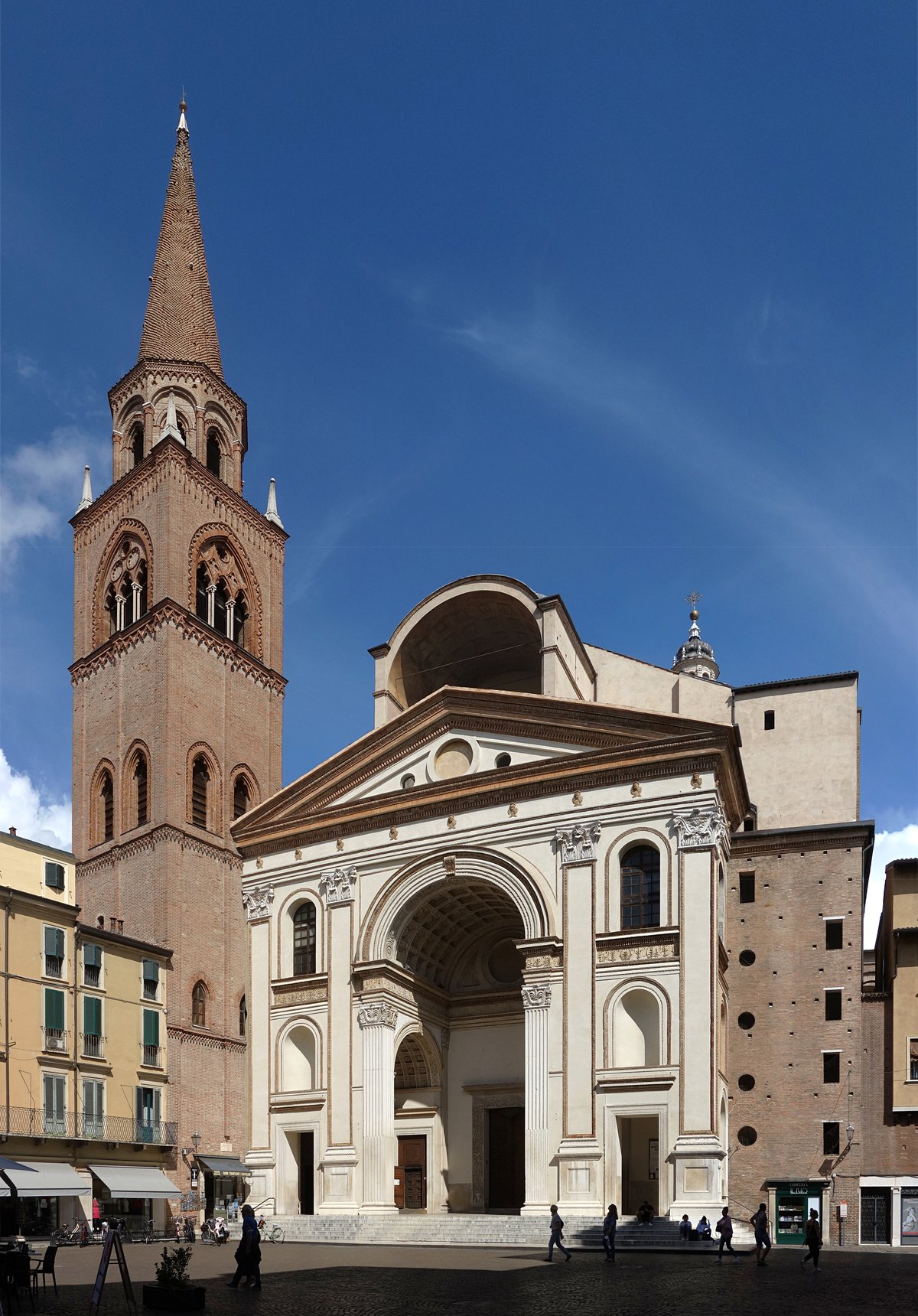 After soaking in the medieval atmosphere of Piazza Broletto, just a few steps away you’ll find yourself before one of the most extraordinary works of the Renaissance: the Basilica of Sant’Andrea. Designed by Leon Battista Alberti starting in 1472 at the behest of Ludovico III Gonzaga, its façade recalls a Roman triumphal arch, with a massive central arch flanked by Corinthian pilasters. The interior is a single nave covered by a coffered barrel vault, creating a play of light and shadow throughout the space. The dome, 80 meters high and 25 meters in diameter, was added in the 18th century by Filippo Juvarra. Here, the precious relic of the Blood of Christ is preserved, kept in the Sacred Vessels in the crypt. In the first chapel on the left, you will find the tomb of Andrea Mantegna, with decorations by Correggio. Admission is free, and the basilica is open daily from 8:00 AM to 12:00 PM and 3:00 PM to 7:00 PM. A place that unites art, faith, and history in a single, majestic embrace.
- Go to the page: Basilica of Sant’Andrea: Alberti’s Renaissance Masterpiece
- Piazza Mantegna, Mantova (MN)
- Open in Google Maps
- View on Google Images
You should go if…
Stop no. 4
Palazzo Te: Giulio Romano’s Mannerist Masterpiece
 Leaving behind the majestic Basilica of Sant’Andrea, you head towards the last great stop of the day: Palazzo Te, the suburban villa commissioned by Federico II Gonzaga as a place of leisure and representation. Built between 1525 and 1535 by the genius of Giulio Romano, Raphael’s favorite pupil, this palace is a riot of illusionism and fantasy. As soon as you cross the entrance on Viale Te, you will be amazed by the Sala dei Giganti: a continuous fresco that makes the ceiling collapse upon you, with Jupiter hurling thunderbolts at the fleeing Titans. Shortly before, the Sala dei Cavalli will surprise you with the Gonzaga steeds portrayed in perspective views that seem to follow you with their gaze. And then the Room of Cupid and Psyche, with mythological love stories perfect for a dreamy pause. Don’t miss the upper floor, where the Museo Civico houses Egyptian and Mesopotamian collections. If time permits, treat yourself to an aperitivo at the new Spazio Te, a bistro overlooking the courtyard. Hours: daily 9 am–7:30 pm (Tuesday 1 pm–7:30 pm), tickets available online. An artistic finale that will leave you speechless.
- Go to the page: Palazzo Te: Giulio Romano’s Mythological Frescoes and the Hall of the Giants
- Viale Te, Mantova (MN)
- http://www.palazzote.it/
- Open in Google Maps
- View on Google Images
You should go if…
Stop no. 5
Church of San Sebastiano: Alberti’s Temple
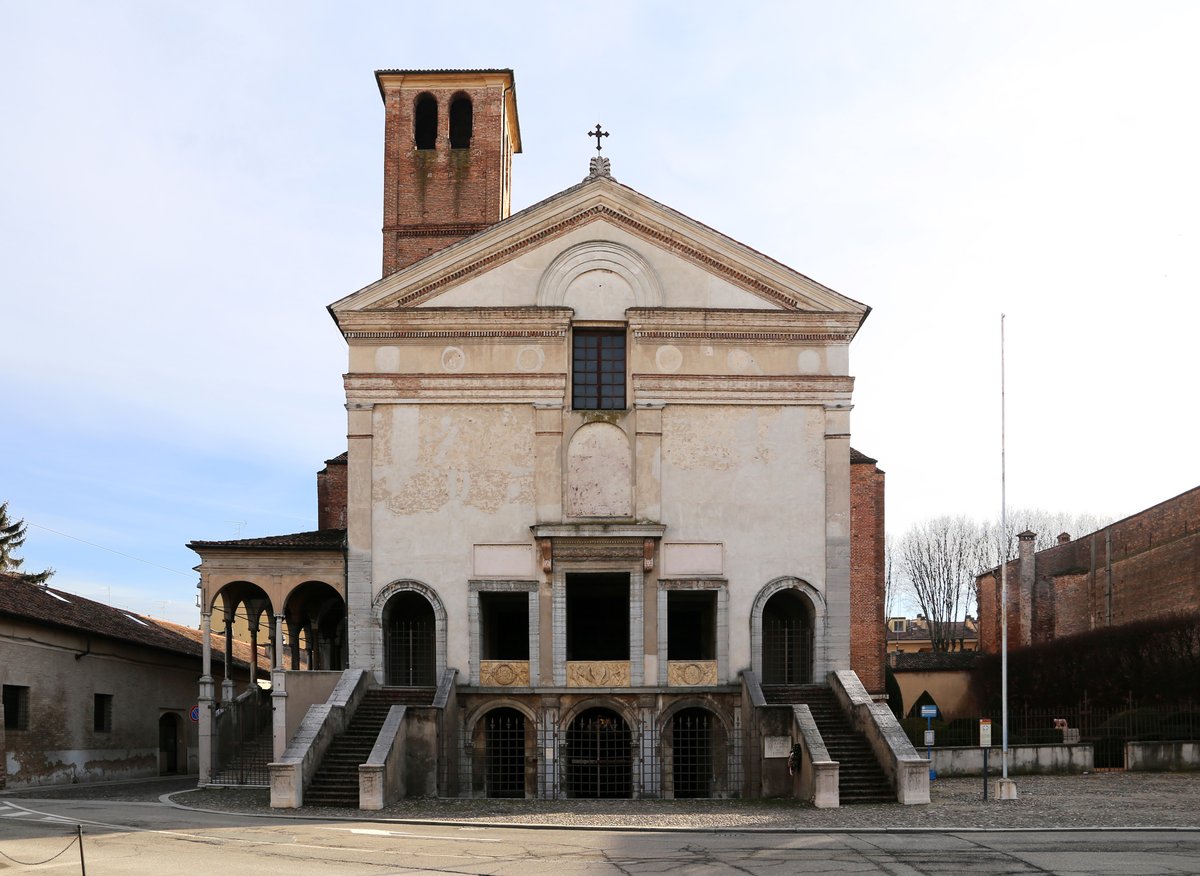 After the wonder of Palazzo Te, a lesser-known but equally enchanting gem awaits: the Church of San Sebastiano, designed by the Renaissance genius Leon Battista Alberti for Ludovico Gonzaga. Construction began around 1460 and was completed by Luca Fancelli, with consecration in 1529. Today the building serves as the Famedio dei caduti, a war memorial that adds an atmosphere of reflection. The Greek cross plan is one of the earliest Renaissance examples: a central cubic space with a cross vault and three apse arms. The facade, austere and solemn, features an original upper section with a broken architrave, a tympanum, and a Syrian arch reminiscent of late antique models. The two side staircases were added in 1926, altering the original entrance. Standing before it, you’ll immediately notice the monumentality and simplicity of the whole. The interior, sparsely decorated, invites contemplation. Practical note: the entrance ticket is often included with that of Palazzo Te (€15.00), or you can visit it separately for €1.50. Opening hours vary (typically 10:00 AM – 5:30 PM, closed Mondays). A tip? Stop for a moment in silence, because history can be felt here.
- Largo XXIV Maggio, Mantova (MN)
- Open in Google Maps
- View on Google Images
You should go if…
Stop no. 6
Piazza Virgiliana Park: Mantua’s Green Lung
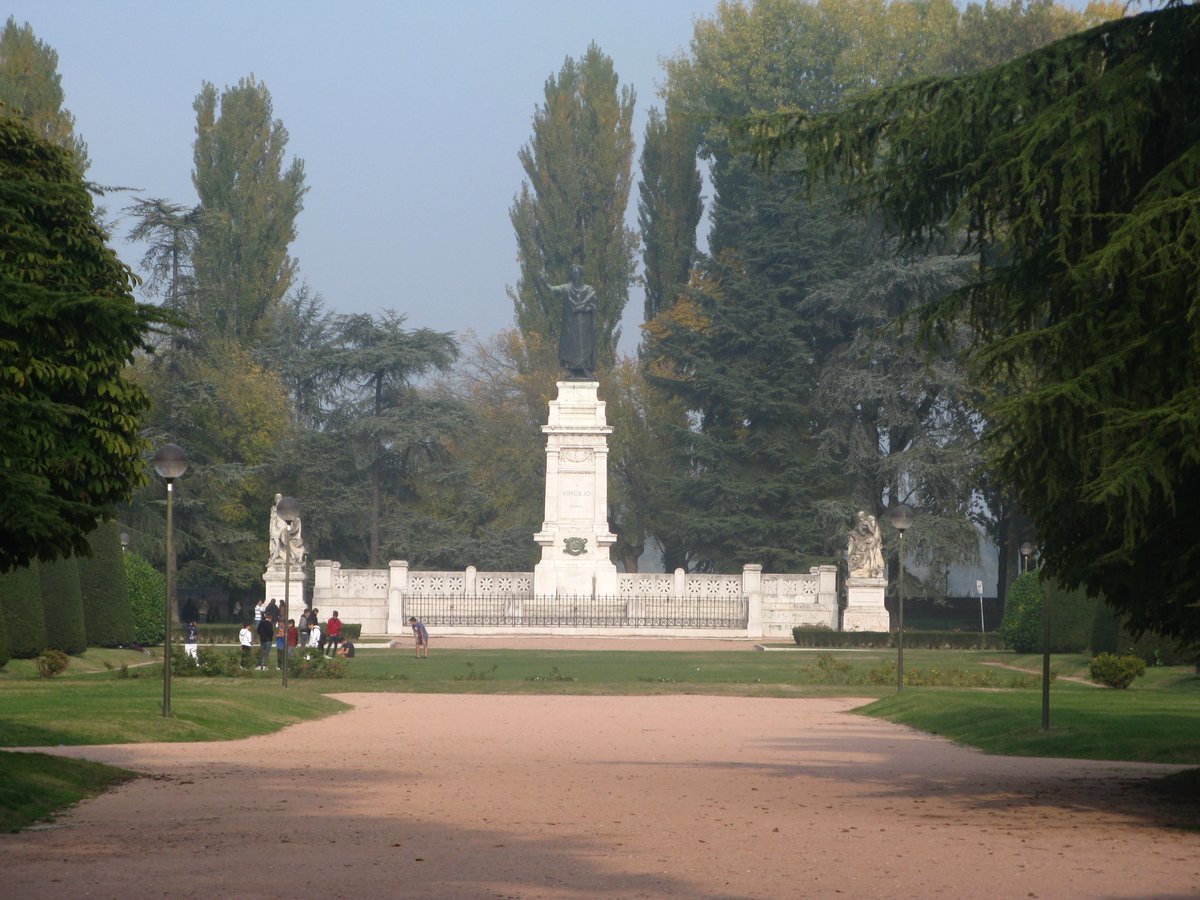 Before ending your day, treat yourself to a relaxing break at Piazza Virgiliana Park, a large green area overlooking the Lago di Mezzo. Until the 1700s, this was a marshy port; it was drained and reclaimed in 1797 under Napoleon, designed by architect Paolo Pozzo. The result is a rectangular garden-square with a semicircle, bordered by rows of trees and flowerbeds. At its center stands the Monument to Virgil, a bronze statue (1927) by Emilio Quadrelli based on a design by Luca Beltrami, flanked by two marble groups depicting Heroic and Pastoral Poetry. The park is also a family-friendly place: there is an inclusive playground from the ‘Gioc-Abili Tutti’ project. After all that walking among palaces and churches, here you can breathe fresh air. Look out over the lakeside: the reflection of the greenery on the water is the perfect finale for your itinerary. If you have children, let them run on the grass; if you’re a couple, enjoy a sunset stroll. And if you feel like it, also visit the nearby Museo Diocesano Francesco Gonzaga (the former convent of Sant’Agnese).
- Mantova (MN)
- Open in Google Maps
- View on Google Images
You should go if…