Palmavera Nuragic Complex: prehistoric village with 8-meter towers and circular huts

The Palmavera Nuragic Complex in Alghero is a prehistoric village over 3500 years old, with limestone and basalt stone towers, circular huts, and a sacred well. Just 10 minutes from Alghero’s center, it offers an authentic archaeological experience with informative panels guiding the visit without needing a guide.

  • Main tower 8 meters high with visible tholos construction technique
  • Village of circular huts with central hearths showing daily life
  • Strategic location just kilometers from Alghero’s beaches
  • Well-marked and accessible route with explanations in Italian and English


Events nearby

Copertina itinerario Palmavera Nuragic Complex: prehistoric village with 8-meter towers and circular huts
3500-year-old nuragic village near Alghero, featuring two stone towers, circular huts, and a sacred well. Accessible route with informative panels, perfect for combining culture and seaside.

Good to know


Introduction

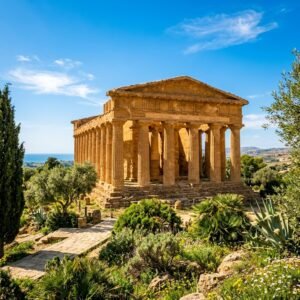
Just outside Alghero, the Palmavera Nuragic Complex welcomes you with an immediacy that almost surprises you. It’s not just an archaeological site; it’s an almost intact nuragic village that makes you feel as if you’re walking among the houses of a community from three thousand years ago. The sight of the two limestone towers rising against the blue Sardinian sky is powerful, immediately giving you a sense of how advanced this civilization was. What strikes you, beyond the majesty, is the feeling of everyday life: the circular huts with their central hearths, the remains of walls that delineated common spaces. It seems as if the inhabitants have just stepped out. For me, it was like taking a leap back in time without needing much imagination; everything is there, concrete and tangible.

Historical Background

Palmavera was not built in a day. Its history unfolded over centuries, beginning in the 16th-14th century BC with the construction of the first tower, the central keep. Then, between the 9th and 8th centuries BC, the village expanded significantly, adding a second tower, a defensive outer wall, and dozens of huts. This period of greatest splendor coincides with the Sardinian Iron Age. Excavations, which began in the 1960s, have uncovered artifacts that speak of daily life, trade, and even a degree of prosperity. It is not just a fortress, but a true community center.

  • 16th-14th cent. BC: Construction of the main tower (keep).
  • 9th-8th cent. BC: Expansion of the village with a second tower, outer wall, and new huts (period of maximum flourishing).
  • 1963-1964: Beginning of systematic archaeological excavations.
  • Today: A museum site open to visitors, one of the best-preserved Nuragic complexes in Northern Sardinia.

The Two Towers and the Courtyard

The heart of Palmavera lies in its two towers, built from blocks of local limestone. The main tower, the oldest, is impressive for its tholos construction technique (false dome), still clearly visible. Beside it, the secondary tower, smaller yet equally sturdy, creates a harmonious ensemble. Between them opens a paved courtyard, likely the site of gatherings and ceremonies. Walking through this space, surrounded by millennia-old walls, evokes a surprising sense of intimacy. I paused to observe the details: the entrance to the main tower is low, almost making you stoop to enter—a detail that makes everything feel more human. The light filtering through the stones, especially at sunset, creates shadow plays that seem to tell ancient stories.

The Circular Huts: Daily Life

Beyond the towers, what makes Palmavera special is the village of circular huts surrounding it. These are not just holes in the ground, but well-defined structures with dry-stone walls and beaten-earth floors. In some, the central hearths are still clearly visible, where families cooked and warmed themselves. One hut, larger than the others, has been interpreted as the ‘meeting hut,’ perhaps a place for community decisions. Walking among these ruins makes you think about everyday life: children playing, women preparing food, artisans at work. This is an aspect often lost in Nuragic sites, but here it’s palpable. Personally, I find that this is what truly gives the place its soul, more so than the towers themselves.

Why Visit

For at least three concrete reasons. First, it’s easily accessible and well-explained: the informational panels (in Italian and English) guide you without being intrusive, perfect for those who aren’t experts. Second, it offers a comprehensive view of Nuragic civilization: not just the monumental part (the towers), but also the residential aspect (the huts), which isn’t a given. Third, the location is enviable: immersed in Mediterranean scrubland, with views of the countryside and just a stone’s throw from the sea of Alghero. It can be perfectly combined with a day at the beach or a nature walk. In short, it’s not a mandatory stop for the ‘distracted tourist’, but an experience that truly enriches your understanding of Sardinia.

When to Go

The best time? Without a doubt, early morning or late afternoon, especially during the warmer months. The low-angled sunlight highlights the textures of the limestone and creates a magical, almost golden atmosphere. In spring, the surrounding Mediterranean scrub is in bloom and the air is fresh, perfect for a peaceful visit. In summer, going early allows you to avoid peak hours and the most intense heat—I’ve seen queues at the entrance at noon in July, so it’s better to plan ahead. In autumn, the vegetation’s colors come alive and there are fewer crowds. Winter can be evocative with grey skies, but always check the opening hours as they might be reduced.

In the Surroundings

After Palmavera, I recommend two nearby thematic experiences. The first is a visit to the Necropolis of Anghelu Ruju, also near Alghero: it’s a pre-Nuragic site with hypogeal tombs carved into the rock, completing the picture of Sardinian prehistory. The atmosphere is more mysterious, almost sacred. The second, for a total contrast, is a walk along the walls of Alghero at sunset: the Catalan city with its medieval towers abruptly brings you back to the Middle Ages, after millennia of prehistory. It’s a juxtaposition that works because it shows the historical layers in this area. If you have time, a boat tour to the Neptune Caves offers another type of natural wonder.

Itineraries nearby


💡 Did You Know…?

During excavations, everyday objects such as grindstones, loom weights, and ceramics were found, which are now displayed at the Archaeological Museum of Alghero. An interesting fact: the name ‘Palmavera’ might derive from the dwarf palms that grow in the area or, according to some hypotheses, from a term indicating a marshy place. Observing the huts, you’ll notice that some have a central hearth: this is where the community cooked and warmed themselves. The most enigmatic structure is the so-called ‘meeting enclosure,’ where important decisions for the village were probably made. If you visit in spring, you might see wild orchids blooming among the ruins.