
Are you ready to discover Sassari in a day? This historical and architectural itinerary takes you to explore a city rich in charm, where every stone tells a story. We'll start from the Mont'e Prama necropolis, a prehistoric site unique in its kind, then immerse ourselves in the historic center with its noble palaces and medieval churches. We'll walk through the cobblestone streets of the Castello district, admire the majestic Rosello Fountain, and visit the Cathedral of San Nicola, a symbol of the city. With this route, ideal for those who love history and architecture, you'll experience an intense and memorable day in Sassari, capturing the essence of a city that blends antiquity and elegance in every corner.
🗺️ Your trip at a glance
A historical walking itinerary that traverses Sassari from prehistory to the 18th century, ideal for those seeking culture away from the busier tourist paths.
- Ideal for:
history and architecture enthusiasts, and curious travelers looking for an authentic experience.- Highlights:
5 stops from prehistory to the 18th century, a walking itinerary with integrated maps, off the beaten tourist track.- Who it's for:
perfect for those with just one day who want to capture the historical and architectural essence of Sassari in an intense and memorable way.
Itinerary stops
Stop no. 1
Domus de Janas of Molafà
 Begin your itinerary in Sassari with a leap back in time at the Domus de Janas of Molafà, an archaeological site that takes your breath away. These prehistoric tombs, carved directly into the limestone rock, date back to the Neolithic period and immediately give you a sense of how ancient this area's history is. The burial chambers, with their simple yet evocative geometric shapes, are a perfect example of how local populations honored their deceased. I was struck by the silent, almost mystical atmosphere of the place, far from the city's chaos. It's located on Via Caniga, in a green area that invites a peaceful stroll. Bring comfortable shoes because the terrain can be a bit uneven, but it's worth it to touch a piece of Sardinia that few know about. Personally, I paused to observe the details of the carvings on the walls, trying to imagine the lives of those ancient inhabitants. It's a place that makes you reflect, away from the usual tourist attractions.
- Via Caniga, Sassari (SS)
- Open in Google Maps
- View on Google Images

You should go if...
Stop no. 2
Piazza d'Italia
 After exploring the ancient prehistoric roots, our itinerary takes us to the beating heart of Sassari: Piazza d'Italia. It's not just a square; it's the true living room of the city, an elegant, spacious area that immediately conveys its importance. Surrounded by imposing historic buildings, such as the Provincial Palace with its neoclassical facade, the square has a majestic yet welcoming atmosphere. I enjoy observing the architectural details, statues, and cast-iron lampposts that seem to tell stories from the late 19th century. It's the perfect spot for a break, perhaps sitting on a bench and watching life go by: university students chatting, families strolling, the typical comings and goings of a square that serves as a meeting point. Personal note: the feeling of open space after the alleys of the historic center is pleasantly surprising. Here, you truly breathe the air of a vibrant city proud of its history.
- Sassari (SS)
- Open in Google Maps
- View on Google Images
You should go if...
Stop no. 3
Fontana del Rosello
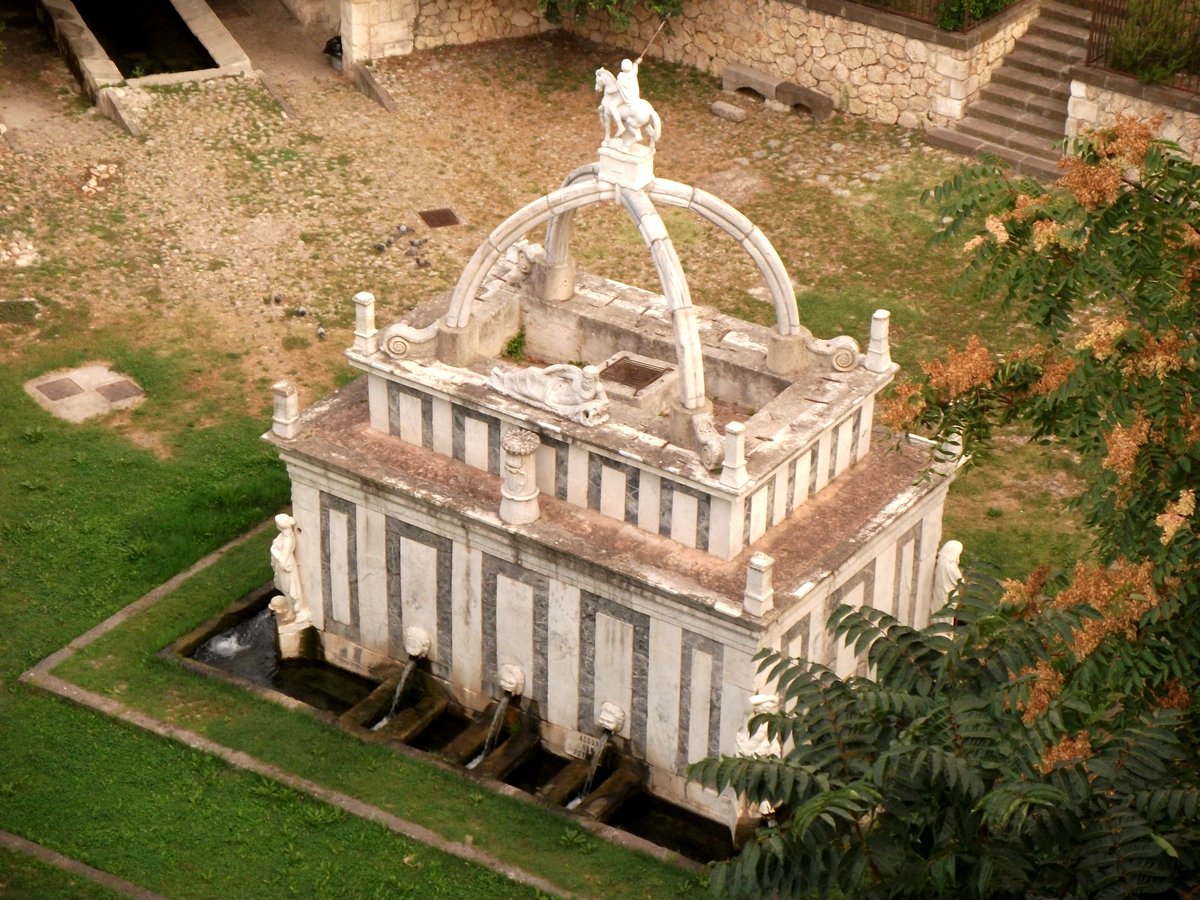 Leaving behind the 19th-century elegance of Piazza d'Italia, one ventures towards an older and more evocative symbol: the Fontana del Rosello. Located on Via Col di Lana, this monumental fountain from 1606 is not just a water source but a true stone book narrating Sassari's history. Its structure made of local trachyte, with the four statues representing the seasons and the city's coat of arms, struck me with its meticulous details, as if each sculpture had a story to whisper. The water still flows today, fresh and clear, and seeing locals approach to fill their bottles is an image that tangibly links past and present. Personally, I paused to admire the rampant lion, a symbol of strength for the city, and noticed how the afternoon light plays on the figures, creating shadows that seem to animate them. It's a quiet corner, away from the chaos, where one breathes an almost sacred atmosphere, tied to the very essence of urban life from times past.
- Via Col di Lana, Sassari (SS)
- Open in Google Maps
- View on Google Images
You should go if...
Stop no. 4
Palazzo Bozzo
 After the Fontana del Rosello, move towards Largo Ittiri to discover Palazzo Bozzo, an eighteenth-century gem that often goes unnoticed but deserves a stop. This building, with its sober facade made of local stone, struck me for its discreet elegance, far from baroque excesses. Upon entering, the inner courtyard immediately catches the eye, where light filters through, creating a cozy, almost intimate atmosphere. Architectural details, such as the window frames and the entrance portal, speak of an era when noble families in Sassari sought to distinguish themselves without showing off too much. Personally, I admired the stone staircase leading to the upper floors, imagining what life must have been like here centuries ago. It's a place that invites you to slow down, to observe calmly, and reminded me that in Sassari, history isn't only in the most famous monuments but also in these quiet corners, where every stone has a story to tell. A tip: look up to catch the details of the cornice, often overlooked but full of charm.
- Largo Ittiri, Sassari (SS)
- Open in Google Maps
- View on Google Images
You should go if...
Stop no. 5
Montalè Necropolis
 Leaving behind the eighteenth-century elegance of Palazzo Bozzo, the Montalè Necropolis offers a surprising contrast: here, on Via Medaglie d'Oro, you find yourself immersed in a landscape that speaks of distant eras. This archaeological site, less known than others in Sardinia, struck me with its secluded and almost intimate atmosphere. The domus de janas, the typical rock-cut tombs of the pre-Nuragic peoples, open along the hillside with simple yet evocative shapes. Walking among them, I noticed how some still bear traces of decorations, signs that tell of ancient rituals and spiritual beliefs. Personally, I lingered at a more isolated tomb, imagining the daily life of those communities who buried their dead here. It's a place that invites silence and reflection, far from the city's chaos, where Sassari's history has its roots in a remote past. A tip: bring a flashlight to better explore the interiors, though natural light often suffices to grasp the essence of the place.
- Via Medaglie d'Oro, Sassari (SS)
- Open in Google Maps
- View on Google Images
You should go if...


