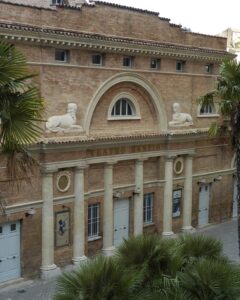
Cagli Municipal Theatre: horseshoe-shaped hall with golden stuccoes and excellent acoustics

The Cagli Municipal Theatre, built in 1856, is a perfectly preserved 19th-century jewel in the historic centre of the medieval village. Its horseshoe architecture ensures surprising acoustics, while the interiors amaze with refined details. Accessible during events or by booking guided tours, it represents an authentic cultural stop away from the more frequented tourist flows.

• Perfectly preserved 19th-century horseshoe-shaped hall with excellent acoustics
• Surprising interiors with three tiers of boxes decorated with golden stuccoes and frescoed ceiling
• Historical curtain from 1857 depicting the arrival of Federico da Montefeltro in Cagli
• Living theatre hosting theatre seasons, chamber music concerts and cultural events

Copertina itinerario Cagli Municipal Theatre: horseshoe-shaped hall with golden stuccoes and excellent acoustics
19th-century theatre from 1856 with three tiers of boxes, frescoed ceiling and historical curtain. Hosts theatre seasons and concerts, accessible during events or with guided tours.

Good to know


Introduction

Have you ever walked into a place and immediately felt it had a soul? The Teatro Comunale in Cagli is exactly like that. It’s not just a building; it’s an atmosphere. As soon as you cross the threshold, you’re greeted by a silence heavy with stories, and your eye is instantly drawn to the frescoed ceiling and the wooden balconies that seem suspended in time. It’s located right in the heart of the old town, in Piazza Matteotti, and despite its modest size, it has a grandeur that strikes you. For me, it’s one of those places that makes you realize how rich the province of Pesaro and Urbino is in hidden treasures, far from the more beaten tourist paths. A gem that speaks of community and passion for art.

Historical Overview

Its history begins in the 19th century, when Cagli felt the need for its own performance space. Construction started in 1845 based on a design by architect Giovanni Santini, and by 1848 the theater was ready to open its doors. However, it hasn’t always been smooth sailing. Like many theaters of the era, it experienced periods of neglect and even faced the risk of demolition in the 20th century. Fortunately, a major restoration between 1998 and 2001 restored its splendor, bringing to light details like the original stuccoes and decorations. Today it’s once again a vibrant venue, carefully managed by the municipal administration. A timeline to put things in perspective:

  • 1845: Construction begins based on Giovanni Santini’s design.
  • 1848: Official inauguration of the theater.
  • 20th Century: Periods of decline and closure, with demolition plans that never materialized.
  • 1998-2001: Major conservation restoration project.
  • Today: Home to an active theater and music season.

The Architecture That Tells a Story

What struck me, beyond the overall beauty, is how every element has its own function and story. The horseshoe-shaped layout, typical of 19th-century Italian-style theaters, creates a surprisingly good acoustic even without modern microphones. The three tiers of boxes (ground floor, first, and second) are not all the same: the central ones, wider, were reserved for the town’s most prominent families. Looking at the historic curtain, still occasionally used, you can see allegorical scenes celebrating the arts. And the details! The column capitals, the brass chandeliers… it feels like you can hear the buzz of the audience from two centuries ago. It’s not a static museum; it’s a perfectly functioning time machine.

Life Beyond the Stage

The magic of this theater lies in the fact that it’s not a relic locked away in a display case. It’s a place that breathes. If you happen to visit at the right time, you might catch a chamber music concert or a local dialect comedy that has the whole audience laughing. The programming often highlights local talents and emerging companies, giving the evening an authentic flavor. During guided tours (which I recommend—book at the town hall), they sometimes let you turn on the stage lights or test the echo from the gallery. It’s this living dimension, created by people who believe in it, that transforms the visit from a simple cultural stop into a genuine experience. It makes you feel part of the story, not just a spectator.

Why Visit It

For three concrete reasons. First: it’s a rare example of a perfectly preserved 19th-century provincial theater still in use, without the crowds of large city theaters. Second: accessibility. It can easily be visited in an hour, perhaps combined with a walk through Cagli, and the information is clear (there’s often material available at the entrance). Third: authenticity. You won’t find souvenir shops inside, but rather the scent of old wood and the silence that allows you to imagine the gala evenings of the past. It’s an unfiltered dive into Marche culture.

When to Go

My advice? Try to coincide with an evening performance during the theatre season, usually between autumn and spring. Seeing the theatre lit up and full of life is a completely different experience compared to a daytime visit. If you prefer tranquility to admire the architectural details, a weekday afternoon off-season is perfect: the light streaming through the windows enhances the colours of the frescoes, and you’ll have all the time to yourself. In summer, it’s sometimes closed for maintenance or preparations, so it’s better to check in advance.

In the Surroundings

The theater visit pairs perfectly with an exploration of Cagli, a perched medieval village with charming alleyways. Just steps away, in the same square, stands the 14th-century Civic Tower, offering lovely views. For a thematically linked experience, about a 15-minute drive away is the Teatro Angelo Mariani in Sant’Angelo in Vado, another small 19th-century theatrical gem of the province, less known but with similar charm. It completes the circle of local culture and historical architecture.

💡 Did You Know…?

The theatre’s historic curtain, painted in 1857 by Francesco Grandi, depicts the arrival of Federico da Montefeltro in Cagli, a tribute to local history that few theatres can boast. During restoration work in the 1990s, an ancient, perfectly preserved wooden stage machinery system was discovered beneath the stage floor, used for special effects like thunder and lightning. Locals recount that during night rehearsals, the footsteps of 19th-century actors can still be heard, and that the ghost of a 19th-century tenor occasionally appears in the main dressing room.