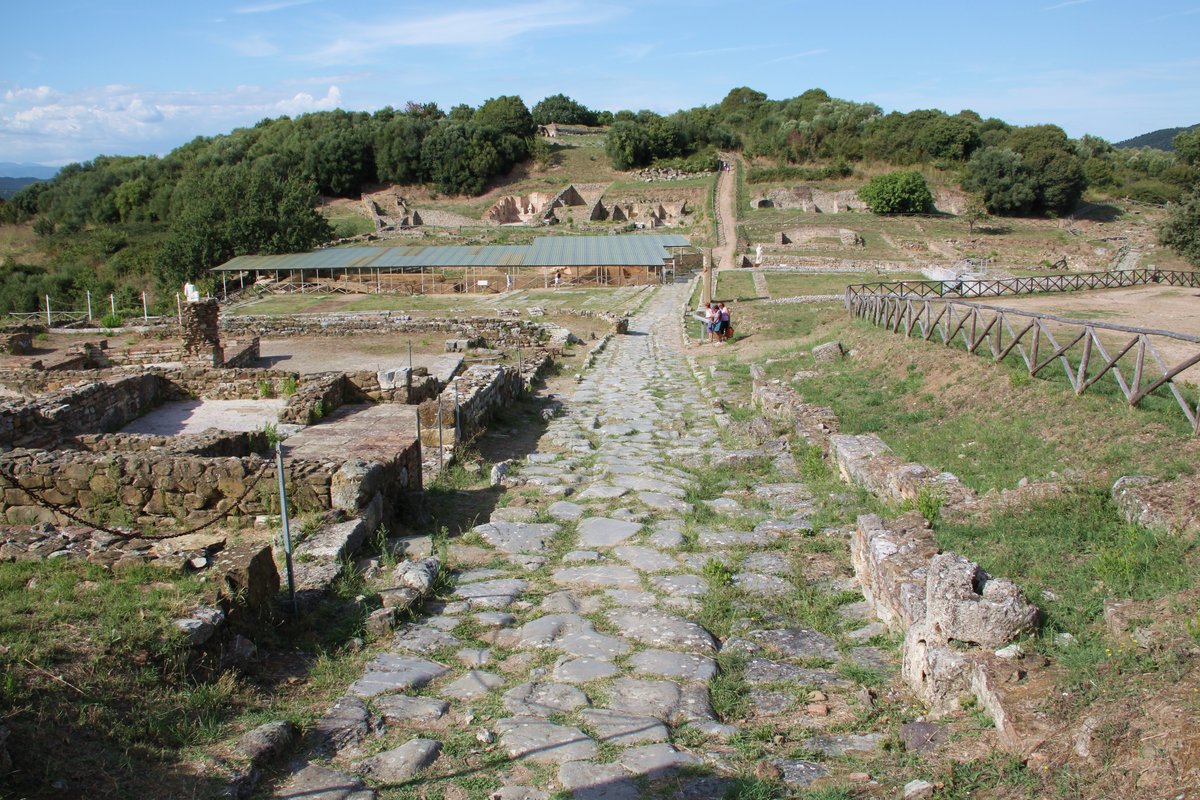
The Roselle Archaeological Area takes you to an entire city, first Etruscan and then Roman, where you can walk among millennia-old ruins with views of the Maremma. It’s less crowded than other Tuscan sites, ideal for an immersive trip through history and nature.
- Roman baths with well-preserved mosaics featuring geometric and figurative patterns
- Amphitheater carved into the hillside with spectacular panoramic views of the countryside
- Paved streets, forum, and Etruscan cyclopean walls that tell a story from the 7th century BC
- Location on two hills overlooking the plain with a quiet and evocative atmosphere
Introduction
You arrive at Roselle and are immediately struck by the silence. It’s not an empty silence, but one dense with history, broken only by the wind caressing the ruins and the songs of birds. The Roselle Archaeological Area welcomes you with a breathtaking panorama of the Tuscan Maremma, a view that alone is worth the trip. You walk among the remains of a city that was first Etruscan, then Roman, and you almost hear the ancient murmur among the stones. It’s not a closed museum, but a living place, where grass grows between mosaics and columns stand out against the sky. Personally, I was surprised by how extensive and well-preserved it is, despite the centuries. You expect something smaller, but instead you get lost among the baths, the forum, the houses. It’s an experience that lets you touch the layering of time with your own hands, without needing complicated explanations. The atmosphere is unique: it feels like being in a historical film, but everything is authentic, real. Perfect for those seeking not just knowledge, but emotions.
Historical Overview
Roselle wasn’t born yesterday.
Founded by the Etruscans in the 7th century BC, it became one of the twelve lucumonies, meaning important city-states. Then came the Romans, who conquered it in the 3rd century BC, transforming it into a municipium. It reached its peak during the Imperial era, with baths, an amphitheater, and paved roads. Decline set in during the Middle Ages, when malaria and invasions pushed the population toward Grosseto. Today, excavations have uncovered a treasure that tells this long story. They’re not just stones: they’re the traces of a civilization that shaped this land. I like to think that merchants, soldiers, and families passed through here, each with their own story. The timeline helps understand the sequence of events:
- 7th century BC: Etruscan foundation
- 3rd century BC: Roman conquest
- 1st century AD: Peak development in the Imperial era
- Middle Ages: Gradual abandonment
- 1950s: Start of systematic archaeological excavations
The Roman Baths and Mosaics
One of the highlights of Roselle is the Roman baths, with well-preserved mosaics featuring geometric and figurative motifs. You step into what was once a place for socializing and relaxation, and you can still see the pools, the hypocaust heating system, and the decorated floors. These aren’t perfect mosaics like those in some more famous sites, but they have a rustic, authentic charm. I lingered over a mosaic with blue and white wave patterns: it looks almost modern. The baths showcase the luxury and technology of the era, and walking through them lets you imagine daily life. It’s a concrete detail that makes the visit more tangible compared to just walls. I recommend also observing the remains of the calidarium and frigidarium to understand how the complex functioned. For me, it was a surprise to find so many colors still visible, despite exposure to the elements.
The Amphitheatre and the Panoramic View
As you ascend to the higher part of the site, you’ll reach the amphitheatre, partially carved into the hillside, with a spectacular view over the Maremma countryside. It’s not as large as the Colosseum, but it has an intimate and powerful atmosphere. Sit on the steps and try to imagine gladiator shows or theatrical performances. The location is strategic: from here, the valley was controlled, and the panorama was enjoyed. I spent a quarter of an hour just gazing at the horizon, where olive groves, woods, and the profile of the hills blend together. It’s a perfect spot for photos, but also for reflecting on the grandeur of this place. The amphitheatre is often less crowded than other areas, so you can enjoy it in peace. In my opinion, it’s here that you can best feel the past, as if time had stood still. A tip: visit this area towards the end, to close with an unforgettable view.
Why Visit It
For three practical reasons. First, it’s one of the most important archaeological sites in Tuscany, yet less crowded than others, so you can explore at your own pace without the rush. Second, it offers a unique blend: Etruscan and Roman history in one place, with artifacts ranging from necropolises to paved streets. Third, the view of the Maremma is included in the ticket: you don’t pay extra for such beautiful scenery. Plus, it’s suitable for everyone, from history enthusiasts to those simply looking for a picturesque spot for a stroll. I found it ideal for escaping the hustle and bustle of nearby art cities. No expertise is needed: the atmosphere speaks for itself. And it’s an excellent base for discovering the area without having to travel long distances. In short, if you want something authentic and meaningful, Roselle is a sure choice.
When to Go
The best time? Late spring or early autumn, when the days are long, the weather is mild, and the vegetation is lush without being overwhelming. I’d avoid peak summer because the site is exposed to the sun and can get very hot, even though there are shaded areas. Personally, I preferred an early afternoon visit, with the light enhancing the colors of the stones and creating dramatic shadows. In winter, on the other hand, the atmosphere is more melancholic and evocative, but always check the opening hours, which may be reduced. If you want to avoid crowds, aim for weekdays. My opinion: the sunset here is magical, but it’s not always possible due to closing times. In general, choose a period when you can enjoy the walk without rushing.
In the Surroundings
After Roselle, I recommend two nearby thematic experiences. First, Grosseto, with its medieval historic center and the Archaeological Museum, where many artifacts found right in Roselle are displayed: complete your visit with a more museum-oriented context. Second, a tour of the Maremma wineries, to taste wines like Morellino di Scansano, which have roots as ancient as the site. Both are options that enrich your journey without taking you too far away. Grosseto is just a few minutes by car, and the wineries are scattered throughout the surrounding countryside. I combined history with taste, and it was worth it. If you have time, also look for some characteristic villages in the area, such as Massa Marittima or Castiglione della Pescaia, for a contrast between archaeology and contemporary life.